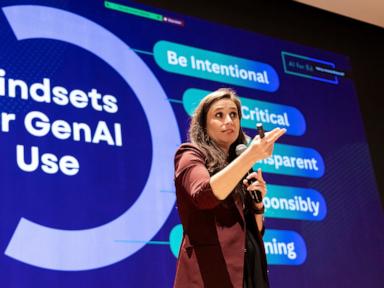
We are currently watching educators march children into computer labs with a singular, misguided mission: teach them how to spot when a language model lies.
The standard curriculum insists that AI literacy means skepticism. Kids are handed a prompt, told to verify the output against a textbook, and taught to hunt for hallucinations as if they are spotting bad grammar in a draft. This approach is comfortable. It fits neatly into existing classroom structures. It treats a fundamental structural shift in human communication like a glorified spellchecker error.
It is also completely useless.
I have spent years watching institutions panic over new technology by forcing it backward into 20th-century pedagogy. When calculators arrived, we panicked about arithmetic. When the internet arrived, we panicked about Wikipedia plagiarism. Now, we are panicking about synthetic text by training children to fact-check machines that were never designed to be encyclopedias in the first place.
Stop teaching kids to catch chatbots in lies. Teach them how to design better constraints.
The Flaw in the Flaw-Hunting Model
The lazy consensus among school boards is that AI literacy equals critical thinking applied to machine outputs. If a chatbot hallucinates a historical date, the student wins a gold star for spotting the error.
This is like teaching driver's education by making students push a broken car down the street instead of teaching them how to drive on a highway.
Language models do not possess a concept of truth. They predict tokens based on probability distributions derived from petabytes of text. When they output false information, they are not lying; they are completing a statistical pattern. Training a twelve-year-old to find factual errors in a language model output is like training them to find wetness in water. It misses the entire mechanism.
Worse, it assumes that the primary danger of these tools is misinformation. The actual danger is human intellectual atrophy through complacency. When kids spend their time evaluating whether a chatbot got a math proof right, they are playing cleanup for a system that should not be used as a calculator anyway.
What Literacy Actually Means in an Automated World
True proficiency with generative models has nothing to do with spotting hallucinations and everything to do with intent architecture.
If you want to understand why current educational programs fail, look at what happens when a student uses a search engine versus a generation engine. Search rewards query optimization and source evaluation. Generation rewards prompt constraints, iterative reframing, and structural decomposition.
A student who knows how to prompt a model to critique its own underlying assumptions is operating at a completely different level than a student who just checks footnotes.
Let us look at the core components of actual computational literacy in the age of neural networks:
- Constraint Design: The ability to restrict a model's operational boundaries so tightly that it cannot wander into hallucination territory.
- Workflow Integration: Knowing precisely when to offload cognitive labor to a machine and when to keep your brain in the loop.
- Systemic Decomposition: Breaking a complex problem into modular pieces where stochastic models excel, rather than asking a single open-ended question and hoping for magic.
When schools tell students to look for flaws, they position the human as a passive consumer grading a finished product. Real mastery turns the human into an active director of a production pipeline.
Why Educators Love the Hallucination Trap
Why do schools cling so tightly to the fact-checking narrative? Because it requires zero institutional restructuring.
You can take an old media literacy lesson plan from 1998, cross out the word "website," write in "chatbot," and call it a day. Teachers do not need to learn how these systems work under the hood. They do not need to understand latent space, temperature parameters, or tokenization limits. They just need to tell kids, "Verify your sources."
It is safe. It is lazy. And it produces graduates who are completely unprepared for actual technical environments.
I have watched corporate teams blow millions on AI adoption initiatives because their employees treated language models like oracle boxes. They ask a question, get a plausible answer, accept it, and move on. The schools training kids to spot hallucinations are creating the exact same brittle mindset. They teach students that the machine is an authority figure that occasionally makes mistakes, rather than an unguided vector that requires constant steering.
The Cost of Low-Bar Digital Education
By focusing on flaws, we handicap the next generation's ambition.
Imagine a scenario where a classroom spends three weeks analyzing why ChatGPT invented a fake Supreme Court case. What did the students actually learn? They learned that AI is unreliable. They learned to be suspicious.
Now imagine that same classroom spending three weeks learning how to chain three different prompt layers together to build a functional prototype of a local business database. Which group leaves with actual leverage in the modern economy?
Suspicion is not a skill; it is a default emotional state. If your entire curriculum boils down to "don't trust the machine," you are not teaching literacy. You are teaching paranoia.
We need to abandon the paternalistic framing that children must be protected from synthetic text. They do not need protection. They need tools.
The Uncomfortable Truth About Machine Outputs
Let us address the elephant in the room. The reason educators focus so heavily on hallucinations is that they are terrified of cheating.
Let's call it what it is. The war on AI flaws is a proxy war against academic dishonesty. Schools are trying to build detection mechanisms because they cannot figure out how to evaluate student work in a post-scarcity text environment.
So they dress up plagiarism prevention as "AI literacy." They teach kids to look for robotic phrasing or factual gaps not because it makes them better thinkers, but because it helps teachers catch students who didn't do their homework.
This is a catastrophic failure of strategic vision. You cannot out-police a mathematical revolution with honor codes and hallucination checklists.
The Blueprint for Real Competence
If we want students to survive and dominate in an automated marketplace, we have to flip the script entirely.
First, stop grading the output. Grade the prompt chain. If a student turns in an essay generated by a single prompt, that is an F, not because AI was used, but because the human did no intellectual labor. If a student turns in a project showing fifty iterations of constraint tuning, prompt optimization, and systematic cross-validation against programmatic code, give them an A+.
Second, teach the limitations of probability, not just the existence of errors. Students need to understand why a model struggles with edge cases, spatial reasoning, and zero-shot logic. They need to know why the hallucination happens so they can engineer environments where it cannot occur.
Third, banish the term "critical thinking" from AI policy documents until people agree on what it means. Saying "use critical thinking with AI" is code for "we have no idea what we are doing, please just be careful."
The world does not need another generation of human proofreaders. It needs architects who know how to build systems that work alongside non-deterministic intelligence.
Put down the red pen. Stop looking for mistakes. Start writing better constraints.