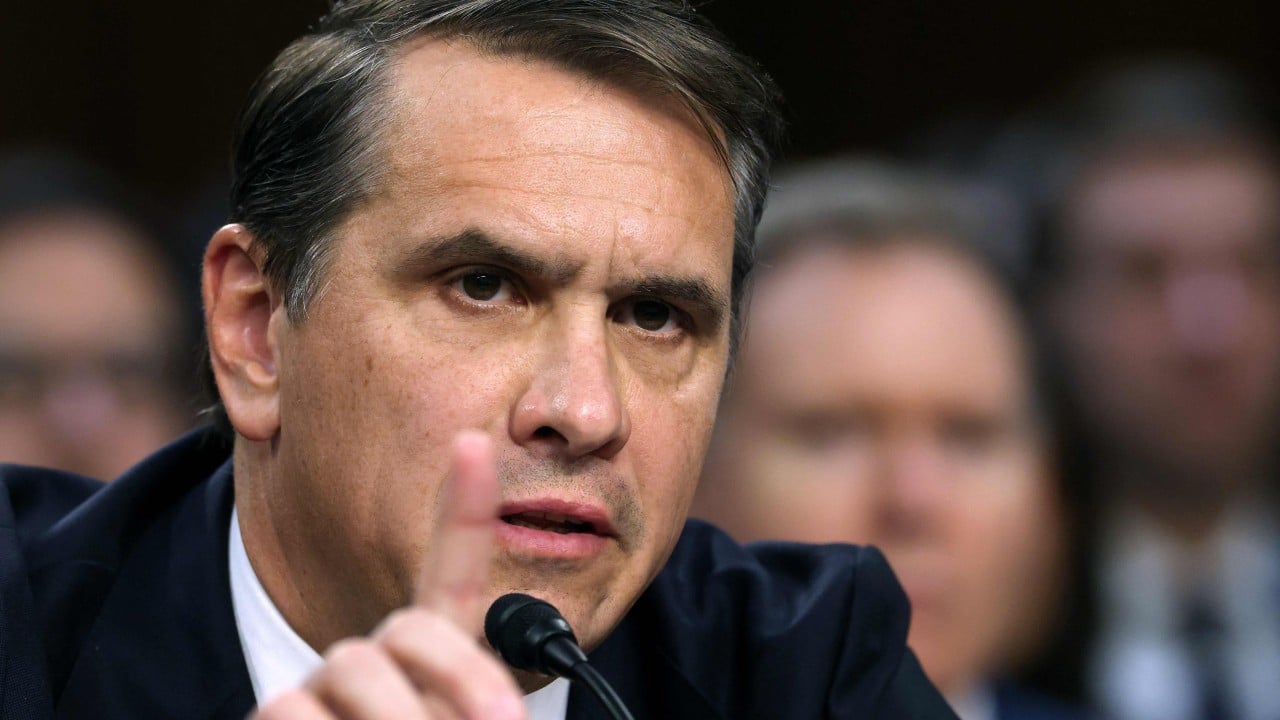
The political press corps spent five hours on Capitol Hill watching Acting Attorney General Todd Blanche sweat under the Senate Judiciary Committee's spotlight, and they completely missed the point.
The mainstream media coverage read like a predictable script: lawmakers "grilling" Trump’s former personal defense lawyer over sloppy Jeffrey Epstein file redactions, a defunct $1.8 billion weaponization fund, and a sweetheart IRS settlement that handed Trump’s inner circle tax immunity. The lazy consensus is that Blanche is a compromised loyalist fighting a losing battle to prove his independence so he can narrowly squeeze through a razor-thin Senate confirmation vote.
This narrative is theater. It is a comforting, toothless illusion designed to make us believe the Senate confirmation process is still a functioning guardrail of American democracy.
The harsh reality is that the public "grilling" of Todd Blanche was not an interrogation. It was a showcase of a highly coordinated structural shift in the American legal system. Blanche isn't a bumbling "yes-man" caught in a bipartisan trap. He is the pioneer of a highly sophisticated, privatized model of state power.
The Slush Fund Fallacy: Why Scrapping the Weaponization Fund Was the Plan All Along
Let’s dismantle the biggest distraction of the hearing: the $1.8 billion "anti-weaponization" payout fund.
The media presented the scrap of this fund as a massive retreat for Blanche—a major concession to salvage his confirmation. Senator Thom Tillis called it a "turkey" and demanded Blanche help draft legislation to permanently kill it. Blanche readily agreed. The press reported this as a win for congressional oversight.
It was a pre-packaged sacrifice.
I’ve watched corporate legal teams and government agencies execute this exact maneuver for decades. When you want to pass a highly controversial, unprecedented policy, you build a massive, cartoonishly offensive lightning rod right next to it. You let the opposition attack the lightning rod. You act chastised, surrender it with theatrical humility, and while your opponents are busy celebrating their "victory," you quietly walk your actual prize through the back door.
The lightning rod was the $1.8 billion payout fund. The prize was the sweeping IRS tax immunity deal for Donald Trump, his family, and his businesses.
While lawmakers high-fived over killing a theoretical slush fund, Blanche calmly defended the tax immunity deal, asserting that such agreements are entirely "common" in complex litigation. It is a masterpiece of legal misdirection. The immunity remains on track. The president’s family is protected from past tax claims, and the Justice Department established a devastating precedent: if you sue the government using a collusive lawsuit, you can negotiate private, permanent immunity from regulatory agencies.
The Myth of DOJ Independence
Throughout the hearing, Democrats and skeptical Republicans like John Cornyn pushed Blanche to declare his independence from the Oval Office. "Counsel does not mean I'm a yes-man," Blanche declared, insisting he would resign if asked to do anything illegal.
This entire debate rests on a deeply flawed premise: that "DOJ independence" is a real, historical norm that Blanche is suddenly threatening.
It is not. The Department of Justice has always been an instrument of executive power. From Robert F. Kennedy serving as his brother’s attorney general to Eric Holder calling himself Barack Obama’s "copilot," the idea of a completely firewall-protected, neutral DOJ is a myth we tell ourselves to sleep better at night.
Blanche is not breaking the system; he is merely stripping away the polite euphemisms.
When a federal judge called the underlying IRS lawsuit a "collusive" effort designed to "manipulate the judicial process," she was pointing out the obvious. The plaintiff (Trump) and the defendants (represented by a DOJ reporting to Trump) were working toward the same goal. This isn't a breakdown of the legal machine. It is the machine running at peak efficiency for its owner.
If you are waiting for a heroic congressional intervention to "restore" the DOJ to some imaginary golden age of neutrality, you are asking the wrong question. The real question is: who owns the machinery of the state when the distinction between private defense counsel and public prosecutor is completely erased?
The 1% Redaction Lie: Transparency as a Weapon
The exchange over the Jeffrey Epstein files revealed the ultimate modern political tactic: weaponized incompetence.
When pressed on why the DOJ’s public release of Epstein documents included "sloppy" redactions that exposed the identities and images of survivors while heavily obscuring the names of potential co-conspirators, Blanche deployed a classic corporate crisis-management metric:
"Only 1 percent of the records had redactions that needed to be fixed."
Epstein File Release Metrics (DOJ)
├── Total Files Reviewed: Millions
├── Redaction Error Rate: ~1%
└── Real-world Impact: Exposed survivor identities & protected high-profile names
To an analyst, a 99% success rate on millions of pages sounds like an operational triumph. But in high-stakes legal releases, a 1% error rate isn't a margin of error. It is where the entire game is played.
If you accidentally leak the names of five survivors while successfully redacting five powerful associates, your "99% accuracy" is a catastrophic failure for the victims and a complete success for the powerful. By framing the issue as a mere administrative hurdle—a "herculean task" handled by "dozens of lawyers"—Blanche successfully shifted the conversation from who was being protected to how hard his staff was working.
This is how modern state power operates. It doesn't deny transparency; it floods the zone with millions of pages of documents, makes "accidental" errors that serve political goals, and then hides behind statistical compliance.
The Playbook for Navigating the New Legal Order
If you are a corporate leader, a legal strategist, or an investor, watching this hearing and hoping for a return to "normalcy" is a losing strategy. The rules of engagement have changed. Here is how you actually navigate the landscape Todd Blanche is building:
- Expect the Privatization of Public Prosecution. The boundary between white-collar criminal defense and federal prosecution is gone. The DOJ is increasingly operating like a highly aggressive, politically motivated corporate legal department. If your business is in the crosshairs of federal regulators, do not rely on traditional administrative remedies. You need to treat regulatory defense as a raw political campaign.
- Use Collusive Litigation as a Shield. The IRS tax immunity deal proves that federal lawsuits can be utilized to lock in regulatory peace. If you can engineer a legal dispute with an agency, you can negotiate consent decrees and settlements that bind future administrations and shield you from audits or enforcement. It is highly controversial, but it works.
- Master Weaponized Compliance. When facing public disclosure demands or congressional investigations, do not stonewall. Instead, comply aggressively. Dump millions of pages of data, maintain a high statistical accuracy rate, and let the critical details get lost in the noise of administrative "mistakes."
Todd Blanche’s confirmation hearing was not a cross-examination. It was a coronation of the new normal. The lawmakers in that room thought they were grilling a nominee. In reality, they were just reading the script of a play he had already written.