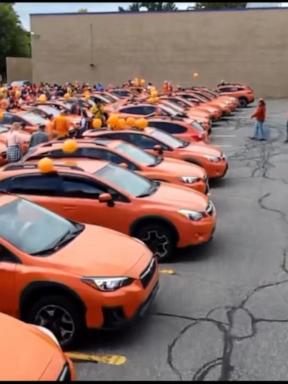
Every autumn, automotive media and lifestyle blogs collectively lose their minds over a parking lot full of identical orange subcompact crossovers. They hyperventilate about how a convoy of brightly painted utility vehicles represents a profound cultural pushback against a sea of grayscale corporate fleet vehicles. It is a comforting narrative. It casts mass-market consumer choices as acts of passionate civil disobedience.
It is also absolute nonsense.
Gathering eighty people who bought the exact same paint code option off a factory assembly line does not mean you are fighting conformity. It means you fell for a marketing department's secondary color palette surcharge.
The Monotony Myth
The lazy consensus across every lifestyle column is that modern automotive roads are a bleak, monochromatic wasteland of silver, white, and charcoal because corporate suits hate joy. The standard talking point claims that manufacturers refuse to build vibrant cars, leaving brave drivers no choice but to purchase high-visibility citrus tones to save humanity from visual depression.
Look at actual automotive registration data. Neutral colors dominate dealerships because residual values dictate trade-in economics. People buy monochrome cars because they want to trade them in five years later without taking a massive financial haircut on a vehicle painted like a construction cone.
When a manufacturer rolls out a limited-run chromatic option like Sunshine Orange, they are not staging a revolution. They are performing market segmentation. They are capturing the exact buyer demographic that desperately wants to feel quirky while still financing a reliable all-wheel-drive crossover with a CVT transmission. Celebrating a parade of these mass-produced units as an uprising against conformity is like praising a flash mob at a suburban strip mall for dismantling global capitalism.
The Illusion of Community Through Manufacturing Specs
There is a deep psychological urge to mistake shared purchasing decisions for shared identity. If you buy a mass-market vehicle in a loud hue, and four dozen other people do the same, you have not formed a tribal commune. You have formed a coincidental product demographic.
We see this across the enthusiast space. Jeep owners buy rubber ducks to place on each other's mirrors. Miata owners pop up their headlights. Subaru owners wave at one another. These micro-rituals provide a cheap dopamine hit of belonging. They require zero ideological alignment, zero friction, and zero sacrifice. You simply hand a finance manager a down payment, show up at a designated grocery store asphalt lot, and bask in the collective illusion that driving a mass-market appliance makes you uniquely whimsical.
Real community is forged through shared labor, political friction, or creative risk. Parking your factory-painted crossover next to seventy other factory-painted crossovers is just an open-air inventory audit for the local dealership network.
The True Cost of Manufactured Quirky
Let us look at the financial mechanics underneath the paint code. That vibrant orange layer on your daily driver carries an implicit depreciation penalty. When the novelty wears off and the secondary market floods with sun-faded chromatic crossovers, the resale curve tells a brutal story.
I have watched automotive trends come and go for decades. I have seen companies blow millions marketing "lifestyle-oriented" color trims that end up as bargain-bin inventory two years later because trends shift faster than lease terms. The people organizing these single-model, single-color parades are celebrating a marketing triumph disguised as a grassroots movement.
You want to drive something that breaks the mold? Build a custom chassis. Restore a rusted-out shell in your driveway. Modify something that society told you to scrap. Do not demand applause because you selected an optional paint swatch off a manufacturer's order form and drove it slowly down Main Street behind eighty identical twins.
Color on the highway is fine. A bit of brightness in traffic harms no one. But let us stop pretending that a corporate paint option is an act of artistic bravery.
Stop confusing a factory option package with a personality.