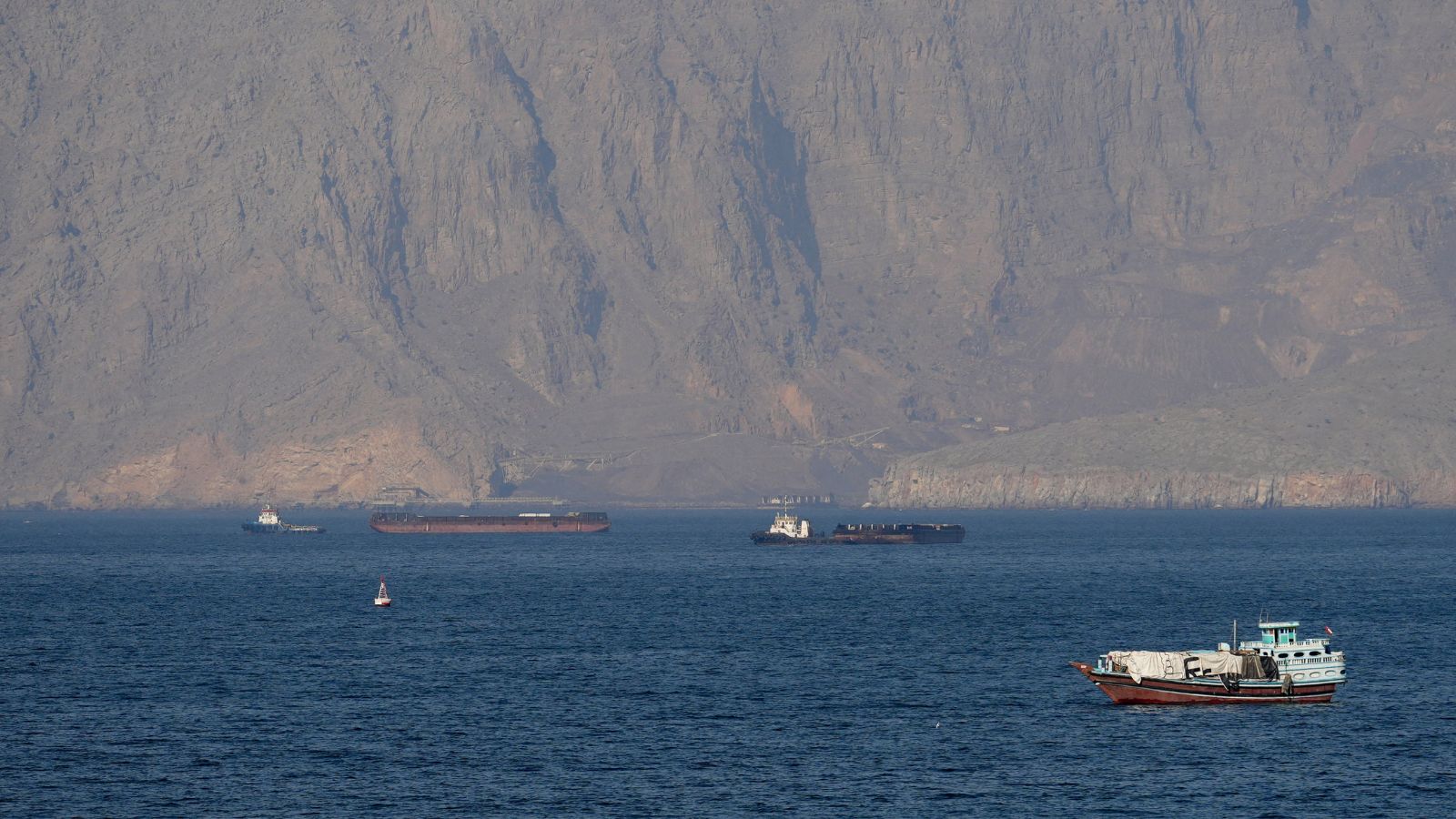
The security architecture of the Strait of Hormuz is currently undergoing a structural shift from conventional deterrence to a high-stakes cycle of maritime seizure and asset denial. When the United States signals a transition from passive monitoring to the active readiness of ship seizures, it isn’t merely responding to kinetic fire; it is attempting to re-establish a price floor for Iranian interference. This geopolitical friction is best analyzed through three distinct operational vectors: the mechanics of the "Choke Point Premium," the legal framework of vessel confiscation, and the tactical disparity between high-value naval assets and asymmetric swarm maneuvers.
The Economic Physics of the Hormuz Choke Point
The Strait of Hormuz functions as the world's most critical energy artery, facilitating the passage of roughly 21 million barrels of oil per day. To understand why "blackmail" is the chosen vernacular for this conflict, one must quantify the Volatility Coefficient triggered by disruptions in this narrow 21-mile-wide passage.
- The Insurance Escalation Loop: Every kinetic incident involving a tanker—whether it is a direct strike or a boarding attempt—triggers an immediate spike in War Risk Insurance premiums. For a Very Large Crude Carrier (VLCC), these costs can jump from negligible amounts to hundreds of thousands of dollars per voyage in a 48-hour window.
- The Freight Rate Penalty: As risk increases, the pool of available hulls willing to transit the Persian Gulf shrinks. This supply-side contraction forces a surge in spot freight rates.
- The Inventory Buffer Depletion: Global markets rely on the "just-in-time" delivery of Middle Eastern crudes. A disruption in Hormuz forces refineries in East Asia and Europe to draw down strategic reserves, creating a secondary price shock that persists long after the physical blockage is cleared.
Iran’s strategy utilizes these economic levers to create a feedback loop where the mere threat of activity generates a "shadow tax" on global energy consumption. The US counter-strategy of preparing ship seizures aims to invert this cost-benefit analysis by threatening the physical and sovereign assets of the Iranian state, thereby attempting to tax the provocateur rather than the consumer.
The Legal and Operational Framework of Ship Seizure
The transition from patrolling to seizing vessels is a significant escalation in the Rule of Engagement (ROE) hierarchy. While the public discourse focuses on the "firing" in the Strait, the professional analyst must look at the legal mechanisms the US utilizes to justify maritime interventions.
Sovereign Immunity vs. Civil Forfeiture
The US often employs the legal theory of civil forfeiture to target Iranian petroleum products. If a tanker is found to be carrying cargo that violates US sanctions—specifically those linked to designated terrorist organizations like the IRGC—the US Department of Justice can issue a seizure warrant. This transforms a naval operation into a law enforcement action.
The operational bottleneck for the US is the "Board-Search-Seizure" (BSS) requirement. Executing a seizure on the high seas requires:
- Positive Identification: Verified intelligence linking the cargo to sanctioned entities.
- Physical Integration: Fast-roping teams or boarding parties must secure the bridge and engine room before Iranian fast-attack craft (FAC) can intervene.
- Logistical Extraction: The seized vessel must be sailed to a friendly or neutral port, often under a heavy naval escort to prevent "re-seizure."
The Reciprocity Trap
When the US readies ship seizures, it enters a "tit-for-tat" cycle. Iran’s naval doctrine emphasizes "reciprocal action." If the US seizes an Iranian-linked tanker in the Mediterranean or the Atlantic, Iran traditionally responds by targeting a Western-flagged or Western-owned vessel within the Persian Gulf. This creates a strategic stalemate where the security of the global merchant fleet is held hostage to bilateral enforcement actions.
The Tactical Asymmetry of Maritime Denial
The disparity in naval technology between the US 5th Fleet and the Iranian Navy (and IRGC Navy) is extreme, yet the geography of the Strait of Hormuz favors the smaller actor. This is the Asymmetric Advantage Function.
- Geographic Constraint: Large US destroyers and carriers have limited room to maneuver in the narrow shipping lanes of the Strait. Their advanced radar and long-range missile systems are less effective at "knife-fighting" ranges.
- Swarm Intelligence: Iran utilizes hundreds of small, fast, armed boats. While a single boat is no match for a destroyer, a swarm of fifty boats attacking from multiple vectors can saturate a ship's Close-In Weapon Systems (CIWS).
- Cost Imbalance: A US SM-2 interceptor missile costs over $2 million. Using it to neutralize a $50,000 drone or a cheap fast-attack boat is a losing economic proposition in a prolonged war of attrition.
The US readiness to seize ships indicates a shift toward Preemptive Denial. Instead of waiting for a tanker to be fired upon, US forces are moving toward "active screening," where they interpose assets between Iranian patrol craft and merchant traffic. This requires a high density of hulls, explaining the recent deployment of additional amphibious ready groups and fighter squadrons to the region.
Strategic Resource Misallocation
The broader geopolitical risk lies in the misallocation of naval resources. Every carrier strike group tethered to the Persian Gulf is an asset that cannot be deployed to the South China Sea or the North Atlantic.
- The Deterrence Drain: By keeping US focus on the Strait of Hormuz, Iran achieves a secondary objective: slowing the "Pivot to Asia."
- The Proxy Leverage: Iran does not need to close the Strait to win; it only needs to make the cost of keeping it open prohibitively high for the US taxpayer and the global shipping industry.
The current friction is not a prelude to a traditional naval battle. It is a contest of Structural Endurance. The US is betting that its ability to seize assets and squeeze the Iranian economy through sanctions will eventually break Tehran’s resolve. Iran is betting that its ability to disrupt the global energy flow will eventually force the West to offer sanctions relief in exchange for "maritime stability."
The Pivot to Kinetic Enforcement
The move toward ship seizures signals that the US has determined that "verbal deterrence" has reached a point of diminishing returns. To regain the initiative, the US must demonstrate that it can physically remove Iranian assets from the board without triggering a full-scale regional war. This requires a surgical approach to maritime law enforcement that prioritizes the cargo over the hull, and the legal warrant over the missile.
The strategic play for the US now involves a three-pronged enforcement model:
- Enhanced Littoral Presence: Deploying smaller, more agile platforms like the Littoral Combat Ship (LCS) or unmanned surface vessels (USVs) to counter swarm tactics.
- Global Cargo Interdiction: Utilizing international port authorities to seize Iranian petroleum at the point of destination or during mid-sea transfers.
- Technological Tagging: Using advanced satellite imagery and AIS (Automatic Identification System) spoofing detection to track "dark fleet" tankers in real-time, making it impossible for Iran to move oil without being shadowed by seizure-ready assets.
The endgame in the Strait of Hormuz will not be determined by who has the biggest ships, but by who can most effectively control the movement of atoms—the physical oil—across the digital and legal borders of the global economy. The US readiness for seizures is the first step in a transition toward a more aggressive, enforcement-heavy maritime regime.