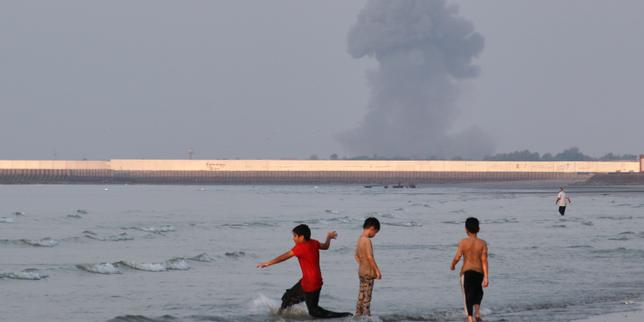
The threat of a sustained closure of the Strait of Hormuz is frequently treated as an absolute binary by commodity markets, yet geopolitical reality dictates that any disruption functions as an escalatory ladder governed by quantifiable economic, logistical, and military variables. When Iranian state media declares that the waterway will remain closed until the cessation of Western military operations, it leverages a geographic monopoly to project strategic deterrence. Evaluating this assertion requires moving past inflammatory rhetoric and dissecting the structural mechanics of global energy transit, asymmetric naval warfare, and global supply-chain elasticity.
Understanding this crisis requires analyzing the physical flow of oil and liquefied natural gas (LNG). The Strait of Hormuz, measuring only 21 miles wide at its narrowest point with shipping lanes restricted to a two-mile-wide inward and outward corridor, handles approximately 20 to 21 million barrels of crude oil and petroleum products daily. This volume represents roughly one-fifth of global liquid petroleum consumption.
The systemic vulnerability of this corridor is defined by three distinct operational layers.
The Three Pillars of Maritime Interdiction
To evaluate the feasibility of a sustained closure, the operational capabilities of the Islamic Revolutionary Guard Corps Navy (IRGCN) and the regular Iranian Navy must be categorized into distinct functional pillars. These pillars demonstrate how a nation with limited conventional blue-water naval power can execute a highly effective asymmetric denial strategy.
Pillar One: Asymmetric Naval Warfare and Sub-Surface Denial
Iran does not require a conventional fleet to disrupt shipping. The primary instrument of denial is the deployment of smart sea mines, including bottom-dwelling influence mines that are difficult to detect and sweep. This is paired with an inventory of shore-to-ship cruise missiles, such as the Ghadir and Raad series, positioned along the rugged coastline of the Hormozgan province and on militarized islands like Abu Musa and the Tunbs.
The tactical objective of this deployment is not the total destruction of every passing vessel, but the inflation of risk metrics. A single naval mine detonation or missile strike on a commercial Supertanker (VLCC) triggers immediate structural consequences:
- Maritime insurers unilaterally declare the Persian Gulf a war-risk zone.
- Underwriters raise Hull and Machinery (H&M) premiums by orders of magnitude.
- Protection and Indemnity (P&I) clubs revoke coverage for vessels transiting the zone.
The physical blockade is therefore preceded by an insurance blockade. The primary mechanism of closure is financial, not physical.
Pillar Two: The Regional Proxy Vector
A blockade of Hormuz cannot be analyzed in isolation from the Bab al-Mandab strait at the southern entrance of the Red Sea. Strategic alignment with the Houthi movement in Yemen allows for a synchronized pincer effect on East-West transit.
By threatening both the Bab al-Mandab and the Strait of Hormuz, regional actors create a compounding logistical bottleneck. Merchant fleets attempting to bypass the Red Sea by sailing around the Cape of Good Hope find their voyage times extended by 10 to 14 days. If the Persian Gulf is simultaneously closed, the global shipping market faces an immediate structural deficit in available tanker capacity, as more vessels are tied up in longer transit loops.
Pillar Three: Domestic Economic Resilience and Escalation Tolerance
Iran’s willingness to sustain a blockade depends on its tolerance for economic isolation. Decades of international sanctions have forced the development of an autarkic economic structure less sensitive to immediate disruptions in global trade than those of neighboring Gulf Cooperation Council (GCC) states.
While Arab Gulf states rely on uninterrupted maritime access to export their oil and import basic food supplies, Iran has spent years constructing domestic infrastructure designed to bypass the strait. The Goreh-Jask pipeline project, designed to transport crude from Bushehr province directly to the Gulf of Oman terminal at Jask, represents a structural attempt to export Iranian crude outside the Persian Gulf bottleneck. Although currently operating below its designed capacity of one million barrels per day, the pipeline’s existence alters the asymmetric cost equation in Iran’s favor.
The Cost Function of Maritime Disruption
To quantify the economic impact of a partial or total shipping halt, we must model the cost function of maritime transit through the strait. The total cost of transporting a barrel of crude oil ($C_{\text{total}}$) under crisis conditions can be expressed through the following structural equation:
$$C_{\text{total}} = C_{\text{base}} + (P_{\text{war}} \times I_{\text{risk}}) + D_{\text{delay}} + F_{\text{freight}}$$
Where:
- $C_{\text{base}}$ represents the baseline operating cost of the vessel per day.
- $P_{\text{war}}$ is the war-risk insurance premium multiplier, which scales exponentially with kinetic activity.
- $I_{\text{risk}}$ is the regional security risk index, determined by the frequency of hostile encounters.
- $D_{\text{delay}}$ represents the demurrage and delay penalties incurred due to rerouting or waiting for military escorts.
- $F_{\text{freight}}$ is the spot freight rate, which rises as global vessel availability shrinks.
Under normal operating conditions, insurance premiums constitute a negligible fraction of voyage costs. During an active interdiction campaign, these premiums can rise to over 1% of the hull value per transit. For a modern VLCC valued at $100 million, a single transit can demand $1 million in insurance premiums alone, effectively rendering the voyage economically non-viable for non-state-backed operators.
The Structural Limits of Bypass Infrastructure
A common counterargument to the threat of a Hormuz closure is the availability of overland pipelines designed to bypass the waterway. An examination of the operational capacities of these systems reveals significant structural limitations.
+------------------------------------------+--------------------+---------------------+-----------------------------+
| Pipeline System                          | Country            | Nameplate Capacity  | Actual Operational Capacity |
|                                          |                    | (Million bpd)       | (Est. Million bpd)          |
+------------------------------------------+--------------------+---------------------+-----------------------------+
| East-West Petroline                      | Saudi Arabia       | 5.0                 | 2.1                         |
| Abu Dhabi Crude Oil Pipeline (ADCOP)     | UAE                | 1.5                 | 0.8                         |
| Abqaiq-Yanbu Natural Gas Liquids (NGL)   | Saudi Arabia       | 0.3                 | 0.3                         |
| Goreh-Jask Pipeline                      | Iran               | 1.0                 | 0.3                         |
+------------------------------------------+--------------------+---------------------+-----------------------------+
The aggregate nameplate bypass capacity of the region is approximately 7.8 million barrels per day. The volume of oil transiting the Strait of Hormuz daily is roughly 20.5 million barrels. This leaves a structural deficit of over 12 million barrels per day that cannot be bypassed under any circumstances.
The Saudi East-West Petroline connects the Eastern Province fields to the Red Sea port of Yanbu. Utilizing this pipeline to its maximum limit requires significant logistical reconfiguration and reduces the volume of crude available for direct shipping to Asian markets, which are structurally optimized for Gulf-side loading.
The Abu Dhabi Crude Oil Pipeline (ADCOP) transports crude from the Habshan fields to Fujairah on the Gulf of Oman. While highly efficient, its 1.5 million barrels per day limit represents only a fraction of the United Arab Emirates' total export capacity.
The remaining global spare production capacity, located primarily in OPEC states, cannot mitigate a total closure because the physical barrels remain trapped behind the blockade. Strategic Petroleum Reserves (SPR) held by OECD nations, designed to release up to 4 million barrels per day collectively, could only bridge the global supply deficit for a limited period, likely no longer than three to six months, before risking catastrophic depletion.
Systemic Feedback Loops in Global Banking and Trade
The secondary consequences of a prolonged blockade extend far beyond energy markets, triggering systemic shocks across the global financial system.
First, a sustained oil price spike to over $120 per barrel acts as an immediate regressive tax on global consumers, dampening discretionary spending and accelerating core inflation. Central banks, tasked with managing inflation expectations, are forced to maintain higher interest rates for longer periods, suppressing global capital investment.
Second, the Arabian Gulf region is home to some of the world’s largest sovereign wealth funds (SWFs), which hold trillions of dollars in Western equities, real estate, and government bonds. A prolonged security crisis that halts energy exports would force these funds to liquidate international assets to support domestic fiscal budgets. This asset liquidation would introduce severe downward pressure on global stock indices and increase the borrowing costs of Western sovereign nations as Gulf states divest from government debt.
Third, liquefied natural gas (LNG) markets would experience immediate regional decoupling. Qatar, the world’s largest exporter of LNG, relies entirely on the Strait of Hormuz to deliver gas to European and Asian buyers. Unlike crude oil, which can be stored relatively easily or traded via flexible paper markets, LNG relies on highly rigid, capital-intensive infrastructure chains. A total halt in Qatari LNG flows would trigger an immediate energy crisis in Europe, driving natural gas prices to levels that would force widespread industrial demand destruction.
Strategic Playbook for Energy Consumers and Sovereign States
To navigate the long-term threat of a Strait of Hormuz disruption, industrial energy consumers and state actors must transition from reactive risk mitigation to structured systemic hedging. Relying on military intervention to keep the strait open is a high-risk strategy, given the asymmetric advantages of coastal defense systems and the long timelines required for mine clearance operations.
Organizations must implement a three-tiered mitigation framework:
Supply Chain Redundancy through Dual-Sourcing: Refiners must structurally adjust their processing configurations to handle non-Gulf crude grades. This involves investing in desulfurization and coking units capable of refining heavier, more sour crudes from West Africa, the Americas, and the North Sea, reducing operational dependence on Persian Gulf light crudes.
Contractual Shipping Flexibility: Shippers and buyers must transition from Free on Board (FOB) contracts, where the buyer assumes the risk once the oil is loaded at the Gulf terminal, to Delivered Ex-Ship (DES) contracts. Under DES arrangements, the seller bears the transit risk and insurance liabilities until the cargo reaches its destination port, shifting the financial burden of geopolitical escalation back to the producing nation.
Strategic Pipeline Capacity Reservation: State buyers must secure long-term capacity rights in overland pipelines bypass routes. By paying a premium to reserve space in systems like ADCOP or the East-West Petroline, importers guarantee physical delivery of at least a baseline volume of crude to open-sea terminals in the event of a sudden maritime shutdown. This ensures business continuity when the Strait of Hormuz is rendered inaccessible by financial or kinetic blockades.
Rather than viewing the closing of the Strait of Hormuz as a simple geopolitical talking point, international market participants must treat it as a calculable operational risk. Hedging against this risk requires a cold calculation of bypass capacity, insurance triggers, and supply-chain diversification. Those who prepare for the structural limitations of the waterway will survive the shock; those who rely on the status quo will find themselves marooned on the wrong side of the chokepoint.