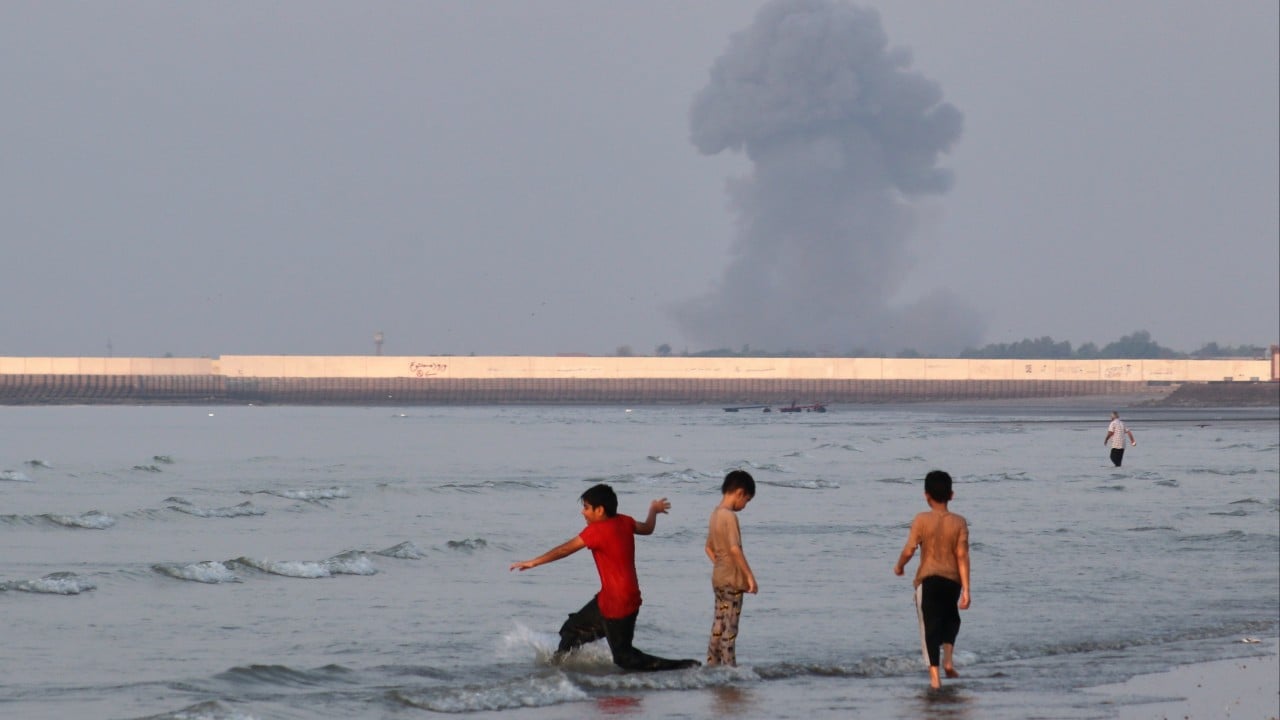
The mainstream media is running its favorite playbook again. A tanker gets clipped in the Persian Gulf, Washington scrambles a carrier strike group, and the financial press panics over a sudden "$150 oil" apocalypse. The narrative is always identical: Iran acts as the irrational, chaotic actor, the United States plays the overextended global policeman, and global trade hangs by a thread in the 21-mile-wide choke point of the Strait of Hormuz.
It is a neat, cinematic story. It is also completely wrong.
The lazy consensus dominating cable news treats these maritime skirmishes as localized, tactical crises that can be solved with more grey hulls, heavier naval escorts, and targeted retaliatory strikes. This view ignores the structural reality of modern asymmetrical warfare. The obsession with protecting physical tankers in the Strait misses the point entirely. The real vulnerability isn't the shipping lane itself; it is the absolute obsolescence of traditional naval deterrence against low-cost, decentralized denial strategies.
The Myth of the Unstoppable Choke Point Blockade
Every boilerplate analysis claims Iran wants to "close" the Strait of Hormuz. Let’s dismantle this premise immediately.
Closing the Strait permanently is a logistical nightmare that would require sustained conventional dominance—something no regional power possesses against the US Fifth Fleet. More importantly, it would be economic suicide for the instigator. The Persian Gulf states, including Iran, rely on these waters to export their own lifelines.
The strategy is never total closure. It is calculated friction.
[Traditional Deterrence] -> Relies on massive capital ships -> Vulnerable to swarm tactics
[Asymmetric Friction]     -> Relies on $20k drones & sea mines -> High economic disruption
When a drone hits a vessel, the goal isn't to sink 2 million barrels of crude. The goal is to spike war-risk insurance premiums until western commercial fleets refuse to sail without state subsidies. I have analyzed risk portfolios where a mere 0.5% bump in maritime insurance rates wiped out the entire net margin of a regional shipping line overnight.
The competitor articles focus on the physical damage to hulls. You need to look at the actuarial tables. The weapon isn't the missile; it's the invoice.
Why Billion-Dollar Destroyer Escorts Are a Math Problem
The current defense establishment believes the solution to asymmetric threats in narrow waterways is simple: deploy more Aegis combat systems and shoot down incoming threats.
This is a losing mathematical equation.
Consider the basic economics of interception. A standard container ship or oil tanker is targeted by a loitering munition or an anti-ship cruise missile that costs between $20,000 and $100,000 to manufacture. To intercept it, a Western destroyer fires a Standard Missile-2 (SM-2) or a Sea Sparrow, which costs anywhere from $1 million to $2.1 million per shot.
Imagine a scenario where an adversary launches twenty low-tech drones simultaneously. The defense spends $40 million to neutralize $400,000 worth of fiberglass and lawnmower engines.
- Cost Coefficient: The offense operates at a 100:1 cost advantage.
- Depletion Rate: Naval vessels have finite vertical launching system (VLS) cells. They cannot reload at sea. Once those cells are empty, the multi-billion-dollar warship must retreat to a friendly port just to turn screws on new ammunition.
- Supply Chain Latency: Manufacturing an advanced air defense missile takes months; stamping out a carbon-fiber drone takes days.
The Pentagon cannot out-produce this supply curve. Relying on physical naval escorts to guarantee the safety of commercial shipping in restricted waters is an unsustainable strategy that burns through high-end munitions to achieve a temporary stalemate.
The UAE Tanker Paradox
When tankers near Fujairah or the Emirati coast come under attack, the immediate reaction from energy analysts is to predict a catastrophic halt in supply. This ignores the massive infrastructure built specifically to bypass the geographic vulnerability of the Musandam Peninsula.
The Abu Dhabi Crude Oil Pipeline (ADCOP) can move 1.5 million barrels per day directly to the port of Fujairah, bypassing the Strait of Hormuz entirely. Saudi Arabia’s East-West Pipeline can shift another 5 million barrels per day toward the Red Sea. While these pipelines cannot handle the total aggregate output of the Gulf, they function as massive safety valves.
The market knows this. It is why oil prices frequently spike for exactly 48 hours after a tanker incident before drifting back down to baseline fundamentals. The financial risk is heavily financialized, hedged, and priced into the options market long before the first drone clears its launch rail. The panic is a media product, not a structural reality of the energy sector.
Dismantling the "Freedom of Navigation" Sentimentality
For decades, the global economy has treated American naval supremacy as a permanent, free utility—like gravity or oxygen. The assumption was that the US would always secure the global commons because it benefited the international order.
That era is over. The domestic political calculus in Washington has shifted decisively toward energy independence through shale production. The United States is no longer structurally dependent on the daily transit of crude through the Persian Gulf to keep its lights on. The primary beneficiaries of open lanes in Hormuz are now East Asian economies, specifically China, India, and Japan.
It is absurd to expect one nation to underwrite the security architecture of its primary economic rivals indefinitely. The contrarian truth is that the US will increasingly tolerate higher levels of friction in these waterways because the strategic cost of policing them now outweighs the domestic benefit.
The Hard Reallocation for Maritime Operators
If you are running a global logistics firm, relying on state navies to clear your path is a failed strategy. The old playbook says: stay the course, wait for the naval escort, and file an insurance claim if things go sideways.
The alternative approach requires a complete overhaul of route optimization:
- Ditch the Choke Point Entirely: Accept the longer transit times around the Cape of Good Hope as a fixed operational baseline rather than an emergency backup. The predictability of a longer route is cheaper than the volatility of an unpredictable short one.
- Autonomous Fleet Dispersal: Stop moving energy exclusively in massive, high-value targets like Very Large Crude Carriers (VLCCs). The future belongs to smaller, modular, semi-autonomous vessels that distribute the risk profile across dozens of hulls rather than concentrating it in one massive hull that invites a geopolitical headline.
- Self-Funded Kinetic Defense: Commercial operators must integrate active, non-lethal, high-energy defense mechanisms directly onto civilian superstructures rather than waiting for a destroyer that is fifty miles away to paint a target.
The downside to this shift is obvious: it drives up structural costs permanently and ends the era of ultra-cheap maritime transport. But the alternative is worse—sitting as a stationary target in a narrow body of water, waiting for a multi-million-dollar interceptor missile that might not be coming.
Stop asking when the United States will finally stabilize the region. They won't. Stop asking if Iran will close the Strait. They don't need to. The friction is the new baseline. Adapt the supply chains, diversify the transit mechanisms, or get comfortable watching your margins burn in the Gulf.