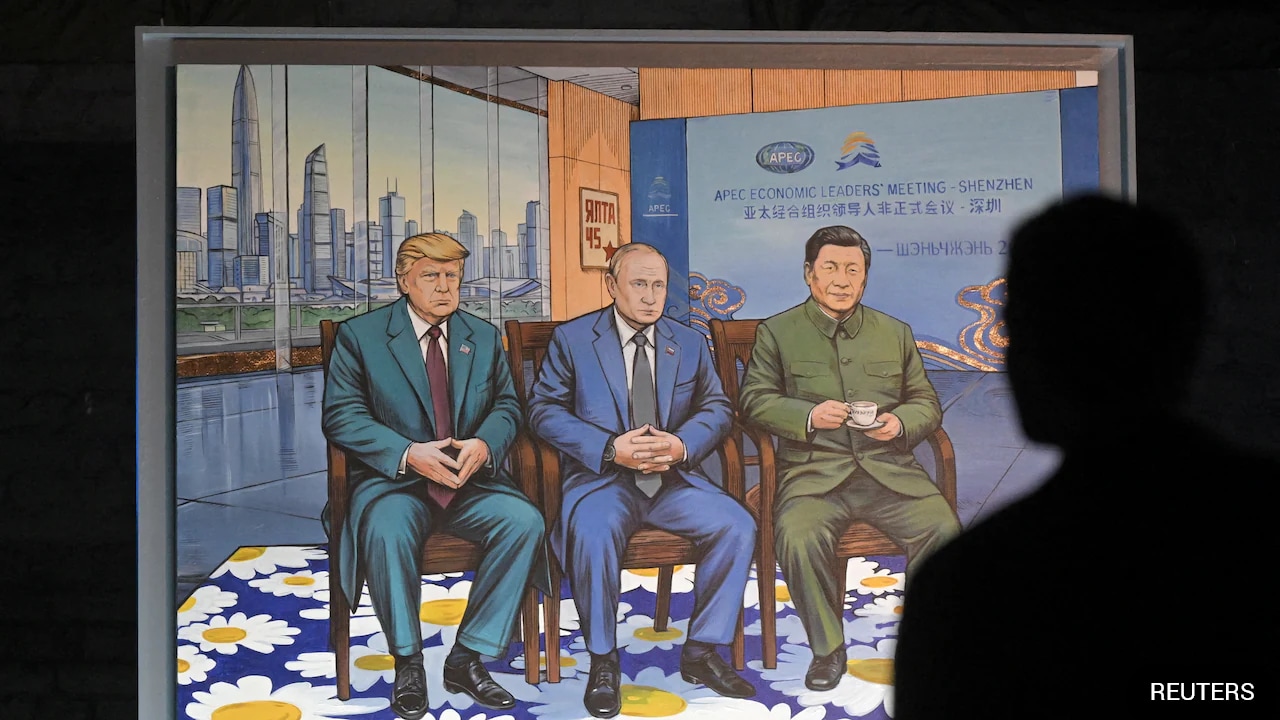
The announcement of a direct trilateral summit between the United States, China, and Russia marks a structural departure from post-Cold War diplomatic architecture, shifting global governance from institutionalized multilateralism back to transactional great-power concert politics. Rather than signaling imminent harmony, this convening reflects acute mutual vulnerabilities—specifically, the unsustainability of parallel economic decoupling, asymmetric nuclear arms races, and simultaneous regional proxy conflicts that threaten to exhaust the strategic reserves of all three capitals. Understanding the real mechanics of this Thursday meeting requires stripping away diplomatic theater and examining the hard constraints, bargaining asymmetries, and incentive structures dictating the negotiating room.
The Collapse of Bilateral Containment
For the past decade, Washington attempted to manage Beijing and Moscow through segregated bilateral tracks, operating under the assumption that Chinese economic interdependence would prevent a formal Sino-Russian strategic alignment. That assumption failed. Sanctions regimes targeting Moscow accelerated ruble-yuan settlement mechanisms, integrated energy supply chains across Eurasia, and created a de facto continental bloc that blunts Western financial coercion. Discover more on a connected topic: this related article.
Simultaneously, Beijing faces domestic structural headwinds—including demographic contraction, property-sector deleveraging, and export market friction—that make a prolonged, multi-front cold war with the G7 economically costly. Moscow, while adapting its industrial base to wartime production, faces long-term technological stagnation and over-reliance on a single Asian buyer for its hydrocarbon exports. Washington confronts its own fiscal constraints, stretched defense industrial capacity, and the political reality that simultaneous deterrence in Eastern Europe, the Middle East, and the Indo-Pacific exceeds current force-posture projections.
A trilateral format emerges not from shared values, but from a shared recognition that bilateral escalation spirals have reached diminishing returns. By placing all three heads of state at the same table, each actor seeks to manipulate the triangular geometry to extract concessions that remain unattainable in two-party talks. Further reporting by NPR explores comparable perspectives on the subject.
Strategic Triangulation and Bargaining Asymmetries
In international relations theory, a strategic triangle operates differently from a bilateral standoff because every move by Player A to pressure Player B alters the leverage of Player C. During Thursday’s session, each delegation enters with a distinct structural objective aimed at exploiting the seams between the other two.
- The United States Objective (Wedge Driving and Risk Reduction): Washington’s primary goal is to prevent the institutionalization of a permanent Sino-Russian military-industrial alliance while establishing hard guardrails against accidental nuclear or kinetic escalation. American negotiators will likely offer targeted tariff relief, semiconductor export-control predictability, or diplomatic normalization mechanisms to Beijing in exchange for Chinese restraint on dual-use exports to Russia and de-escalation in the Taiwan Strait.
- The Chinese Objective (Multipolariy Validation and Economic Breathing Room): Beijing seeks formal recognition as an equal co-architect of global rules, effectively neutralizing American alliance networks in the Pacific without firing a shot. China will position itself as the indispensable mediator—capable of influencing Moscow on European security while demanding that Washington roll back technological containment and refrain from interfering in regional maritime disputes.
- The Russian Objective (Sanctions Erosion and Security Architecture Revision): Moscow’s core interest is breaking diplomatic isolation and locking in territorial and security sphere recognition in Eastern Europe. By participating as an equal alongside Washington and Beijing, the Kremlin validates its narrative of a post-Western order. Russian negotiators will trade tactical restraint on strategic nuclear deployment or Arctic militarization for the dismantling of financial restrictions and the cessation of advanced Western weapons transfers to its periphery.
The fundamental asymmetry lies in time horizons and domestic political cycles. Washington operates within compressed electoral timelines that demand visible, near-term deliverables—such as ceasefire frameworks or trade stabilization. Beijing and Moscow operate on longer authoritarian horizons, allowing them to absorb short-term economic friction while waiting out Western political transitions.
The Four Core Friction Domains
Because no source text or leaked communique confirms a finalized agenda, rigorous analysis requires mapping the four unavoidable domains where the material interests of all three powers directly collide. Any substantive output from Thursday's meeting must address at least one of these bottlenecks.
1. Strategic Stability and Trilateral Arms Control
The expiration of traditional bilateral treaties between Washington and Moscow created a regulatory vacuum just as China began rapidly expanding its nuclear warhead stockpile and delivery systems. Washington refuses to enter new bilateral caps with Russia that leave China unconstrained, while Beijing has historically rejected trilateral limits due to the numerical disparity between its arsenal and those of the two legacy superpowers.
The mechanism for a breakthrough here is not immediate warhead parity, which Beijing will reject, but asymmetric transparency protocols. This includes pre-notification agreements for ballistic missile launches, crisis communication hotlines linking all three strategic commands, and mutual bans on anti-satellite weapon testing in low-Earth orbit. These measures reduce the risk of inadvertent launch-on-warning scenarios without requiring China to freeze its modernization trajectory.
2. Eurasian and Indo-Pacific Security Linkages
Security theaters are no longer geographically insulated. European security dynamics directly dictate Indo-Pacific deterrence, as munitions production, air-defense interceptors, and naval assets are drawn from a finite global pool. Moscow demands a formal halt to NATO infrastructure expansion and recognition of its security perimeter. Beijing demands an end to trilateral security pacts like AUKUS and reduced American military presence in the first island chain.
Washington cannot concede core alliance commitments without triggering allied nuclear proliferation in East Asia and Europe. Therefore, bargaining in this domain relies on reciprocal posture adjustments rather than formal treaties—such as dialing back the scale and proximity of naval exercises in exchange for verifiable reductions in cross-border military logistics and gray-zone maritime harassment.
3. Trade Weaponization and Supply Chain Chokepoints
Over the past five years, national security imperatives have overridden comparative advantage. Export controls on advanced lithography, tariffs on green-energy manufacturing, financial messaging blockades, and restrictions on critical mineral processing have fragmented global commerce.
All three economies suffer from the resulting deadweight loss. China faces overcapacity that requires Western consumer absorption; the United States faces inflationary pressures and input bottlenecks in defense and clean-tech manufacturing; Russia faces severe capital goods shortages. A rational trilateral bargain involves defining a narrow, mutually recognized "small yard, high fence" boundary—explicitly ring-fencing military-grade artificial intelligence and advanced propulsion while reopening predictable trade channels for consumer goods, agricultural commodities, and non-sensitive industrial components.
4. Technological Governance and AI Safety
Frontier artificial intelligence models, autonomous weapons systems, and cyber-offensive capabilities present a classic security dilemma: no power can afford to pause development unilaterally, yet unrestrained deployment threatens regime stability and command-and-control integrity for all three states.
Unlike nuclear enrichment, compute clusters and algorithmic weights are difficult to verify through satellite imagery. Consequently, agreements in this sphere will focus on normative prohibitions—specifically, banning the integration of autonomous AI into nuclear command-and-control architectures and establishing attribution protocols for critical infrastructure cyberattacks.
Distinguishing Verified Mechanics from Speculative Outcomes
When evaluating coverage of high-stakes diplomatic summits, analysts must separate structural facts from media speculation. Because official readouts from this summit are not yet available, public commentary frequently conflates diplomatic signaling with binding commitments.
- Verified Structural Realities: None of the three powers possesses the unilateral capacity to dictate terms to the other two combined. Domestic economic pressures in all three capitals create strong incentives to cap escalation costs. Furthermore, existing bilateral agreements are insufficient to manage multi-domain competition involving space, cyber, and autonomous systems.
- Educated Hypotheses: The summit is highly unlikely to produce a comprehensive grand bargain or a formal peace treaty resolving active regional wars. Deep-seated ideological distrust and domestic political constraints prevent leaders from making irreversible concessions on core sovereignty claims. Instead, the highest-probability outcome is a set of narrowly scoped, transactional executive understandings—such as working groups on arms transparency, prisoner exchanges, or targeted tariff suspensions—designed to buy time and stabilize financial markets.
- Analytical Blind Spots: Most mainstream commentary overestimates the permanence of the Sino-Russian alignment while underestimating the friction between Beijing’s need for global market stability and Moscow’s reliance on geopolitical disruption. Conversely, analysts often underestimate how domestic legislative opposition in Washington can hollow out executive agreements before they are fully implemented.
Operational Limitations of Trilateral Diplomacy
Even if Thursday’s summit yields concrete frameworks, trilateral concert diplomacy suffers from inherent structural vulnerabilities that limit its durability.
First, the enforcement deficit remains acute. Without an external arbiter or mutually trusted verification regime, any agreement relies entirely on self-enforcement through the threat of reciprocal retaliation. If one party covertly violates a dual-use export restriction or a cyber restraint pledge, the other parties face a binary choice between tolerating the cheating or collapsing the entire framework.
Second, allied blowback constrains American negotiating latitude. Every concession Washington offers to Moscow or Beijing triggers immediate anxiety among treaty allies in Europe and Asia. If Tokyo, Seoul, Warsaw, or Brussels perceive that their core security interests are being traded away over their heads in a great-power concert, they will hedge—either by pursuing independent nuclear deterrents or by cutting separate economic deals with Beijing.
Third, divergent definitions of status quo guarantee recurring friction. Washington defines stability as the preservation of existing maritime rules, territorial borders, and alliance structures. Beijing and Moscow define stability as the revision of those exact structures to reflect current distributions of material power. A summit can manage the pace of that friction, but it cannot resolve the underlying contradiction.
Strategic Action and Post-Summit Positioning
Decision-makers across corporate, financial, and policy sectors must treat Thursday’s summit not as the end of geopolitical fragmentation, but as the formalization of managed tripolar competition. Planning for a return to pre-2016 globalization is a strategic error; planning for imminent total war is equally flawed.
Organizations and policymakers should execute three immediate adjustments following the summit communique:
- Audit Exposure to Dual-Use Regulatory Boundaries: Expect the three powers to clarify which technologies remain permanently restricted and which civilian sectors receive temporary tariff or licensing relief. Supply chains must be bifurcated along those exact regulatory lines rather than relying on broad geographic assumptions.
- Monitor Verification Mechanisms Over Rhetorical Pledges: Ignore joint statements praising mutual respect or multipolarity. Track whether the delegations establish permanent, working-level military-to-military communication channels and technical inspection working groups. The presence of bureaucratic follow-through is the sole reliable indicator of near-term escalation reduction.
- Hedge Against Third-Party Reaction: Watch the immediate diplomatic responses from Brussels, Tokyo, and New Delhi. Any perception of a US-China-Russia accommodation will prompt middle powers to accelerate independent industrial subsidies, regional trade blocs, and localized defense procurement, creating secondary market shifts that outlast the summit itself.