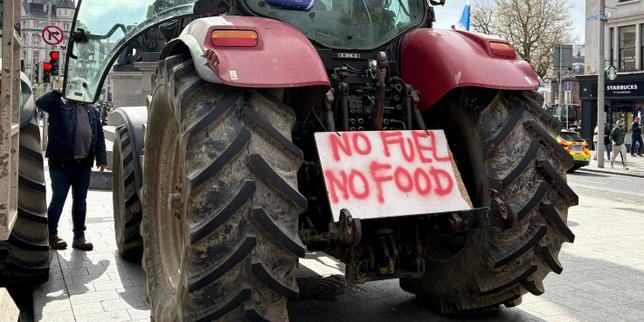
The Irish government’s reversal on fuel tax increases represents a collapse of fiscal resolve under the pressure of asymmetric logistics disruption. When a state enters a standoff with the transport sector, it is not merely debating a carbon tax; it is testing the elasticity of its own supply chain. The Irish "capitulation" serves as a primary case study in how decentralized, grassroots blockades can bypass traditional political negotiation to force immediate monetary concessions through the threat of total economic stasis.
The Triad of Irish Logistics Vulnerability
To understand why the Dublin administration retreated, one must quantify the specific vulnerabilities that the protest movement exploited. Ireland’s economic geography creates a high-sensitivity environment for fuel pricing due to three structural factors:
- Peripheral Dependency: Unlike continental Europe, Ireland lacks a high-density rail freight network. Over 90% of internal goods movement relies on heavy goods vehicles (HGVs). A price hike in diesel is not a marginal cost increase; it is a direct tax on the entire consumer price index.
- The Island Bottleneck: Supply enters through a handful of key nodes—Dublin Port, Rosslare, and Cork. By identifying and obstructing these specific geographic chokepoints, a small number of vehicles (under 500) achieved the same economic impact as a national general strike.
- SME Margin Compression: The Irish haulage sector is dominated by small-to-medium enterprises (SMEs) operating on margins of 2% to 5%. A €0.20 per liter increase in fuel costs effectively eliminates net profit, transitioning the protest from a political choice to an existential necessity for the operators.
The Cost Function of Civil Disruption
The government’s decision-making process was governed by a deteriorating cost-benefit ratio. Initially, the state attempted to maintain the integrity of its Climate Action Plan, which relies on escalating carbon taxes to meet 2030 emission targets. However, the protesters applied a different variable: the daily loss of Gross Value Added (GVA).
When hauliers blockaded the M50 motorway and the Dublin Port access points, they introduced a non-linear cost to the economy. The delay of a single container does not just cost the driver's time; it triggers a cascade of penalties across the "Just-in-Time" delivery model used by Irish supermarkets and pharmaceutical plants.
The state’s internal logic shifted when the projected revenue from the fuel tax hike (estimated in the low hundreds of millions) was eclipsed by the potential multi-billion-euro risk of a week-long logistics blackout. This is the Threshold of State Compliance: the point where the cost of enforcing a policy exceeds the fiscal benefit of the policy itself.
Mechanism of the Policy Reversal
The government did not just "give in"; it restructured the tax burden to buy social peace. This intervention took the form of a significant reduction in excise duty—approximately 20 cents per liter for petrol and 15 cents for diesel.
This move created a massive fiscal hole. To bridge it, the state had to divert surplus corporation tax receipts, primarily from the multinational technology and pharma sectors. This creates a dangerous precedent: Fiscal Substitution. By using volatile multinational tax revenue to subsidize fossil fuel consumption, the government has weakened the link between carbon pricing and consumer behavior. The "polluter pays" principle was discarded in favor of "the state pays to prevent friction."
The Failure of Incrementalism
A primary failure in the Irish strategy was the use of transparent, scheduled tax increases. By announcing the phases of the carbon tax years in advance, the government provided a fixed target for mobilization.
Structural analysis suggests that incrementalism, while intended to allow for gradual adaptation, actually serves as a roadmap for resistance. The protesters knew exactly when the next "pain point" would occur, allowing them to coordinate logistics, media cycles, and political pressure with surgical precision.
Furthermore, the government failed to provide a viable "off-ramp" for the haulage industry. Transitioning an HGV fleet to electric or hydrogen power is a decade-long capital expenditure project. Without immediate, subsidized alternatives for freight energy, the tax hike was perceived as a punitive measure rather than a transformative one.
The Leverage of the Dublin Port Blockade
The Dublin Port is the jugular vein of the Irish economy. It handles approximately 50% of the Republic’s trade. The protesters utilized a Congestion Multiplier strategy:
- Phase 1: Slow-play convoys on the M50 (Dublin's orbital motorway) to saturate the city's transport arteries.
- Phase 2: Stationary blockades at the Port Tunnel entrance.
- Phase 3: Strategic abandonment of vehicles in high-traffic zones.
This sequence forced the Gardaí (police) into a dilemma. Forcible removal of hundreds of HGVs requires specialized heavy-lift recovery equipment, much of which is owned by the very companies involved in the protest. The state lacked the "sovereign capacity" to clear its own roads without the cooperation of the industry it was attempting to tax.
The Second-Order Effects of Subsidization
While the immediate crisis was averted, the "Irish Model" of concession has introduced three long-term risks:
- Incentive Alignment for Future Protests: Other sectors—agriculture and construction—now recognize that the government’s fiscal policy is negotiable through physical disruption. The barrier for entry into civil disobedience has been lowered.
- Inflationary Lag: While fuel prices at the pump dropped, the logistical costs already baked into the supply chain did not revert as quickly. Transport companies often maintain fuel surcharges for months after a price drop to recoup earlier losses, meaning the consumer saw minimal relief in grocery prices despite the tax cut.
- Climate Target Deficit: Ireland is now statistically unlikely to meet its immediate carbon reduction goals. Each month of subsidized fuel keeps older, less efficient vehicles on the road longer, delaying the fleet renewal cycle.
Tactical Realignment for State Actors
For a government to implement carbon-related price hikes in a high-dependency logistics environment, it must shift from Revenue Collection to Reinvestment Cycles. The Irish error was the perception that the tax was disappearing into the "Black Hole" of the exchequer.
A more resilient strategy involves a ring-fenced rebate system where fuel tax revenue is immediately and transparently returned to the haulage sector in the form of "Green Freight Credits." This transforms the tax from a cost-center into a transition-subsidy, neutralizing the economic justification for blockades.
The Irish government’s retreat was a rational response to an irrational degree of vulnerability. It exposed a fundamental truth of modern governance: a state’s power is only as strong as its ability to keep its ports open and its trucks moving. When the movement of goods stops, the authority of the legislature ceases to function.
The final strategic move for the Irish administration is the immediate acceleration of the "Western Rail Corridor" and similar freight rail projects. To prevent future ransom by the trucking sector, the state must break the HGV monopoly on national logistics. Until a diversified freight infrastructure exists, the government remains a hostage to the price of a liter of diesel and the whims of those who transport it.