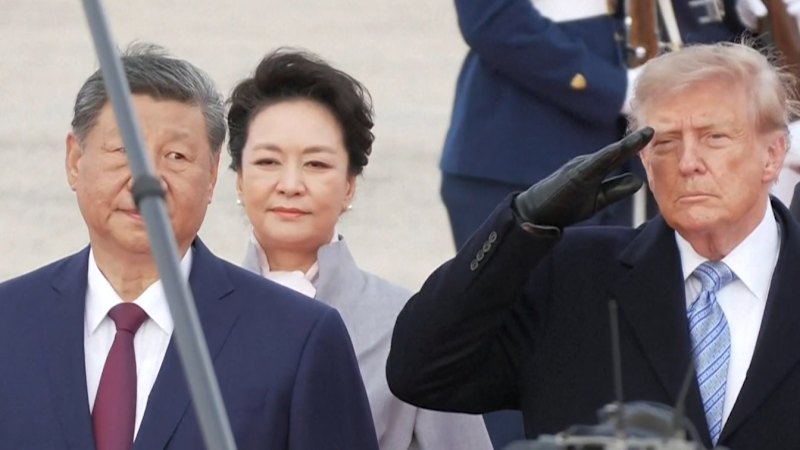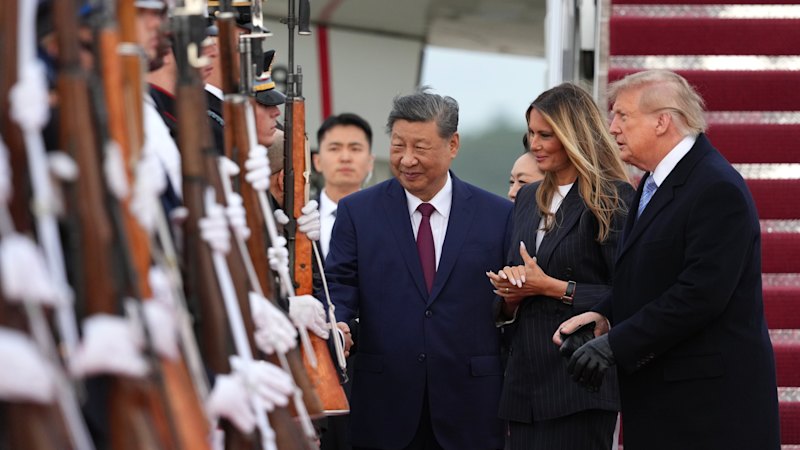
Diplomatic engagements between major nuclear-armed states are frequently filtered through the lens of personal rapport or immediate concessions. This approach misreads the structural constraints that govern state behavior. When bilateral summits occur between top leadership, the outcomes are not determined by interpersonal chemistry or spontaneous negotiation tactics. They are constrained by domestic economic fundamentals, institutional veto players, and structural incentives that precede the actual meeting by years. Analyzing high-stakes geopolitical summits requires moving past the superficial theater of tarmac arrivals and press conferences to map the underlying cost-benefit matrices of both state apparatuses.
The architecture of modern US-China relations operates on an asymmetric playing field where two distinct governance models collide. Understanding how these systems interact requires examining the structural levers each executive controls, the domestic constraints limiting their maneuverability, and the systemic friction points that render permanent rapprochement mathematically improbable.
The Domestic Imperative Function
Every foreign policy action executed by a head of state is bounded by a domestic survival function. In democratic systems characterized by divided or fragile legislative majorities, executive action is continuously weighed against electoral volatility. A leader operating under these conditions faces a high discount rate on long-term structural gains if those gains incur immediate localized economic costs. Protectionist tariffs, trade friction, and supply chain decoupling are frequently deployed not as optimal economic strategies, but as signals to domestic constituencies. The utility of a tariff is measured primarily by its domestic signaling value rather than its long-term impact on bilateral trade deficits.
Conversely, centralized state models operate under a different optimization calculus. The primary constraint is not electoral timing, but systemic stability and resource allocation efficiency. Economic performance functions as the foundational source of political legitimacy. When external friction threatens industrial capacity, capital flows, or technology acquisition pipelines, the state response is swift, institutionalized, and insulated from short-term public opinion polling.
This asymmetry creates a fundamental divergence in negotiation horizons. One system thinks in multi-decade strategic trajectories anchored by national industrial plans. The other optimizes for electoral cycles and immediate market sentiment. When these two systems negotiate, the structural friction is inevitable because their internal metrics of success are mutually incompatible.
The Three Structural Pillars of Bilateral Friction
Bilateral tension is not a byproduct of rhetorical hostility; it is the structural output of three distinct systemic clashes.
Industrial Policy and Technological Autarky
The global economy has entered a phase of defensive mercantilism. Both major powers recognize that foundational technologies—semiconductors, artificial intelligence, quantum computing, and advanced biotechnology—are national security assets.
The structural driver here is the security dilemma applied to economics. When State A restricts the export of advanced lithography equipment to State B, it is executing a rational defensive move to preserve its technological lead. When State B responds by subsidizing domestic chip manufacturing and restricting critical mineral exports, it is executing a rational counter-move to eliminate dependency. Neither action is driven by temporary diplomatic annoyance. Both are outputs of structural logic. A summit cannot resolve this tension because neither leadership can afford to compromise on technological sovereignty without risking long-term strategic obsolescence.
Supply Chain Redundancy and Capital Bifurcation
For decades, global trade was governed by the principle of economic efficiency. Supply chains optimized for the lowest possible cost, routing components across multiple borders regardless of geopolitical alignment. This era has ended.
The contemporary calculus prioritizes resilience over efficiency. The cost function has shifted from minimizing unit production costs to minimizing exposure to geopolitical choke points. Capital flows are increasingly bifurcated by regulatory walls, investment screening committees, and national security directives. When trade delegations meet, they are attempting to negotiate rules for a global trading system that both sides are actively dismantling. The structural reality is that de-risking and decoupling are irreversible trends driven by risk mitigation models used by multinational corporations and sovereign planners alike.
Sphere of Influence and Institutional Architecture
Geopolitical competition is ultimately a contest over standard-setting and institutional architecture. International organizations built in the post-war era are increasingly strained by shifts in global economic weight.
State capital models project influence through infrastructure finance, bilateral lending, and alternative trade frameworks. Market-driven models rely on alliances, security guarantees, and regulatory enforcement through financial institutions. When these two architectures intersect in developing regions, they generate friction over debt sustainability, governance standards, and security alignment. This is a structural zero-sum game regarding normative dominance. A diplomatic arrival ceremony does not alter the underlying competition for structural hegemony.
The Cost Function of Strategic Signaling
The theater surrounding high-level summits serves a specific informational purpose: signaling resolve to domestic and international audiences. However, the market for signals is plagued by asymmetric interpretation.
What one side intends as a gesture of pragmatic engagement is frequently interpreted by domestic hardliners as a sign of weakness or appeasement. To maintain credibility with internal coalitions, leaders must frequently accompany diplomatic overtures with punitive administrative actions or bellicose rhetoric. This creates a ratchet effect. Every diplomatic cycle raises the baseline of hostility, making subsequent de-escalation more politically costly.
Consider the mechanics of trade negotiations under these conditions. If a state removes tariffs without securing verifiable, structural concessions in return, its domestic opposition weaponizes the move as capitulation. Therefore, negotiations stall not because of personal stubbornness, but because the Pareto-optimal outcome—mutual liberalization—lies outside the win-set of domestic political survival.
Systemic Limitations and Inevitable Bottlenecks
The structural barriers to comprehensive bilateral agreements are structural, institutional, and immutable under current governance paradigms.
The first bottleneck is verification. In decentralized market economies, state actors cannot directly command private corporations to alter their supply chains or investment strategies without invoking emergency authorities that disrupt the broader economic ecosystem. In contrast, centralized states possess direct administrative control over enterprise behavior. This creates an asymmetry in implementation capability. A pledge made by a market-driven executive is subject to judicial review, corporate lobbying, and market reactions. A directive issued by a centralized authority is implemented via administrative fiat.
The second limitation is strategic distrust rooted in zero-sum assumptions. Because both actors view advanced technologies and global supply chains as instruments of potential coercion, any cooperative agreement contains an inherent prisoner's dilemma. Compliance cannot be easily verified without intrusive inspections that violate sovereignty principles. Consequently, hedging strategies—such as stockpiling critical inputs, dual-sourcing production, and restricting cross-border data flows—continue regardless of joint communiqués issued at the conclusion of a summit.
Strategic Execution and Systemic Forecast
The analytical takeaway from high-level diplomatic choreography is clear: summits do not alter structural trajectories; they merely manage the velocity of friction.
The operating environment for multinational enterprises, sovereign wealth funds, and global supply chain architects will remain defined by managed fragmentation. Strategic planning must abandon assumptions of reversion to a frictionless globalized baseline. Capital allocation models must incorporate structural decoupling, regulatory bifurcation, and state-directed industrial policy as permanent environmental variables rather than temporary anomalies.
Organizations that fail to model these structural constraints into their long-term operational framework will remain vulnerable to sudden regulatory shifts and geopolitical shocks. The future belongs not to those who bank on diplomatic breakthroughs, but to those who engineer resilience against structural volatility.