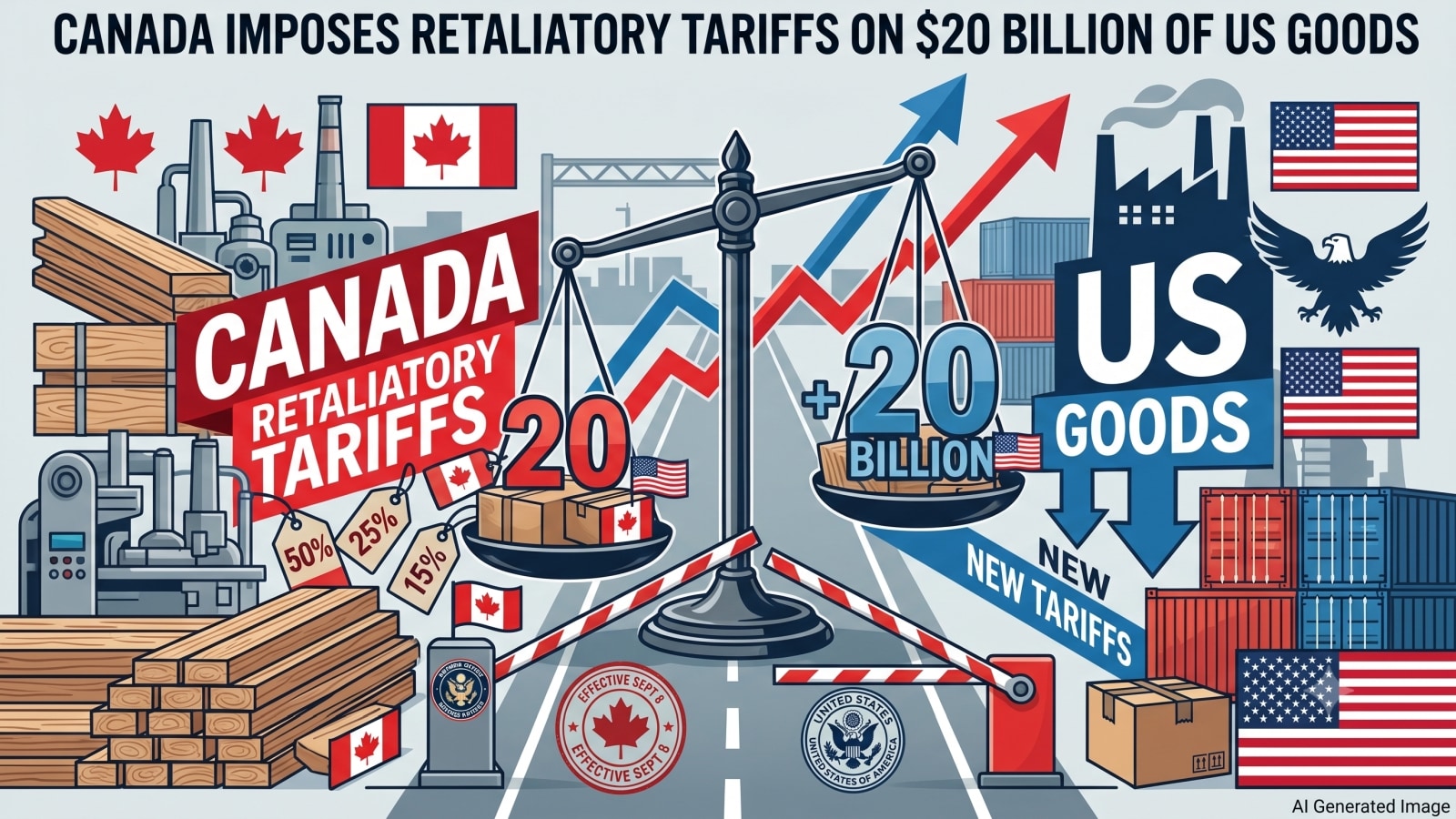
Trade retaliations operate through rigid economic feedback loops rather than arbitrary political retaliation. When Canada implements $20 billion in retaliatory tariffs against United States exports starting September 8, the policy functions as a calculated stress test on integrated cross-border supply chains. This analysis deconstructs the structural friction points, the cost-allocation mechanisms governing imported intermediates, and the macro-level adjustment costs borne by firms operating within the North American trade corridor.
Understanding the immediate mechanics requires abandoning generalized political rhetoric. Trade disputes at this scale represent deliberate shifts in input costs for downstream manufacturing sectors. Analysts frequently misdiagnose these events as binary contests of national will, ignoring the microeconomic transmission channels that transfer the tax burden directly to domestic assemblers and consumers. For another perspective, consider: this related article.
The Transmission Channels of Border Friction
Tariffs do not tax foreign entities; they act as a direct tax on domestic commercial entities importing intermediate goods. The $20 billion volume designated by Canadian authorities targets specific industrial inputs, agricultural commodities, and consumer goods designed to maximize political signaling while minimizing self-inflicted structural damage.
[Tariff Imposition]
       │
       ▼
[Import Cost Inflation]
       │
       ▼
[Margin Compression OR Price Transmission]
       │
       ├─► Margin Compression ──► Reduced Capital Expenditure
       └─► Price Transmission ──► Downstream Inflationary Pressure
This structural vector operates through three distinct operational phases for firms caught in the crossfire: Related coverage regarding this has been provided by Al Jazeera.
- Input Cost Shock: Manufacturers dependent on components crossing the border face an immediate margin compression. Because supply chains cannot be re-engineered overnight, firms absorb the initial cost delta or pass it downstream.
- Substitution Inelasticity: In the short run, alternative suppliers do not exist at scale. The lack of domestic capacity in specialized manufacturing inputs creates an inelastic demand curve, forcing buyers to pay the tariff-inclusive price.
- Logistical Routing Shifts: Freight forwarders and logistics coordinators must recalculate optimal transport nodes, occasionally shifting inventory holding locations to mitigate border delays and compliance verification overhead.
Firms attempting to navigate this operational turbulence face a zero-sum choice between absorbing the tariff tax or risking market share losses through price escalation. The friction is unevenly distributed, penalizing companies with low liquidity and high inventory turnover cycles.
The Cost Function of Retaliatory Trade Policy
Evaluating the net macroeconomic impact involves analyzing the deadweight loss generated by market distortion. When a government imposes tariffs, it trades market efficiency for strategic leverage. The efficiency loss is a function of the tariff rate multiplied by the reduction in trade volume, compounded by administrative compliance costs.
The cost function breaks down into identifiable operational expenditures:
- Compliance Overhead: Customs brokerage fees, tariff classification audits, and origin verification documentation increase administrative headcount requirements for import-heavy enterprises.
- Working Capital Strain: Higher per-unit acquisition costs tie up larger amounts of revolving credit, reducing the capital available for research, development, or labor expansion.
- Opportunity Cost of Delayed Sourcing: Management bandwidth shifts from core product optimization to contingency sourcing and regulatory risk management.
These internal operational metrics explain why corporate lobbying strategies shift rapidly during trade disputes. The battle is rarely about the headline tariff percentage; it is about securing tariff exemptions for vital components that lack domestic substitutes.
Sectoral Vulnerability Matrices
Not all industries experience trade shocks uniformly. Vulnerability correlates directly with the degree of cross-border integration and the availability of local substitutes.
Automotive assembly and agricultural processing represent high-vulnerability nodes. Because automotive parts cross the border multiple times during the manufacturing lifecycle, cumulative tariff exposure compounds exponentially. A component entering Canada, returning to the United States for secondary processing, and finishing in Canada accumulates friction at every single border checkpoint.
Conversely, consumer goods with highly commoditized supply chains experience lower structural vulnerability. If a specific brand of manufactured retail goods faces punitive duties, retailers substitute alternative brands with relative ease, shifting the commercial penalty back to the manufacturer who fails to maintain competitive pricing.
Supply chain managers must execute a granular exposure audit across their Bill of Materials. Identifying single-source components originating from the targeted jurisdiction allows firms to front-load inventory prior to the enforcement date, buying crucial temporal buffer space to negotiate alternative vendor agreements.
Strategic Execution and Margin Defense
Mitigating the fiscal damage of escalating trade barriers requires a departure from standard procurement strategies. Traditional cost-reduction frameworks fail when external regulatory shocks artificially inflate input costs.
Procurement teams must deploy targeted tariff-mitigation protocols:
- Tariff Engineering: Reviewing product classifications to determine if minor modifications in manufacturing specifications permit re-classification under tariff codes with lower or zero duty rates.
- Geographic Arbitrage: Accelerating qualification pipelines for secondary and tertiary suppliers located in jurisdictions exempt from current retaliatory measures.
- Contractual Risk-Sharing: Re-negotiating master service agreements with suppliers to share the tariff burden proportionally, rather than leaving domestic buyers to absorb 100 percent of the margin erosion.
Trade disputes of this magnitude inevitably restructure long-term corporate procurement maps. Firms that treat retaliatory tariffs as temporary political noise rather than permanent structural changes to their cost baseline will suffer sustained margin deterioration. The operational response must focus on building systemic flexibility into supply chain architecture, ensuring rapid pivot capabilities when trade corridors experience sudden regulatory compression.