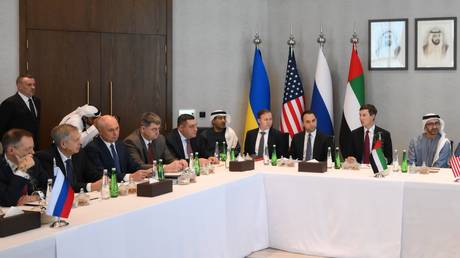
Standard reporting on the conclusion of the second day of trilateral talks between Russia, Ukraine, and the United States in Abu Dhabi mistakes diplomatic presence for substantive convergence. While conventional coverage focuses on the rarity of simultaneous participation by senior delegations from Moscow, Kyiv, and Washington, the operational reality of these negotiations is governed by asymmetric leverage, incompatible security architectures, and the structural constraints of third-party mediation. To evaluate whether the Abu Dhabi forum represents a genuine inflection point or a tactical pause, analysts must strip away diplomatic communiqués and examine the underlying bargaining variables, the utility function of the Emirati host, and the verification bottlenecks that historically derail ceasefire frameworks.
The Structural Architecture of the Abu Dhabi Forum
Trilateral diplomacy involving two active belligerents and a primary security guarantor operates fundamentally differently from bilateral negotiations or multilateral peace conferences. In a standard bilateral setting, concessions are traded directly along a single axis of friction. Introducing the United States into a room with Russia and Ukraine transforms the negotiation into a two-level game where Washington functions simultaneously as Kyiv's primary logistical supplier and Moscow's primary strategic peer.
The choice of Abu Dhabi as the venue is not incidental. The United Arab Emirates has engineered a distinct diplomatic niche by maintaining open financial, aviation, and political channels with Moscow while preserving deep defense and intelligence ties with Washington. Unlike European capitals, which have aligned their sanctions regimes with NATO strategic objectives, the UAE offers a neutral operational environment where sanctioned officials can travel without legal exposure and where back-channel communications can occur without immediate domestic political blowback. Prior Emirati mediation on prisoner-of-war exchanges established the baseline procedural trust necessary to host higher-stakes discussions.
However, venue neutrality does not resolve the core structural asymmetry of the talks. The delegations arrive in Abu Dhabi operating under entirely different time horizons and domestic constraints:
- The Russian Delegation's Optimization Function: Moscow approaches trilateral engagement primarily as a mechanism to decouple Washington from Kyiv. By engaging directly with US representatives on broader strategic stability, sanctions relief, and European security architecture, Russian negotiators seek to frame Ukraine as a subordinate theater rather than an independent sovereign actor. Tactical pauses or localized ceasefires are evaluated based on whether they allow Russian forces to consolidate territorial gains and reconstitute degraded military formations.
- The Ukrainian Delegation's Survival Constraint: Kyiv enters the talks constrained by constitutional boundaries regarding territorial integrity and an acute awareness that any freeze along current lines of contact without binding security guarantees merely delays a renewed offensive. For Ukrainian negotiators, the presence of the United States is essential not to pressure Kyiv into concessions, but to underwrite the enforcement mechanisms of any potential agreement.
- The American Delegation's Bandwidth and Risk Calculus: Washington balances the strategic imperative of preventing Russian territorial expansion against the domestic and global resource costs of prolonged attrition. US negotiators must manage alliance cohesion across NATO while testing whether Moscow's stated willingness to negotiate reflects genuine economic and military strain or simply an effort to influence Western aid appropriations.
The Three Core Bargaining Variables
When diplomatic readouts state that talks have "concluded" after two days without a joint declaration, the absence of a communiqué indicates deadlock across three non-negotiable variables: territorial demarcation, security guarantees, and economic de-escalation.
1. Territorial Demarcation and the Freeze Dilemma
The primary friction point remains the legal and operational status of occupied territories. A standard diplomatic workaround in protracted conflicts is the distinction between de facto control and de jure recognition. Under this model, belligerents agree to cease kinetic operations along an established line of contact without requiring the losing party to formally cede sovereignty.
In the context of the Russia-Ukraine war, this model faces an immediate structural breakdown. Moscow has incorporated occupied Ukrainian oblasts into its domestic constitutional framework, creating a rigid legal barrier to territorial withdrawal without severe internal political cost. Conversely, Kyiv cannot accept an informal freeze that leaves major population centers and critical industrial infrastructure under Russian occupation without a credible pathway to restoration. Two days of talks in Abu Dhabi cannot bridge a gap where one side demands the formalization of conquest and the other requires the reversal of it.
2. The Credibility Deficit in Security Guarantees
Any cessation of hostilities requires a mechanism to deter future aggression. Historically, agreements such as the Budapest Memorandum and the Minsk accords failed because they lacked automatic enforcement triggers. If a ceasefire is violated, the guarantor states must be legally and logistically compelled to intervene.
During the Abu Dhabi sessions, the central debate surrounding security guarantees revolves around what substitutes for formal NATO membership. Moscow demands permanent Ukrainian neutrality and strict caps on the size and capability of the Ukrainian Armed Forces. Kyiv and Washington recognize that a demilitarized, neutral Ukraine lacking an Article 5-style mutual defense treaty would remain perpetually vulnerable to a subsequent Russian mobilization. Bridging this divide requires designing bilateral defense pacts, pre-positioned weapons stockpiles, and automated intelligence-sharing frameworks that deter Russia without crossing Moscow's threshold for direct confrontation with NATO.
3. Sanctions Architecture and Economic Sequencing
Economic statecraft forms the third pillar of the trilateral equation. Western sanctions on the Russian central bank, energy sector, and technology imports represent Washington's primary non-kinetic leverage. Moscow views the lifting of these restrictions—particularly the unfreezing of sovereign assets and the restoration of access to global financial messaging systems—as a prerequisite for any comprehensive settlement.
The sequencing problem here is acute. Sanctions, once lifted, are politically and logistically difficult to reimpose across a broad coalition of states. Territorial withdrawals or ceasefire compliance, by contrast, can be reversed within days. Consequently, US and Ukrainian negotiators insist on a phased, reversible model of sanctions relief tied strictly to verifiable milestones on the ground, whereas Russian negotiators push for upfront economic concessions in exchange for promises of behavioral restraint.
The Verification Bottleneck
Even if the delegations in Abu Dhabi were to reach a political understanding on the three variables above, any resulting agreement would immediately collide with the technical realities of modern battlefield verification. A ceasefire along a front line stretching over a thousand kilometers cannot rely on traditional diplomatic observers.
The failure of the Organization for Security and Co-operation in Europe (OSCE) Special Monitoring Mission prior to 2022 demonstrated the limits of unarmed human monitors in an environment saturated with electronic warfare and heavy artillery. Modern verification requires a multi-layered technical architecture:
- Persistent Overhead Surveillance: Continuous synthetic aperture radar and electro-optical satellite imagery to detect troop concentrations, logistics buildup, and heavy armor movements behind the line of contact.
- Unmanned Aerial Monitoring: Long-endurance drones operating in designated buffer zones, supported by strict prohibitions on electronic jamming and air-defense targeting of monitoring assets.
- Automated Acoustic and Seismic Sensors: Ground-based sensor networks capable of triangulating artillery launches and identifying the origin of ceasefire violations in real time to prevent reciprocal escalation.
- Joint Inspection Commissions: Rapid-response teams empowered to conduct unannounced inspections of ammunition depots and rail hubs within a defined exclusion zone.
Without explicit agreement on the rules of engagement for these verification systems—specifically, who controls the data, how violations are adjudicated, and what penalties automatically trigger upon breach—a ceasefire simply creates an operational blind spot that favors the aggressor. The conclusion of the second day of talks without an announcement of a technical working group on verification confirms that negotiations remain stalled at the political threshold.
Tactical Signals Versus Strategic Shifts
Analysts evaluating the outcome of the Abu Dhabi meetings must distinguish between diplomatic signaling and actual shifts in strategic posture. Participating in multi-day trilateral talks generates immediate political utility for all three parties, independent of the substantive outcome.
For Moscow, sending a delegation to Abu Dhabi counters the narrative of international isolation and signals to non-Western powers in the Global South that Russia is a constructive diplomatic actor. It also introduces friction between Washington and European capitals that may view trilateral US-Russia-Ukraine formats as sidelining European Union security interests.
For Kyiv, active participation demonstrates to the US Congress and European parliaments that Ukraine is not an obstacle to peace, thereby protecting the political consensus required to sustain military and financial aid packages.
For Washington, convening the talks allows the administration to test Russian intentions directly, gather intelligence on internal Kremlin priorities, and demonstrate diplomatic leadership to domestic audiences fatigued by prolonged foreign entanglements.
Because each party derives distinct benefits merely from attending, the conclusion of a two-day round does not imply imminent breakthrough. Instead, it reflects a rational calculation by all three capitals to keep a communication channel open while continuing to pursue maximum leverage on the battlefield.
Limitations of the Trilateral Mediation Model
Relying on discrete, high-level trilateral summits in third-party venues carries inherent structural limitations that constrain its effectiveness:
- Exclusion of Key European Stakeholders: A format limited to the US, Russia, and Ukraine omits the European Union and major European military powers such as the United Kingdom, France, Germany, and Poland. Because Europe bears the primary geographic risk and provides a massive share of Ukraine's financial and military backing, any security architecture negotiated without European buy-in lacks long-term political durability.
- Vulnerability to Battlefield Volatility: High-level diplomatic tracks move slowly, whereas kinetic operations generate rapid shifts in leverage. A major tactical breakthrough, a strike on critical energy infrastructure, or a shift in weapons supply can instantly invalidate the assumptions underlying a negotiation round.
- Asymmetric Domestic Accountability: Democratic governments in Washington and Kyiv face transparent legislative oversight, media scrutiny, and electoral cycles that constrain their ability to make secret concessions. An authoritarian system in Moscow faces no comparable institutional checks, allowing Russian negotiators to absorb prolonged diplomatic stalemates without immediate domestic political penalty.
Operational Indicators to Watch
To assess whether subsequent rounds following the Abu Dhabi talks are moving toward a substantive framework rather than serving as diplomatic theater, analysts should disregard vague statements of "constructive dialogue" and track four concrete operational indicators:
- Elevation of Delegation Rank and Technical Composition: Watch for the inclusion of senior military operations officers, sanctions compliance lawyers, and intelligence officials alongside career diplomats. Political generalists cannot negotiate a disengagement line or a sanctions snapback mechanism.
- Establishment of Standing Technical Sub-Groups: A transition from episodic two-day summits to continuous working groups focused on prisoner exchanges, nuclear plant safety, maritime corridors, or buffer-zone telemetry indicates serious intent to build an enforceable architecture.
- Asymmetric Kinetic Restraint: Look for unannounced, reciprocal reductions in specific categories of strikes—such as long-range attacks on energy grids or Black Sea port infrastructure—which often serve as real-world confidence-building tests prior to formal agreements.
- Synchronized Messaging Across Capitals: When negotiations enter a decisive phase, public rhetoric from Moscow, Kyiv, and Washington typically shifts from maximalist demands to calibrated ambiguity designed to prepare domestic audiences for compromise. Continued maximalist messaging immediately following the Abu Dhabi adjournment confirms that the core conflict remains unresolved.
Strategic Recommendation for Policy and Risk Analysts
Treat the conclusion of the second day of talks in Abu Dhabi as a baseline intelligence-gathering event rather than a catalyst for near-term de-escalation. Organizations, defense planners, and market participants exposed to Eastern European geopolitical risk should maintain existing contingency postures for sustained high-intensity conflict through the upcoming operational quarters. Do not price in sanctions relief or reconstruction capital flows until the three parties establish a dedicated technical working group on ceasefire verification and demonstrate sustained, reciprocal restraint on strategic infrastructure strikes.