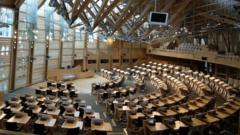
The Scottish parliamentary election cycle is defined not by a linear progression of voter intent, but by the collision of two distinct constitutional pressures and the mechanics of a dual-ballot voting system. While surface-level polling often suggests a binary choice between independence and the union, the structural reality is a sophisticated optimization problem for voters. The final 24 hours of a campaign do not merely represent a race for the "undecided"; they represent a critical recalibration of tactical voting within the Additional Member System (AMS).
The AMS Optimization Problem
The Scottish Parliament utilizes a proportional representation system that creates a mathematical tension between constituency seats and regional lists. Understanding the outcome requires an analysis of the Threshold of Diminishing Returns on the regional list for dominant parties.
When a party wins a significant number of constituency seats, the D'Hondt formula—the mathematical method used to allocate regional seats—drastically reduces their chances of gaining additional representation from the list. This creates a strategic vacuum. Voters who support a dominant party are often incentivized to "split" their ticket, supporting a secondary party on the regional list to maximize the total number of pro-independence or pro-union MSPs.
The Mechanics of the D'Hondt Dividend
The D'Hondt formula functions as follows:
$$ \text{Quotient} = \frac{V}{s + 1} $$
Where:
- $V$ is the total number of votes the party received on the regional list.
- $s$ is the number of seats the party has already won in that region (constituency seats + previously allocated list seats).
In regions where a party sweeps the constituencies, their "s" value is high, meaning their regional vote is divided by a larger denominator, often 8 or 9. This mathematically penalizes success, leading to the "wastage" of hundreds of thousands of votes. The final day of campaigning is less about persuasion and more about the management of this "surplus" vote.
The Three Pillars of Electoral Uncertainty
The claim that an election is "uncertain" is often a lazy substitute for lack of data. In the Scottish context, uncertainty is a quantifiable variable driven by three specific structural pillars.
1. The Pro-Independence Split-Ticket Risk
The primary variable in the current cycle is the fragmentation of the pro-independence vote. If a secondary pro-independence party gains enough traction on the regional list, it could theoretically capture the seats that the dominant party loses due to the D'Hondt penalty. However, if that secondary party fails to reach the roughly 5% to 6% threshold required to win a seat in a specific region, those votes are effectively deleted from the constitutional tally. This creates a "dead zone" where fragmented support actively harms the broader movement's objective.
2. Unionist Tactical Consolidation
On the opposing side, the unionist strategy relies on a "Negative Correlation" model. Since the three main unionist parties (Conservatives, Labour, and Liberal Democrats) compete for a similar constitutional outcome but different policy platforms, their success depends on voters suppressing their ideological preferences in favor of the candidate most likely to defeat the incumbent in a specific constituency. The uncertainty here lies in the Friction of Realignment: the degree to which a traditional Labour voter is willing to pull the lever for a Conservative candidate to prevent a nationalist majority.
3. The Turnout Differential
Elections are won on the "Margin of Enthusiasm." In a system where the constitutional question is the primary driver, turnout is not uniform across demographics.
- The Age-Probability Gap: Younger voters show higher support for independence but lower historical turnout probabilities.
- The Engagement Decay: High-intensity campaigns can lead to voter fatigue, where the marginal utility of one more door-knock becomes negative, potentially suppressing turnout in key battlegrounds.
Path Dependency and the Battleground Constituencies
The outcome is anchored in a handful of "Hyper-Marginal" constituencies. These are geographic areas where the lead is within the statistical margin of error (typically 3% to 4%). These seats act as the "Constitutional Lever." If the incumbent party loses even two or three of these, the path to an overall majority becomes mathematically improbable, regardless of their performance in safe seats.
The "Winner’s Curse" in the Scottish system is that winning a constituency by a landslide provides no extra value, whereas winning by a single vote secures the seat and allows the remaining votes to be theoretically "reallocated" in the minds of tactical voters toward the list. The strategic failure of most campaigns is the inability to communicate this complex mathematical reality to a general electorate that perceives voting as a purely emotional or ideological act.
The Constitutional Ceiling vs. The Policy Floor
There exists a hard "Constitutional Ceiling" in Scotland. Polling on independence has remained remarkably stable, oscillating within a narrow band. This suggests that the "persuadable" middle is much smaller than political consultants claim.
The real movement occurs on the "Policy Floor." When voters feel that the delivery of core services—healthcare, education, and transport—has fallen below an acceptable threshold, their constitutional preference becomes secondary to their desire for functional governance. This creates a Governance Penalty. For an incumbent, the final day of campaigning is a desperate attempt to decouple their constitutional stance from their administrative record. For the opposition, the goal is to fuse them.
The Liquidity of the "Don't Know" Vote
Standard analysis treats "Don't Know" voters as a monolithic block that will eventually split according to historical averages. This is a flawed assumption. In a high-stakes constitutional election, "Don't Know" often signifies Social Desirability Bias or Internal Conflict.
A voter may support the idea of independence but fear the economic transition, or they may support the union but despise the current UK government. These voters do not "break" toward a party; they "break" toward the path of least perceived risk. In the final 24 hours, the campaign that successfully frames the other side as the higher-risk option wins the liquidity of the undecided block.
Structural Bottlenecks in the Final 24 Hours
The final hours of a campaign are a logistics exercise in "Get Out The Vote" (GOTV). The effectiveness of this is limited by two bottlenecks:
- Data Decay: Voter intent data gathered three weeks ago is often obsolete by election day due to late-breaking news cycles.
- Volunteer Saturation: There is a physical limit to how many doors can be knocked and how many phone calls can be made. Campaigns often misallocate resources by "preaching to the choir" in safe seats rather than surging into the marginals where the D'Hondt quotient is most sensitive.
Strategic Projection
The most probable outcome is not a "wave" but a "grind." The mathematical hurdles placed by the AMS make a single-party majority an anomaly rather than the norm. The focus should not be on the total vote share, but on the Regional Quotient Efficiency.
A party that achieves a "Broad and Shallow" vote across the country will be penalized by the D'Hondt system. A party that achieves a "Targeted and Deep" vote in specific regions, while managing tactical transfers in others, will over-perform their polling.
The ultimate metric to watch is the Constituency-to-List Ratio. If the leading party sees their constituency count rise while their list vote remains stagnant, they will likely fail to secure a majority. The stability of the next Scottish Government depends entirely on whether the pro-independence or pro-union "blocs" can solve the coordination problem of the second ballot. Failure to coordinate leads to a fragmented parliament where the balance of power is held by smaller, fringe parties, increasing the complexity of legislative passage and decreasing the mandate for a second referendum.
The strategic play for any party in this position is to abandon the "national" message in the final 12 hours and pivot entirely to regional micro-targeting. This involves informing voters of the specific mathematical reality in their region—essentially teaching a masterclass in the D'Hondt formula on the doorstep. Whoever reduces the "waste" in their vote tally will dictate the constitutional direction of the country for the next five years.