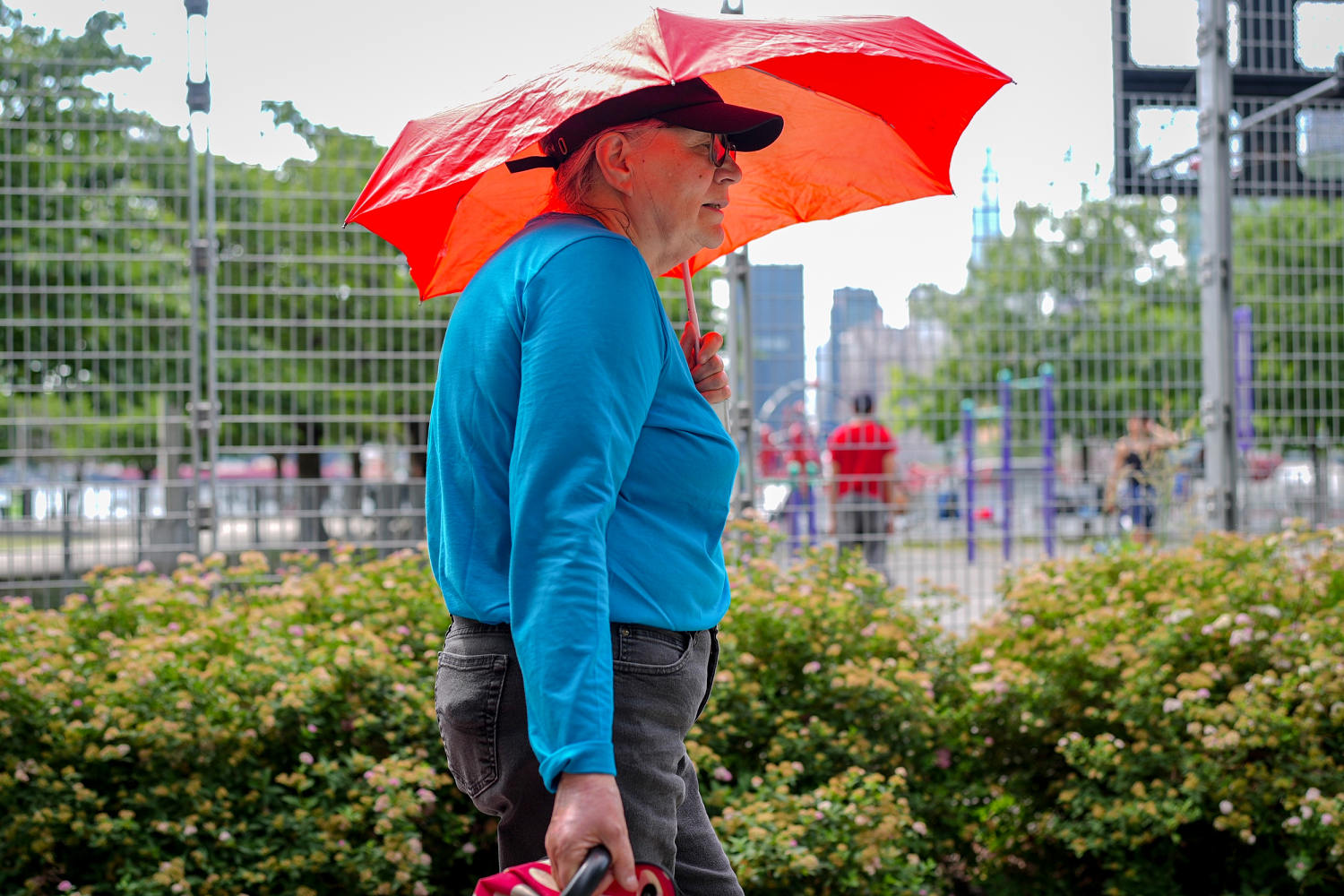
The media has a seasonal script, and right now, they are running the June edition perfectly. "Record-breaking heat is sweeping the country before summer even officially begins," the headlines scream. They point at a thermometer in June, gasp in collective horror, and imply that a sweaty pre-solstice week is the definitive harbinger of an impending apocalypse.
It is lazy journalism. More importantly, it is bad science.
Focusing on early-summer temperature spikes as the ultimate proof of a worsening climate crisis is looking at the scoreboard instead of the mechanics of the game. I have spent fifteen years analyzing energy grid infrastructure and climate risk data. I can tell you that the obsession with these flash-in-the-pan June heat waves misses the real, structural threats staring us in the face.
The mainstream narrative treats every early June heat dome as an unprecedented anomaly. In reality, atmospheric blocks—like the Omega blocks that park high-pressure systems over North America—have been triggering pre-solstice spikes for centuries.
We are measuring the wrong things, panicking over the wrong symptoms, and ignoring the structural fragility that will actually cost lives when the bill comes due.
The Flawed Premise of the "Official Summer" Benchmark
Let's dismantle the first piece of lazy consensus: the idea that heat before June 21st is somehow fundamentally worse or more unnatural than heat on July 10th.
The "official start of summer" is an astronomical marker based on Earth’s axial tilt. The atmosphere does not care about the solstice. Meteorologists have used "meteorological summer"—which starts on June 1st—for generations precisely because the atmosphere transitions to its summer patterns weeks before the calendar changes. Calling a June 10th heat wave "pre-seasonal" is a semantic trick designed to maximize clicks. It creates an illusion of accelerating chaos out of standard seasonal variance.
When the National Oceanic and Atmospheric Administration (NOAA) tracks heat anomalies, they use baseline averages over thirty-year periods. If you actually look at the historical data, early June spikes are common historical features. What has shifted is not the sudden presence of June heat, but the baseline humidity and overnight cooling minimums.
That is the nuance the standard panic pieces miss. The daily high temperature makes a great headline. The overnight low temperature is what actually kills.
Why High Max Temperatures Don't Matter (And Low Minimums Do)
The media wants you to stare at a map covered in deep purple and dark red ink, showcasing a predicted high of 98°F in a city used to 88°F. It looks terrifying. But physiologically and infrastructurally, that number is a distraction.
Human bodies and electrical grids can handle extreme daytime peaks if they get a chance to recover at night.
Imagine a scenario where a city hits 100°F at 3:00 PM, but the dry air allows the temperature to plummet to 62°F by 4:00 AM. The concrete cools down. The transformers on the power poles radiate their trapped heat back into space. The human body drops its core temperature during deep sleep. The system resets.
Now look at the real threat: a city hits 92°F during the day, but because of elevated atmospheric moisture, the overnight low never drops below 80°F.
- The built environment stays hot.
- Air conditioning units run at 100% capacity for 24 hours straight without relief.
- Transformers bake in their own internal heat until they fail.
- The human cardiovascular system remains under constant stress, never entering a recovery state.
By focusing purely on the shocking daytime maximums "before summer even starts," the public conversation ignores the creeping rise in dew points and overnight minimums. We are bracing for a sprint when we are actually trapped in a marathon of thermal saturation.
The Energy Grid Fallacy: It's Not a Supply Problem
Every time an early heat wave hits, the immediate commentary shifts to energy generation. "Can the grid handle the demand? Do we need more solar? More gas? More wind?"
This is the wrong question. I have consulted for utility companies struggling to balance regional transmission organizations (RTOs) during peak load events. The bottleneck is rarely a lack of raw electron generation. The bottleneck is the physical infrastructure of distribution and local transformational capacity.
You can build a thousand gigawatts of clean energy, but if the local substation transformer overheats because the ambient night temperature stayed at 84°F, the neighborhood goes dark.
The Hidden Threat of Thermal Derating
When temperatures rise, the efficiency of power lines and transformers drops. This physical reality is known as thermal derating.
- As a power line heats up, its electrical resistance increases.
- High resistance means more energy is lost as waste heat during transmission.
- The physical wire expands and sags, forcing utilities to cut the amount of power they send through the line to prevent it from touching trees and grounding out.
The result? At the exact moment a city demands the maximum amount of power to stay cool, the grid's physical capacity to deliver that power shrinks by 10% to 20%.
The competitor's article wants you to look at the sky and fear the sun. You should be looking at the ground and fearing the copper. Our infrastructure is built on historical assumptions of rapid thermal cooling that no longer match reality. Forcing an ideological debate about fuel sources during a heat wave ignores the fact that the physical wires are melting regardless of where the electrons originated.
Stop Obsessing Over Carbon Offsets While the Concrete Bakes
The standard prescription offered by mainstream environmental commentary during a heat wave is a reiteration of macro-level climate goals: reduce emissions, buy carbon credits, transition the macro-economy.
While those goals matter for the century-scale trajectory, they are utterly useless for the immediate, localized crises of urban heat islands. They represent a form of intellectual escapism—focusing on global abstractions because the local reality requires boring, expensive, physical work.
Consider the layout of a modern mid-sized city. It is essentially a giant thermal battery made of asphalt and dark roofs.
[Solar Radiation] ---> [Dark Asphalt / Roofs] ---> [Heat Retained Overnight]
                                                              |
[Increased AC Load] <--- [Urban Heat Island Effect] <---------+
        |
[Grid Strain & Local Failures]
This structural design is a choice. We choose to build wide, unshaded blacktop roads. We choose to build sprawling logistics centers with acres of dark rubber roofing. We choose to clear-cut urban canopies to make room for strip malls.
If you want to stop people from dying during a June heat wave, stop talking about global emissions targets for five minutes and start mandates for cool roofs, permeable high-albedo pavements, and aggressive urban forestry. These modifications can drop local ambient temperatures by up to 10°F during a heat event. That is the difference between a grid that survives and a grid that collapses.
The downside to this contrarian approach? It is local, it requires zoning battles, it costs municipal cash immediately, and it doesn't allow politicians to give grand speeches on international stages. It is unglamorous engineering. But it works.
The Flawed Concept of "Normal" Weather
We have been conditioned to view "normal" weather as a stable, flat line from which any deviation is a catastrophic failure of the natural order. This baseline bias is ahistorical.
The climate record is a chaotic, jagged graph defined by extremes. The Dust Bowl era of the 1930s saw heat waves that still hold records across the American Midwest—records that have not been broken by modern warming trends. To imply that a hot week in early June is a brand-new phenomenon caused exclusively by modern industrialization is to misunderstand the baseline volatility of continental weather patterns.
The real danger is not that the weather is becoming fundamentally unexampled every single day. The danger is that our hyper-optimized, just-in-time civilization has built zero tolerance for volatility into its systems.
We have engineered a society that assumes a narrow envelope of environmental conditions. We optimized supply chains, building codes, and energy markets for a world where deviation doesn't exist. When a standard atmospheric block occurs—the same kind of block that happened in 1820 or 1910—our brittle, over-leveraged infrastructure shatters.
The narrative shouldn't be "look how angry the weather is." The narrative must be "look how fragile we chose to make our world."
Your Climate Action Checklist is Outdated
If your response to an early-season heat wave is to share an infographic about global warming or adjust your personal thermostat by two degrees to "save the planet," you are participating in a theater of efficacy. You are treating a systemic infrastructure crisis as a personal morality play.
If you actually want to build resilience against the shifting climate baseline, the focus must shift entirely to local structural hardening.
- Demand Local Albedo Mandates: Push for municipal ordinances requiring all new commercial developments to use high-reflectance roofing materials.
- Overhaul Substation Metrics: Force public utility commissions to upgrade local transformers to units rated for higher ambient night temperatures, rather than just buying more wholesale generation capacity.
- Decentralize Personal Reliability: If you rely on continuous power for health or survival, stop assuming the macro-grid will protect you because a regulator promised it would. Invest in localized, behind-the-meter storage and solar that can isolate from a failing distribution network.
Stop letting headlines manipulate you with astronomical calendar dates. The sun isn't breaking the world because it got hot before the solstice. The world is breaking because we built it to survive only on the coolest days.