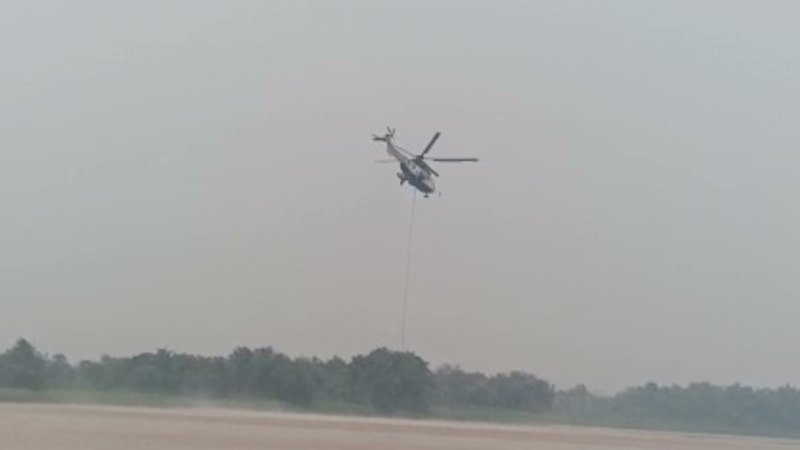
Mainstream media loves a tidy hero story. A chopper goes down in the choking peat smoke of Kalimantan or Sumatra, two Australian pilots kick out the Perspex, walk away with scratches, and the headlines practically write themselves. "Miracle escape." "Aussie grit." "Bravery in the skies."
That narrative is dangerously lazy.
When a heavy-lift firefighting helicopter slams into remote Indonesian jungle and the crew walks away, you are not witnessing a feel-good triumph of human spirit. You are witnessing the razor-thin margin between a lucky break and a body bag, courtesy of an international aerial firefighting contract model that routinely trades crew safety for political optics and cheap hourly rates.
I have spent two decades watching aviation procurement teams and government agencies write checks for aerial suppression. I have sat in the hangars in Darwin and Jakarta, reviewed the maintenance logs that nobody wants leaked to the press, and watched operators get squeezed until their safety margins evaporate. When an aircraft hits the dirt in Southeast Asia, clapping for the pilots' survival misses the entire point. The real story is why that airframe was put in a position to fail in the first place.
The Myth of the Heroic Survival
Let us look at the mechanics of what actually happens when an Australian crew goes down in remote Indonesia. First, credit where it is due: Australian utility pilots are among the sharpest stick-and-rudder aviators on the planet. Years of mustering cattle in the Outback, slinging drills into the Pilbara, and fighting bushfires in Victoria build muscle memory that saves lives when the transmission seizes or a tail rotor strikes invisible timber.
If the crew walked away, they executed an autorotation or a controlled crash landing into dense canopy or soft peat. They used the airframe to absorb kinetic energy, kept the rotor RPMs alive until the last possible second, and got out before the fuel cells ruptured. That is pure skill.
Here is the part the press releases leave out. Walking away from a hull loss is a statistical anomaly, not proof that the system works.
In aerial firefighting—especially in the hostile environment of Indonesian peatlands—surviving a forced landing depends heavily on luck. Did you hit a fifty-meter ironwood tree, or did you hit secondary scrub? Did the main gearbox punch through the cabin roof, or did the skids shear off cleanly? Celebrating the survival without dissecting the operational failures that caused the descent is like praising a bulletproof vest after someone shoots you in the face and misses by an inch.
Why Indonesian Peat Fires Are an Aviation Meat Grinder
To understand why these crashes happen, you have to understand the theater of operations. Fighting fires in New South Wales is violent, unpredictable, and exhausting. Fighting fires in Indonesia is an entirely different beast, and treating it like an extension of the Australian fire season is a fatal mistake.
Indonesian fires are largely subsurface peat fires. They do not just burn trees; they burn the ground itself, sometimes meters deep. This creates two catastrophic problems for rotorcraft operations:
- Zero-visibility particulate soup: Peat smoke is thick, oily, and hangs low under tropical temperature inversions. Pilots routinely transition from clear air into total instrument meteorological conditions (IMC) within seconds, often at 150 feet above ground level while carrying a two-ton Bambi Bucket on a long line.
- Density altitude and mechanical stress: High ambient temperatures combined with crushing humidity destroy rotor efficiency. Engines run right against their redline temperature limits (ITT/EGT) on every single lift. Sand, ash, and corrosive smoke get ingested into turbine intakes, eroding compressor blades at three times the normal rate.
When you drop an aging airframe—often a Vietnam-era Bell UH-1H Huey, a Sikorsky S-61, or a heavily worked Kamov—into that environment for twelve-hour days, the machine is operating on borrowed time.
The Dirty Secret of International Fire Contracts
Why are Australian crews and aircraft in Indonesia in the first place? Follow the money and the politics.
Every dry season, Indonesia faces immense diplomatic pressure from Singapore and Malaysia to stop the transboundary haze that chokes Southeast Asian financial hubs. Jakarta responds by declaring emergencies and opening the wallet for foreign aerial assets. Because Indonesia lacks a massive domestic fleet of heavy-lift firefighting helicopters, the contracts flow to international brokers, predominantly out of Australia, Canada, and Eastern Europe.
On paper, this looks like regional cooperation. In reality, it is a classic race-to-the-bottom procurement trap.
I have seen operators bid on these dry-lease and wet-lease contracts at margins so thin they cannot afford to rotate fatigued engineers. When you operate in remote Kalimantan, you are not a twenty-minute drive from a certified Bell or Sikorsky parts depot. You are hours away by riverboat or fixed-wing charter from basic tooling.
If a hydraulic pump starts weeping or a chip detector lights up in the middle of a high-profile fire campaign, the pressure to "keep the rotors turning" is immense. Local officials want to see water dropping on the fire so they can report progress to Jakarta. Brokers want to bill their daily minimums and flight-hour rates. Nobody gets paid when a helicopter sits grounded in a muddy clearing waiting three weeks for customs to clear a replacement bearing.
So corners get cut. Maintenance intervals get stretched to the absolute legal limit. Crews fly in marginal visibility because turning back means losing the contract to a hungrier competitor.
Dismantling the "People Also Ask" Fallacies
Whenever an incident like this hits the news cycle, the public asks the exact same predictable questions. Almost all of them are built on flawed assumptions about how aerial firefighting works.
"Are helicopters even effective against Indonesian peat fires?"
The brutal truth: Barely. Dropping 1,000 gallons of water from a helicopter onto a burning peat bog is like spitting on a charcoal grill. Peat burns underground. Aerial water drops only suppress surface flames temporarily; they do not extinguish the subterranean combustion. Helicopters are used in these campaigns primarily for political theater—to show visible, dramatic action—and to protect specific high-value palm oil concessions or infrastructure. Putting aircrews at extreme risk for low-yield tactical results is a massive misallocation of resources.
"Why didn't the pilots just abort the mission when conditions got bad?"
The brutal truth: Because the commercial structure penalizes caution. While every aviation authority on earth preaches that the Pilot in Command has final authority to say no, reality on the ground is different. In third-party contract aviation, a pilot who repeatedly calls off flights due to smoke or mechanical skepticism quickly gets labeled "difficult" by local coordinators. Replacing a cautious crew with a cowboy crew takes forty-eight hours.
"Don't Australian aviation safety standards protect these crews overseas?"
The brutal truth: CASA (Australia's Civil Aviation Safety Authority) regulations lose their teeth the moment an aircraft crosses international borders onto a foreign-registered wet lease or operates under a local Indonesian Air Operator's Certificate (AOC). Once you are operating under local regulatory oversight in a developing aviation market, enforcement is inconsistent, accident investigation transparency is notoriously slow, and the safety net relies almost entirely on the internal integrity of the private operator.
The Structural Fix Nobody Wants to Pay For
If the aviation and forestry sectors actually cared about preventing the next crash—rather than just celebrating when the crew survives—they would tear up the current contracting model tomorrow.
Right now, contracts reward flight hours and availability. The operator makes maximum profit when the aircraft flies maximum hours with minimum ground time. That financial incentive is directly opposed to flight safety in harsh environments.
To fix this, procurement agencies and the agribusiness giants funding these operations need to flip the risk model on its head:
- Shift to guaranteed readiness retainers, not hourly burn rates. Pay operators a flat, high-margin daily rate for keeping a fully compliant, mechanically pristine aircraft on standby, with minimal financial upside for logging extra flight hours. Remove the financial incentive to fly in zero-visibility smoke.
- Mandate twin-engine, modern-avionics platforms for zero-visibility smoke zones. Putting single-engine legacy helicopters over dense jungle canopy with zero emergency landing zones is an archaic practice. If a single turbine flames out over primary rainforest, you are going into the trees. Twin-engine redundancy with true single-engine hover capability should be a non-negotiable baseline, regardless of the cost.
- Enforce independent, Western-standard maintenance audits on-site. Do not rely on paperwork stamped in a capital city thousands of miles away. Put an independent, third-party aviation auditor in the field camp with authority to ground an aircraft immediately without financial penalty to the pilot.
- Stop using helicopters as PR tools. Redirect seventy percent of the aerial firefighting budget into early-detection satellite monitoring, ground-based water-table rewetting infrastructure, and local rapid-response ground crews. You put out peat fires with bulldozers, pumps, and canal blocks, not Bell 212s.
The Downside of Doing It Right
Admitting this reality comes with a heavy price tag, and here is the catch: nobody in power wants to pay it.
If you enforce modern twin-engine standards, on-site third-party audits, and conservative weather minimums, the cost of aerial firefighting in Southeast Asia triples overnight. Half the current fleet operating in the region would be grounded immediately. Flight hours would drop by forty percent. Politicians would lose their favorite photo-op of helicopters dumping water over smoking jungles, and agribusiness conglomerates would have to absorb massive upfront compliance costs.
Until those incentives change, nothing will improve. Two Australians walked out of the wreckage in Indonesia because they were skilled enough and lucky enough to beat the odds. The next crew might not be. Stop applauding the survival, and start auditing the contracts that put them in the trees.


