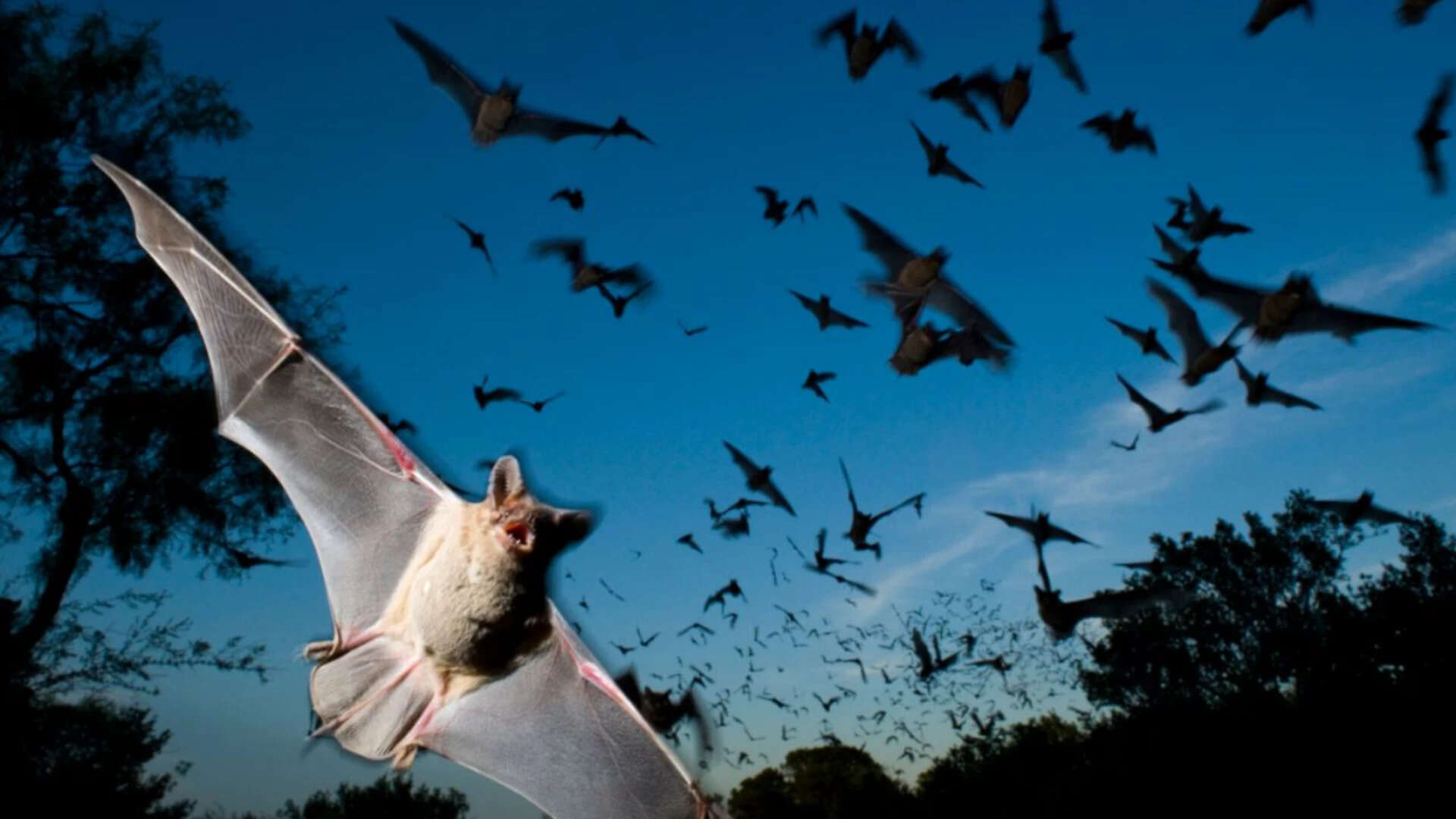
Darkness is not empty. When you stand inside a cave carved deep into the limestone of Japan, the silence does not exist. Instead, the air vibrates with an electric, breathless urgency. Thousands of bodies hang packed together, upside down, waiting for the sun to die so their own lives can begin.
Imagine living in a room where every single person is screaming at the top of their lungs, all at the exact same time, inside a space the size of a walk-in closet.
That is not a metaphor for an office building on a Monday morning. That is the physical reality of a Japanese horseshoe bat colony.
For decades, we looked at these creatures through the flat lens of our own limitations. We saw animals with oversized ears and crude leather wings, navigating the void through echolocation. We assumed they were isolated actors playing solo instruments in a chaotic orchestra. We thought every bat simply shouted its own high-pitched frequency into the void, listening for the echo to bounce off a moth or a stalactite.
We were wrong.
Science has a way of reducing wonder to a ledger of assets and liabilities. Researchers look at a roost and see dB levels, acoustic interference, and signal-to-noise ratios. They record the air. They measure the sound pressure.
And then, they find something that breaks the spreadsheet.
(Note: The following behavioral observation is drawn directly from recent bioacoustic studies on Rhinolophus ferrumequinum cornutum, the Japanese lesser horseshoe bat.)
When the colony prepares to hunt, something remarkable happens to the acoustic chaos. The cacophony narrows. It focuses. Hundreds of individual bats, each capable of emitting their own distinct frequency, begin to adjust. They shift upward. They slide downward. They bend their voices until they meet at a singular, shared pitch.
They tune in.
Why? Because shouting alone in a crowd is a fool's errand. If every bat broadcasts a random frequency, the air becomes a soup of white noise. Echoes blur. Obstacles become ghosts. A beetle fluttering ten feet away is masked by the deafening roar of your next-door neighbor.
By matching frequencies, the colony performs an act of radical, biological cooperation. They clean the room.
Consider the acoustic physics of a crowded cave. Sound waves do not simply vanish; they collide, they interfere, they drown each other out. In signal processing, this is known as jamming. Engineers spend millions of dollars trying to solve the problem of multi-user interference in cellular networks and radar systems. Bats solved it millions of years ago in the damp dark of a subterranean vault, without a single line of code, purely through evolutionary survival.
When a bat matches the frequency of its neighbor, it creates an acoustic shield. They share the acoustic space so that everyone can hear better. It is the biological equivalent of whispering in a library, except the whisper is a piercing ultrasonic wave capable of mapping a flying gnat in total blackness.
We talk about nature as a red-and-tooth claw arena. We romanticize the lone predator hunting in the moonlight. We forget that the most profound triumphs of life on Earth are often collective.
Stand in that cave for a moment. Close your eyes. Strip away the visual world that humans rely on so entirely. Imagine navigating entirely by sound, where your voice is your eyes, your hands, and your map. Now imagine thousands of other voices trying to blind you with their own noise.
The temptation in that environment is to shout louder. To crowd out the competition. To dominate the acoustic channel.
The bats chose a harder path. They listened.
They calibrated their internal oscillators—the biological engines in their larynxes—to match the prevailing frequency of the roost. They surrendered their individual noise for the collective clarity of the group. By dropping their guard, they raised their survival odds.
There is a lesson buried in the limestone, far older than human cities.
We live in an age of hyper-connectivity where we are lonelier and noisier than ever before. We blast our opinions, our content, our digital frequencies into the ether, creating a modern social cave of deafening interference. Everyone is shouting. Nobody is hearing the echo.
The Japanese horseshoe bat offers a different blueprint. It reminds us that clarity does not come from screaming louder than the person next to you. It comes from finding the common pitch. It comes from recognizing that sometimes, the only way to navigate the dark is to make sure the room is quiet enough for everyone to hear.
The sun sets outside the cave mouth. The air turns cool. A single bat drops from the ceiling, unfolds its wings, and slips into the night. Behind it, the chorus pulses—steady, unified, and brilliantly clear.