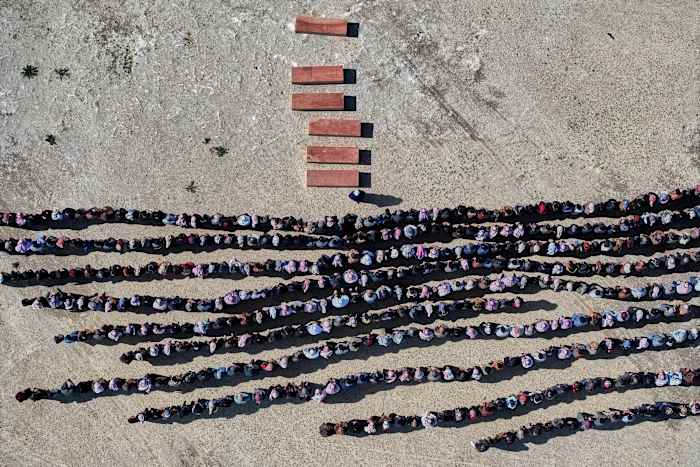
He didn't come to Lebanon to die. Like hundreds of thousands of others, Abdul-Halim Al-Akla came to find a sliver of safety after the Syrian civil war tore his original home apart. He brought his wife and his children, hoping the border crossing meant the end of the sound of falling bombs. It didn't. This week, the 44-year-old Syrian man stood over five white shrouds in a dusty cemetery in Lebanon. He buried his wife and his four children. They were killed by an Israeli strike on the building where they lived in the southern suburbs of Beirut.
The math of modern war is brutal. One missile. Five lives from one family gone. Thousands of Syrians who sought refuge in Lebanon now find themselves trapped in a terrifying loop of history. They're dying in a conflict they didn't start, in a country that was supposed to be their sanctuary. If you think the "refugee crisis" is just a headline about boats and borders, look at the dirt on Abdul-Halim’s hands.
Why Syrian families are the invisible victims in Lebanon
Most people watching the news see the geopolitical chess match. They see Hezbollah and Israel. They see the Iron Dome and the drone footage. What they miss is the demographic reality of Lebanon. This country hosts the highest number of refugees per capita in the world. When the bombs drop on residential blocks in Beirut or southern villages, they don't distinguish between Lebanese citizens and the Syrian laborers living in the basements or cheap apartments nearby.
Abdul-Halim’s family—his wife and four kids—are part of a rising death toll of Syrian nationals in Lebanon. According to the Syrian Observatory for Human Rights, hundreds of Syrians have been killed since the escalation began. These aren't combatants. These are people who were already living on the edge of poverty, working as janitors, farmers, and construction workers. They don't have bunkers. They don't have second homes in the mountains to flee to. They just have the rooms they rent, which often turn into their graves.
The trap of no return
You might wonder why they don't just go back to Syria. It’s a fair question, but the answer is grim. Many of these families fled the Assad government. Going back means risking arrest, forced conscription, or disappearance. Others have literally nothing left to go back to—their homes in Homs or Aleppo are piles of rubble. They're stuck between a war zone they left and a war zone that found them.
Lebanon is currently home to roughly 1.5 million Syrians. The social tension was already high before the strikes started. Now, with resources stretched to a breaking point, the vulnerability of these families has reached a terrifying peak. They are the first to be displaced and the last to find space in crowded schools-turned-shelters.
The human cost of the Beirut strikes
When a strike hits a densely populated area like Dahiyeh in Beirut’s south, the collateral damage isn't just a statistic. It’s a bedroom where kids were sleeping. It’s a kitchen where a mother was preparing a meal. Abdul-Halim recounted how he was out when the strike happened. He returned to find the building flattened. Imagine that walk. Imagine seeing the place where your children laughed turned into a smoking pile of grey concrete.
Reports from the Lebanese Ministry of Public Health show that the casualty rates in these residential areas are skewed heavily toward women and children. This isn't precision in the way military briefings describe it. This is a meat grinder. The funeral for Abdul-Halim’s family wasn't a state affair with flags and anthems. It was a quiet, heartbreaking moment in a graveyard where he had to say goodbye to his entire world in one afternoon.
No place left to run
The displacement in Lebanon is massive. Over a million people have moved in a matter of weeks. While Lebanese citizens are finding shelter with relatives or in government centers, Syrians often face discrimination at the door. Some shelters have reportedly turned away non-Lebanese families, citing "capacity issues" that often mask deeper xenophobia.
This forces many Syrians to sleep in parks, on the Beirut corniche, or under bridges. They're exposed, hungry, and terrified. When the sirens go off, they have nowhere to hide. They're essentially waiting for a strike to happen near them, praying the "precision" everyone talks about is real this time. It wasn't real for Abdul-Halim’s family.
The failure of international protection
The UN Refugee Agency (UNHCR) and other NGOs are doing what they can, but let’s be honest. The funding isn't there. The political will isn't there. The international community has largely moved on from the "Syrian problem," treating it as a legacy issue from 2015. But for the people on the ground, the war never ended. It just changed its coordinates.
We need to stop viewing these casualties as unavoidable side effects. When a Syrian man has to bury his entire family in a foreign land because he had no safe way to leave or hide, the global system of refugee protection has failed. It’s a total breakdown of the basic promise that if you flee a war, you won't be hunted by another one.
How the world sees the victims
There is a subtle, ugly hierarchy in how victims are reported. Sometimes, because they are "refugees," their deaths are treated as less shocking. There’s an assumption that they are used to tragedy. That’s garbage. Abdul-Halim’s children had favorite toys. They had school books. They had dreams that had nothing to do with rockets or border disputes.
The grief of a Syrian father in Beirut is identical to the grief of a father in any other city on earth. He isn't a "migrant." He isn't a "displaced person." He’s a man who lost his heart. If we lose the ability to see that, we’ve lost our own humanity in the process.
What happens next for the survivors
For those who survived the recent strikes, the future is a blank wall. The Lebanese economy is in a freefall that started years ago. The infrastructure is crumbling. Now, with the threat of a full-scale ground invasion or continued aerial bombardment, the few jobs Syrians held are disappearing.
Many are now attempting the "reverse flight" back into Syria, despite the risks. They'd rather face the devil they know in Syria than the bombs they can't predict in Lebanon. Over 200,000 people have already crossed the border back into Syria since the escalation began. It’s a desperate move. It’s the move of people who realize that nowhere is truly safe for them.
If you want to help, support organizations that don't discriminate based on nationality. Groups like the Lebanese Red Cross and MSF (Doctors Without Borders) are on the front lines treating everyone who comes through the door. Don't look away from the individual stories like Abdul-Halim’s.
The dirt in that cemetery is fresh, and it’s being moved every single day. We don't need more "holistic" strategies or "synergistic" international meetings. We need an immediate halt to the targeting of residential areas and a massive surge in aid that actually reaches the people sleeping on the streets. Anything less is just watching a slow-motion catastrophe from the sidelines.



