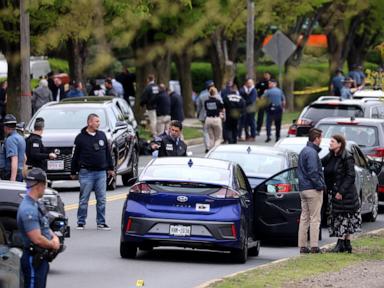
The progression of a high-profile criminal case from initial violent incident to judicial resolution is often obscured by emotional narrative, yet it functions as a rigid sequence of procedural gates and evidentiary thresholds. The recent "not guilty" plea entered by the individual accused of wounding two drivers during a shooting spree in Cambridge, Massachusetts, serves as a critical case study in the friction between public safety optics and the presumption of innocence. This analysis deconstructs the legal mechanics of the case, the ballistic variables of the incident, and the structural hurdles inherent in prosecuting multi-site urban violence.
The Triad of Prosecution Logistics
The prosecution of this specific incident relies on the convergence of three distinct evidentiary pillars. Any failure to establish a causal link within one of these pillars creates a bottleneck that the defense can exploit during the discovery phase.
- Spatial Correlation and Ballistic Continuity: The incident occurred across multiple locations in Cambridge. For the state to secure a conviction on all counts, they must provide forensic proof that the same weapon—and by extension, the same operator—was present at each coordinate. This requires a "ballistic fingerprint" (striation matching) linking recovered shell casings to a single firearm found in the defendant's possession or vicinity.
- The Intent-Action Feedback Loop: Under Massachusetts law, "Assault with Intent to Murder" requires the Commonwealth to prove a specific mental state. The defense’s "not guilty" plea forces the prosecution to demonstrate that the discharge of the firearm was not merely reckless or a result of a mental health crisis, but a calculated attempt to end life.
- Witness Reliability in High-Stress Environments: Human perception degrades under the physiological stress of a shooting. The prosecution face a challenge in synchronizing the testimony of two separate victims who were targeted while operating vehicles—a variable that introduces movement, obstructed sightlines, and rapid transit away from the threat.
Kinetic Variables of the Cambridge Incident
The mechanics of a shooting involving moving vehicles introduce complex ballistics that differ significantly from static encounters. When a projectile is fired at a vehicle, several physical constraints dictate the lethality and "success" of the act from a criminal standpoint.
- Deflection and Barrier Integrity: Automotive glass and door panels are not uniform obstacles. Depending on the angle of incidence, a round may undergo "glancing" deflection or fragment upon impact with tempered glass. The wounding of two separate drivers suggests a high volume of fire or a specific proximity that overcame these structural barriers.
- Target Acquisition in Transit: The difficulty of striking a driver in a moving vehicle implies either a high degree of "spray and pray" volatility or a deliberate engagement at intersections where velocity was low. The prosecution will likely use traffic camera data to map the defendant's movement against the victims' GPS coordinates to establish a "hunting" pattern versus a random discharge.
The Arraignment as a Strategic Pivot
The defendant’s decision to plead not guilty is a standard but critical maneuver in the Massachusetts Superior Court system. It serves as the formal rejection of the Commonwealth’s initial narrative and triggers the "discovery" clock. This phase is characterized by a strategic information asymmetry: the prosecution must reveal its evidence, while the defense remains largely opaque.
The Presumption of Innocence vs. Public Safety Detention
In cases involving firearm-related violence, the "Dangerousness Hearing" (often referred to as a 58A hearing in Massachusetts) becomes the primary theater of operation. The court must weigh the defendant’s constitutional right to pre-trial liberty against the "quantum of risk" they pose to the Cambridge community. Factors influencing this include:
- Prior criminal history and "Failure to Appear" (FTA) rates.
- The recovery of the weapon (is the instrument of the crime secured?).
- The presence of a "Target List" or evidence of premeditation, which elevates the risk profile from "random volatility" to "targeted execution."
Forensic Bottlenecks in Multi-Site Urban Shooting Cases
The complexity of this case is compounded by its urban setting. Cambridge’s density provides a wealth of digital evidence but creates a "data noise" problem for investigators.
Digital Exhaust and Surveillance Integration
The modern "Digital Canvas" of a crime scene includes private doorbell cameras (Ring/Nest), municipal ShotSpotter sensors, and automated license plate readers (ALPR). The challenge lies in time-synchronization. If the timestamp on a private camera is off by even sixty seconds, the defense can argue a "Timeline Divergence," suggesting the defendant could not have traveled from Point A to Point B in the allotted window.
The Ballistic Matching Lag
While television portrayals suggest instant matching, the Integrated Ballistic Identification System (IBIS) requires manual verification by a forensic examiner. If the firearm used was a "ghost gun" (unserialized) or modified with a "Glock switch" to allow fully automatic fire, the forensic complexity increases exponentially. A high rate of fire changes the shell casing ejection pattern, making it harder to pin a specific "firing point" in a busy street like Massachusetts Avenue or Broadway.
Judicial Trajectory and Defense Posturing
The defense will likely pivot toward one of two structural arguments as the case moves toward trial.
- The Misidentification Defense: Given that the shooter was likely in a vehicle or obscured by the chaos of the event, the defense will scrutinize the "Identification Procedure." If the police used a "show-up" identification (bringing a witness to see a suspect in handcuffs shortly after the arrest), the defense will file a Motion to Suppress, arguing the process was "unnecessarily suggestive."
- The Diminished Capacity Framework: If the evidence of the shooting itself is overwhelming (e.g., clear video of the defendant), the strategy shifts from "who did it" to "why they did it." This involves exploring the defendant’s psychological state. In Massachusetts, a "lack of criminal responsibility" defense requires proving that a mental disease or defect rendered the defendant unable to appreciate the wrongfulness of their conduct or unable to conform their conduct to the law.
The Economic and Social Cost of Judicial Delay
The "not guilty" plea ensures that this case will likely remain in the system for 18 to 24 months. During this period, the "Cost of Prosecution" scales vertically.
- Resource Allocation: Multiple ADA (Assistant District Attorney) hours, expert witness fees for ballistics, and the sequestration of evidence.
- Victim Erosion: Over a two-year period, witness memory fades, and the emotional drive to participate in a trial often diminishes, leading to "witness unavailability" which can force a dismissal or a reduced plea deal.
The state’s objective is to maintain a "high-pressure discovery" environment, providing enough evidence early on to force the defendant into a change of plea (guilty) in exchange for a sentencing cap. This avoids the "Trial Penalty"—the significantly longer sentence often handed down by judges if a defendant is found guilty after a full trial.
The tactical path forward for the prosecution requires a synthesis of ballistic data and digital breadcrumbs to eliminate the possibility of a "secondary shooter" or "wrongful identification." For the defense, the objective is to introduce "Reasonable Doubt" by attacking the integrity of the crime scene perimeter and the reliability of eyewitnesses under fire. The outcome hinges not on the obviousness of the violence, but on the technical precision of the evidence linking the man in the dock to the trigger pull at every coordinate in the Cambridge spree.
Strategic success in this litigation will be determined by the "Chain of Custody" for the digital evidence. If the prosecution fails to authenticate every second of surveillance footage through a rigorous forensic audit, the defense will successfully move to exclude the very images that define the public's perception of the crime. Legal teams must prioritize the "Hard Data" of cell site location information (CSLI) over the "Soft Data" of eyewitness accounts to build a baseline that survives cross-examination.