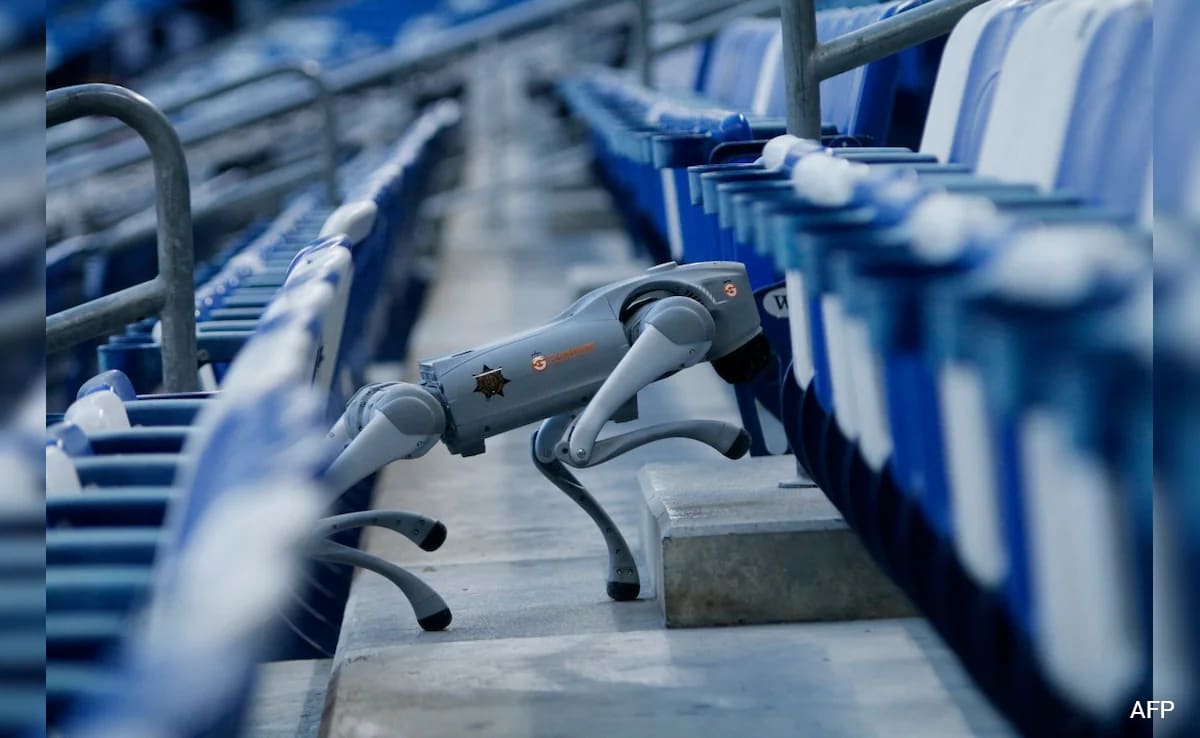
The defense industry loves a good photo opportunity, and nothing says media bait quite like a quadrupedal robot with an automatic rifle bolted to its spine. On June 2, 2026, Taiwan’s National Chung-Shan Institute of Science and Technology proudly paraded three modified Ghost Robotics quadrupeds in Taipei. The narrative sold to the public was comforting: these autonomous, four-legged sentries could solve the staffing nightmare on the remote, contested outposts of the Spratly and Pratas Islands, patrolling beaches in the grueling heat so human coast guards do not have to.
It is a neat, high-tech solution to a brutal geopolitical problem. It is also an absolute tactical delusion. Meanwhile, you can read other events here: The Sterile Mosquito Illusion Why Big Techs Biotech Bets Wont Save Us From Dengue.
Deploying a handful of bespoke, expensive, American-designed robot dogs to guard isolated sandbars in the South China Sea is not a strategic masterstroke. It is a fundamental misunderstanding of modern automated warfare. While Taipei celebrates a media demonstration of three machines, Beijing is already integrating mass-produced, heavily subsidized "robot wolfpacks" into its amphibious assault doctrines. Taiwan is investing in a handful of high-maintenance status symbols; China is building a swarm.
The Logistics of a Remote Sandbar Death Trap
The primary justification for sending quadrupeds to islands like Itu Aba or the Pratas is human scarcity. These outposts have no local civilian populations, are incredibly difficult to resupply, and feature punishing environments of salt spray, extreme humidity, and intense heat. The defense establishment views the robot as the ultimate tire-free sentry. To explore the full picture, check out the detailed article by The Next Web.
Let's dissect the reality of maintaining complex electronics in a maritime environment. Saltwater is an aggressive corrosive agent. Fine sand destroys exposed gears, actuators, and optical sensors within days if not meticulously maintained. A human marine can clean their rifle and wipe down their gear with a rag. A quadrupedal robot relies on sealed joints, specialized lubricants, and pristine camera lenses to execute basic spatial mapping.
Consider the energy math. A standard military-grade quadrupedal platform delivers between two and four hours of operational runtime before requiring a battery swap or a dedicated charging dock. If an island perimeter requires continuous surveillance, you do not need one robot; you need a rotation of four or five per patrol route, alongside a hardened, climate-controlled charging infrastructure.
If a conflict breaks out, these islands are not meant to be held indefinitely; they are early-warning tripwires. Placing a weapon on a platform that requires constant local infrastructure and lacks the basic cognitive flexibility to unjam its own rifle in a sandstorm is a massive misallocation of defense capital.
The Illusion of Asymmetric Sentry Tech
Defense analysts often fall into the trap of assuming that any unmanned system automatically confers an asymmetric advantage to the defender. This is a false premise. For a technology to be asymmetric, it must be cheap enough to deploy in numbers that overwhelm the economic calculations of the aggressor.
Taiwan’s current approach relies on importing premium platforms from Western suppliers like Ghost Robotics, then retrofitting proprietary reconnaissance and firepower modules onto their chassis. This is an expensive, boutique engineering pipeline.
Contrast this with the adversarial reality. Late last year, the People’s Liberation Army demonstrated its own operational transition during amphibious assault exercises. The PLA deployed clusters of domestic quadrupedal robots—dubbed "robot wolves"—built on consumer-scale supply chains from companies like Unitree, which mass-produces platforms for a fraction of the cost of Western military alternatives.
These adversarial systems are powered by localized hardware like Huawei’s Ascend processors, enabling a single human operator to coordinate an entire cluster of eight machines simultaneously. They are designed to be explicitly disposable. They drop from the ramps of air-cushioned landing craft, withstand seawater submersion during the final sprint to the beach, and clear minefields by taking the blast.
Taiwan is treating the robot dog as an invaluable, long-term asset to be preserved on a quiet perimeter. The adversary treats them like high-velocity, autonomous ammunition. You cannot win a war of attrition when your defensive unit costs fifty times more than the offensive unit designed to liquidate it.
The Software Bottleneck
The physical hardware of a quadruped is only as effective as the edge computing driving its navigation and target acquisition. In a clean media hall in Taipei, a robot dog looks flawless navigating small obstacles. On a shifting beachhead under active electronic jamming, it becomes an expensive paperweight.
True autonomy in a combat zone requires massive onboard processing power that does not rely on a constant connection to a localized network or satellite link. If the communications link is severed by electronic warfare assets, a remote-controlled or semi-autonomous sentry reverts to its base programming: it either sits down and waits for instructions, or it attempts to return to its home beacon. In either scenario, its tactical utility drops to zero.
Furthermore, an armed autonomous sentry introduces immense liabilities in grey-zone scenarios. The South China Sea is characterized by ambiguity—fishing vessels, maritime militia, and close-quarters posturing. Programming a machine to accurately differentiate between an unarmed civilian fisherman seeking shelter from a storm and an active commando unit attempting a covert landing is an incredibly high bar for computer vision. A false positive triggers an international incident; a false negative results in the loss of the platform.
Redefining the Robotic Sentry
If the goal is to secure far-flung islands without wasting human lives, Taiwan must abandon the desire for visually impressive walking biotics and focus on hidden, distributed attrition.
Instead of mobile quadrupeds that draw immediate attention and require complex mechanical maintenance, the focus should shift toward low-profile, static, subterranean sensor nests. Imagine a matrix of partially buried, solar-assisted monitoring pods that remain dormant until triggered by acoustic, seismic, or thermal anomalies. They do not walk boundaries; they wait.
When triggered, these units do not fire a single mounted rifle. They launch micro-drones or direct precision rocket fire from hidden, hardened silos elsewhere on the island. This achieves the exact same operational outcome—continuous surveillance and lethal denial—without the mechanical vulnerability, high unit cost, and logistical overhead of a walking machine.
The desire to put a gun on a robotic dog is driven by a psychological need to match the visual paradigm of modern military cinema. It makes for excellent propaganda, but poor strategy. Taipei must stop trying to match its adversary machine-for-machine in a category where the adversary owns the global manufacturing supply chain. True defense innovation means building systems that make the enemy's expensive new toys irrelevant.