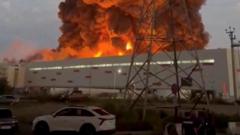
The strategic targeting of commercial e-commerce infrastructure represents a major evolution in economic warfare. By striking central fulfillment hubs belonging to Wildberries—Russia’s dominant digital marketplace—long-range strike campaigns have disrupted the physical distribution channels that support consumer retail and dual-use supply flows.
Analyzing these disruptions requires moving past surface-level news reports and evaluating the structural vulnerabilities of centralized fulfillment networks under asymmetric attack.
The Network Effect Vulnerability: Hub-and-Spoke Fragility
Modern e-commerce platforms rely on hyper-concentrated hub-and-Spoke network topologies to maximize margin efficiency. Large regional fulfillment centers (RFCs) consolidate inventory management, automated sorting, and long-haul transport. This model minimizes marginal distribution costs under standard operating conditions, but creates severe single-point-of-failure risks during physical disruptions.
       [ Regional Fulfillment Center (RFC) ]  <--- High-Volume Target Concentration
                      /     |     \
                     /      |      \
        [Sorting Hub] [Sorting Hub] [Sorting Hub]
             /   \         /   \         /   \
          (PUDO) (PUDO) (PUDO) (PUDO) (PUDO) (PUDO)  (Pick-Up / Drop-Off Outlets)
The destruction of critical nodes—such as the 250,000-square-meter Elektrostal facility near Moscow and the 108,000-square-meter Kotovsk facility in the Tambov region—erases significant fixed inventory capacity instantly. When a network loses 7% to 10% of its total operational warehouse footprint within days, systemic capacity bottlenecks cascade through every layer of the supply chain:
- Inventory Sinks: Merchant inventory stored at targeted fulfillment centers is destroyed instantly, creating severe capital losses for third-party sellers.
- Dynamic Ingress Bottlenecks: Inbound inventory routes must be immediately redirected to surviving secondary nodes. This sudden surge overloads sorting systems, creating severe intake delays across adjacent facilities.
- Egress Delays: Outbound delivery times spike exponentially as localized delivery points (PUDO points) lose steady inventory streams, increasing operational friction across consumer markets.
The Cost Function of E-Commerce Kinetic Risk
The economic fallout from physical attacks on retail infrastructure extends far beyond the immediate value of destroyed real estate. Total losses can be framed through a three-part cost model:
$$\text{Total Economic Loss} = C_{\text{Asset}} + C_{\text{Inventory}} + C_{\text{Systemic Market}}$$
Where:
- $C_{\text{Asset}}$ (Direct Capital Expenditure Loss): The expense required to clear, rebuild, and re-equip automated logistics facilities. Rebuilding costs for modern industrial warehouse space range between 60,000 and 100,000 rubles per square meter, placing direct structural replacement costs between 22 billion and 36 billion rubles.
- $C_{\text{Inventory}}$ (Working Capital Destruction): The wholesale and retail value of stock held within destroyed facilities. Estimates place merchant inventory losses at up to 150 to 170 billion rubles.
- $C_{\text{Systemic Market}}$ (Friction and Insurance Surcharges): The structural cost increases passed down to sellers, carriers, and end consumers as risk premiums rise across the economy.
+-------------------------------------------------------------------------------+
|                       ESTIMATED DIRECT ECONOMIC LOSSES                        |
+----------------------------------+--------------------------------------------+
| Structural Reconstruction Cost   | 22B – 36B Rubles ($270M – $450M USD)       |
+----------------------------------+--------------------------------------------+
| Merchant Inventory Destruction   | 150B – 170B Rubles ($1.9B – $2.1B USD)     |
+----------------------------------+--------------------------------------------+
| Total Direct Economic Impact     | Up to 200B+ Rubles (~$2.5B USD)            |
+----------------------------------+--------------------------------------------+
Liability Transfer and Merchant Insolvency Cascades
The operational dynamic following these strikes highlights a critical shift in platform liability policy. Weeks prior to these events, major regional e-commerce operators updated merchant service agreements to include expanded force majeure clauses. Under these revised terms, platforms explicitly disclaimed financial liability for inventory destroyed by military action, drone strikes, or security disruptions.
Force Majeure Risk Allocation: By shifting kinetic risk to third-party merchants, marketplace operators protect their own balance sheets while passing structural losses down to small and medium enterprises (SMEs).
This liability transfer triggers a predictable series of economic failures:
- Capital Depletion: Merchants holding high concentrations of inventory in single fulfillment nodes lose working capital instantly, wiping out months or years of retained earnings.
- Credit Default Spikes: Third-party sellers frequently finance inventory acquisitions using short-term commercial lines or working capital loans. Uncompensated stock destruction leads directly to debt defaults.
- Supply Chain Contraction: Depleted merchant equity reduces future inventory purchases, shrinking product availability across marketplace categories and pushing secondary prices higher.
Dual-Use Integration and Strategic Target Selection
Beyond consumer retail, modern e-commerce networks serve as dual-use logistics backbones during war. High-capacity, highly digitized distribution networks excel at processing micro-procurements—such as commercial drone parts, thermal optics, secure radios, and navigation modules—and delivering them directly to operational units.
[ Dual-Use Procurement Flow ]
    │
    ├── Micro-Sourced Components (Transistors, GPS, Optics)
    │     │
    │     ▼
    ├── Merchant Ingress into E-Commerce Hubs (Wildberries RFCs)
    │     │
    │     ▼
    ├── Consolidated Commercial Transit Networks
    │     │
    │     ▼
    └── Rapid Forward Delivery to Border and Operational Zones
By striking these central facilities, kinetic operations hit two targets at once: they disrupt the domestic consumer economy while creating immediate bottlenecks in civilian-grade military procurement lines.
Strategic Adaptation: Decentralization and Cost Penalties
To maintain operational continuity under sustained kinetic threat, e-commerce platforms must pivot from efficiency-optimized networks to resilient distribution models. This shift forces three major structural changes:
Efficiency-Optimized Network          Resilient / Decentralized Network
  (Low Unit Cost, High Vulnerability)    (Higher Unit Cost, Higher Redundancy)

     [ Mega Regional Hub ]                   [ Hub ]    [ Hub ]    [ Hub ]
      /   |   |   |   \                     /   \      /   \      /   \
    [S]  [S] [S] [S]  [S]                 [S]   [S]  [S]   [S]  [S]   [S]
1. Geographic Dispersal
Platforms must replace centralized multi-hundred-thousand-square-meter mega-hubs with networks of smaller, geographically separated distribution points. This strategy reduces the loss footprint of any single strike, but it sacrifices the economies of scale that keep handling costs low.
2. Multi-Node Inventory Duplication
To maintain delivery speed without relying on single regional hubs, merchants must split stock across multiple facilities. This safety-stock approach increases holding costs and requires substantially more working capital to sustain identical sales volumes.
3. Capital-Intensive Defensive Measures
Logistics operators face rising capital requirements to install physical defense systems—such as anti-drone netting, localized signal jamming equipment, and expanded perimeter security teams—at key fulfillment nodes.
Decentralization preserves business continuity under attack, but it permanently lowers platform margins and drives consumer prices higher across the entire e-commerce ecosystem.