The explosion tore through the evening air of a provincial French town, leaving a seventeen-year-old boy with a severed hand and an irreversible disability. This was not the result of an industrial accident or a rogue explosive device. It was the outcome of a standard police dispersal operation employing a munition that has transformed routine crowd control into a theater of severe trauma. For years, human rights organizations, parliamentary observers, and street medics have tracked an escalating pattern of catastrophic injuries caused by French law enforcement munitions. Yet, the playbook remains unchanged.
When a kinetic grenade or sting-ball device lands in a crowd, the calculation made by the state is simple dispersal at any human cost. That calculation demands closer inspection. Read more on a related subject: this related article.
The Anatomy of a Public Order Munition
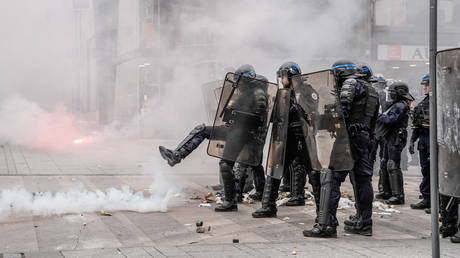
To understand how a teenager loses a hand during a street demonstration, one must examine the specific hardware issued to French security forces. The GLI-F4 and its successor models are not traditional tear gas canisters. They are classified as offensive dispersion weapons containing a heavy charge of explosive material combined with CS gas. When detonated, they generate a massive concussive blast alongside a chemical agent cloud.
The blast is powerful enough to shatter concrete or blow off limbs if intercepted at close range. French tactical units rely on these devices to clear space when conventional baton charges or water cannons fail to break up determined groups. The official doctrine dictates that these grenades should be thrown at a specific angle to bounce across the pavement, minimizing direct impact velocity. In the chaos of a moving street protest, theory and practice rarely align. Smoke, panicked crowds, and uneven terrain mean these explosives frequently land directly among pedestrians or are instinctively swatted away by protestors before detonation. Further reporting by BBC News explores related perspectives on the subject.
That instinctive reaction—raising a hand to bat away a smoking canister hurtling toward one's face—is precisely where the structural failure of the tactic becomes lethal to bodily integrity. A fraction of a second of panic turns into permanent disfigurement.
The Doctrine of Disproportionate Force
Public order policing in France occupies a unique space within Western democracies. The tradition of maintien de l'ordre has historically prioritized reclaiming public space and neutralizing perceived threats through overwhelming displays of force rather than negotiation or containment. When social unrest flares—whether over pension reforms, fuel taxes, or police accountability—the state deploys specialized mobile units trained for high-intensity confrontation.
This approach creates a dangerous feedback loop. As protestors anticipate aggressive tactics, they alter their gear, wearing helmets, goggles, and gas masks. In response, security forces escalate their munitions to pierce that defensive posture. The result is a technological arms race on public streets, with citizens caught in the crossfire of escalating state power.
Critics within the legal community argue that the deployment of explosive grenades against civilian populations violates foundational principles of proportionality enshrined in international human rights law. Law enforcement agencies counter that their personnel face extreme hostility and require potent tools to maintain public safety against violent elements embedded within demonstrations. That argument loses its footing when the statistics show a consistent tally of bystanders, journalists, and peaceful protestors sustaining life-altering trauma from weapons originally designed for military battlefields.
The Institutional Wall of Silence
Following every high-profile incident involving severe mutilation, a predictable ritual unfolds. The initial news breaks via social media and local reporting. Eyewitness accounts contradict official police statements. The internal inspectorate launches an inquiry. Months or years later, a report trickles out, often concluding that the officer in question acted within operational guidelines or that individual culpability cannot be definitively established due to the fog of operations.
Accountability in these cases is notoriously difficult to secure. The anonymity provided by tactical helmets, combined with the collective nature of unit deployments, shields individual shooters and commanders from direct legal consequences. Administrative courts occasionally award financial compensation to victims, but the systemic authorization of the weapons remains intact. The state pays out damages while continuing to purchase and deploy the exact same hardware.
This cycle erodes public trust in the institutions meant to protect civil society. When young people view law enforcement not as a public service but as a physical threat, the social contract frays.
Beyond the Battlefield Streets
The integration of military-grade munitions into everyday urban policing reflects a broader militarization of the state apparatus. Weapons built to disable combatants in war zones have no legitimate place in managing civil dissent. As long as ministries prioritize rapid dispersal over de-escalation and dialogue, more teenagers will pick up smoking canisters, and more families will deal with the catastrophic aftermath of a state-sanctioned explosion. The true cost of this policing strategy is measured in flesh, bone, and a steadily deepening democratic deficit.