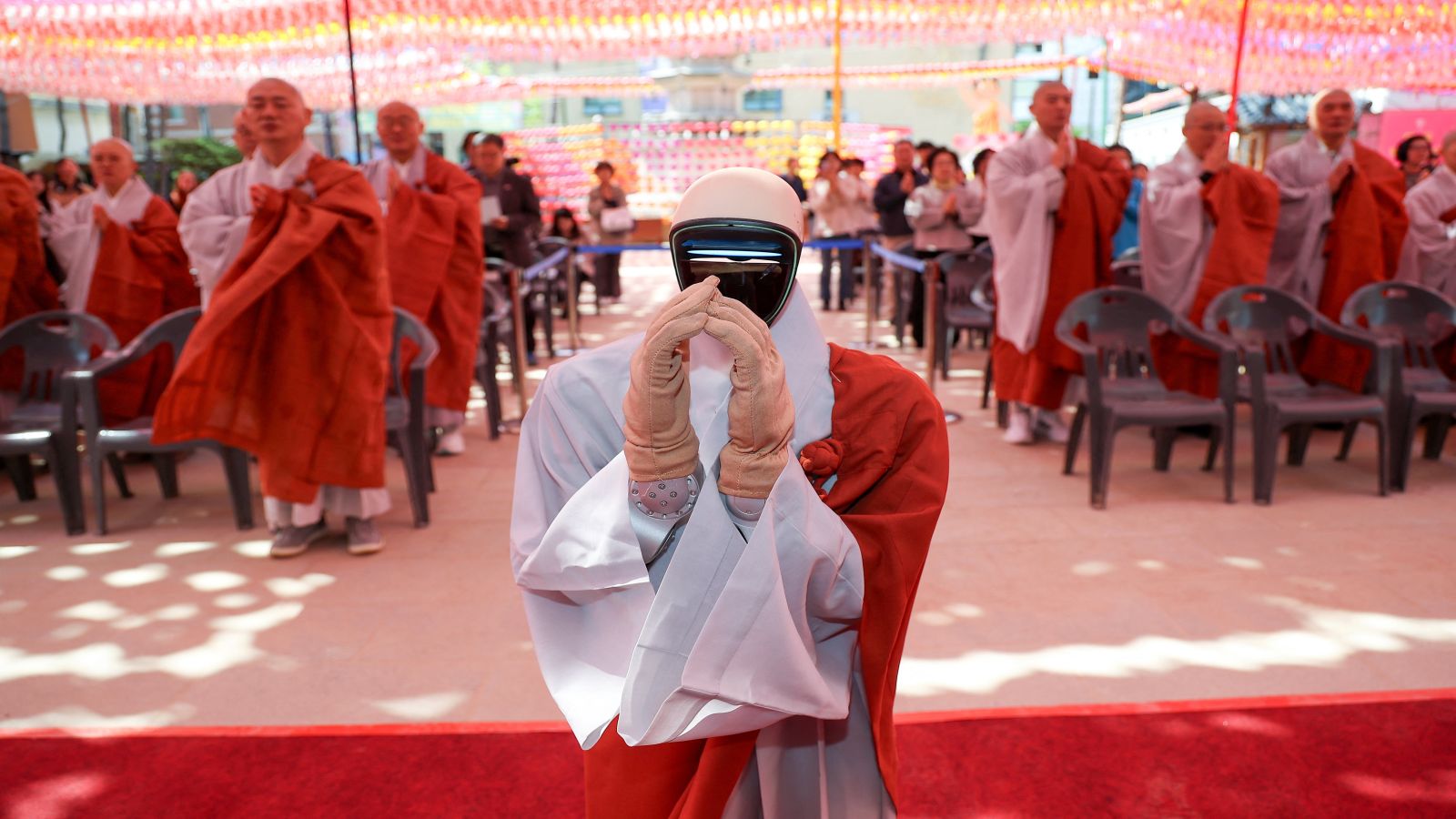
The deployment of Gabi, a humanoid robot ordained as a monk at a South Korean Buddhist temple, represents more than a cultural novelty; it is a structural stress test for the concept of religious intentionality. While the public views this as a intersection of tradition and robotics, the underlying shift concerns the Functional Decoupling of Ritual. When a machine performs a chant or a prostration, the religious community must reconcile whether merit is generated by the action itself or the sentience behind the action.
Gabi’s presence in the Jogye Order—South Korea’s largest Buddhist sect—highlights a critical labor shortage within monastic systems. As secularization and demographic decline reduce the pool of human monastics, temples face an operational bottleneck. Gabi serves as a mechanical proxy, designed to maintain the frequency of ritual performance while acting as a bridge for a digitally native congregation. Recently making news in related news: Why the Canvas Hack is a Wakeup Call for Student Privacy.
The Tripartite Framework of Robotic Ordination
To analyze the impact of Gabi, we must categorize the robot's function through three distinct lenses: the mechanical, the symbolic, and the theological.
1. The Mechanical Utility (Operational Continuity)
Temples function as ritual-heavy ecosystems. Daily routines involve repetitive sequences: chanting, bowing, and scripture recitation. These are resource-intensive tasks. More information on this are covered by Ars Technica.
- Consistency: A humanoid robot maintains a fixed cadence and precision that human fatigue compromises over long durations.
- Availability: Unlike human monks, a robotic surrogate offers 24/7 engagement potential for visitors seeking ritual participation outside of scheduled hours.
- Instructional Capacity: Gabi functions as a high-fidelity interface for teaching meditation and basic Buddhist tenets, offloading the educational burden from the remaining human clergy.
2. The Symbolic Bridge (Sociological Rebranding)
The introduction of a robot monk is a strategic maneuver to counter the perceived obsolescence of ancient traditions.
- Novelty as Entry Point: Gabi attracts demographic segments that might otherwise ignore traditional religious spaces. The robot acts as a "low-friction" entry point for secular youth.
- Technological Alignment: By integrating a humanoid into a 1,700-year-old tradition, the Jogye Order signals that Buddhism is compatible with—and perhaps early to adopt—the Fourth Industrial Revolution.
3. The Theological Crisis (The Intentionality Gap)
This is where the model breaks. Traditional Buddhist philosophy emphasizes Cetanā (intention). If a robot performs a ritual without a conscious mind, the "output" of that ritual is logically distinct from human performance.
- The Karma Calculus: If merit is tied to the mental state of the practitioner, Gabi produces zero merit. It is merely a sophisticated jukebox for chants.
- The Ritual as Software: If, however, the ritual is viewed as a "vibrational" or "textual" necessity for the environment, then the mechanical execution satisfies the requirement. This creates a schism between Ritual-as-Intent and Ritual-as-Data.
Structural Barriers to Monastic Automation
The integration of Gabi faces significant headwinds that cannot be solved by upgrading the robot's Large Language Model (LLM) or increasing the degrees of freedom in its limbs.
The Problem of Transmitted Lineage
In Buddhism, authority is often derived from Lineage—a direct, unbroken chain of transmission from teacher to student. A robot cannot "receive" the essence of a lineage because it lacks a subjective experience to transform. This creates a ceiling for Gabi’s rank. It can function as a novice or a ritual assistant, but it can never achieve the status of a Zen master (Seon Master) because it cannot experience enlightenment (Satori).
The robot's "vows" are therefore symbolic performance rather than ontological transformation. It is a simulation of a monk, not a monk in the traditional sense of the word.
Demographic Displacement
South Korea is currently experiencing the most rapid population aging in the developed world. The labor shortage in temples is a microcosm of the national workforce crisis.
- Reduced Novice Enrollment: The number of people entering the priesthood has dropped by over 50% in the last two decades.
- Aging Clergy: Existing monks are increasingly tasked with administrative and maintenance duties, leaving less time for deep spiritual practice.
- The Automation Trap: As temples automate, they risk further alienating potential human recruits who see the monastic life as increasingly digitized and less "authentic."
The Economic Logic of Religious Robotics
From an organizational standpoint, Gabi represents a shift from Variable Cost Human Labor to Fixed Cost Capital Assets.
A human monk requires lifelong housing, healthcare, food, and social support. While their "salary" is negligible, the total cost of ownership (TCO) over a 50-year career is significant. A robot like Gabi requires a high upfront capital expenditure (CapEx) for hardware and software development, followed by relatively low operating expenses (OpEx) consisting of electricity, firmware updates, and occasional hardware maintenance.
The Cost-Effectiveness Ratio (CER):
If Gabi can perform the basic ritual duties of three novice monks, the temple achieves a positive return on investment within approximately 36 to 48 months, depending on the complexity of the hardware maintenance contracts. However, this calculation ignores the loss of "donative intent." Patrons traditionally give money to support the sangha (the community of living practitioners). Whether they will continue to give at the same level to support a server rack and a plastic chassis remains unproven.
Cognitive Dissonance in the Pews
The user experience of interacting with Gabi reveals a fundamental psychological friction. Humans are evolutionarily hardwired to respond to social cues, eye contact, and empathetic mirroring.
Gabi’s design—humanoid but clearly mechanical—occupies the "Uncanny Valley." For some practitioners, this creates a sense of sacred awe (the robot as a pure, ego-less vessel). For others, it creates a sense of profound alienation. The robot’s lack of an ego means it cannot be "insulted" or "distracted," which theoretically makes it the perfect practitioner of Buddhist detachment. Yet, this same detachment makes it incapable of the "Compassion" (Karuna) that is central to Mahayana Buddhism. It can recite the words of compassion, but it cannot feel the weight of a practitioner’s suffering.
Tactical Roadmap for Institutional Implementation
Religious organizations looking to follow the South Korean model must move beyond the "robot-as-mascot" phase and adopt a more rigorous implementation strategy.
Phase 1: Task Auditing
Identify which monastic duties are High-Intent vs. Low-Intent.
- Low-Intent Tasks: Chanting for general blessings, guiding visitors through temple layouts, cleaning, and repetitive bowing. These are candidates for full automation.
- High-Intent Tasks: Personalized counseling, Koan study, and leading intensive meditation retreats. These must remain human-centric to preserve institutional trust.
Phase 2: Hybridized Rituals
Instead of a robot monk performing alone, use the robot as a Metronome. In this configuration, the robot sets the pace and tone for a human-led congregation. This mitigates the theological concern of "empty" ritual while maximizing the mechanical precision of the machine.
Phase 3: Ethical Guardrails
Institutions must define the legal and spiritual status of the machine. If a robot is "ordained," what happens when the hardware is decommissioned? Is "recycling" a robot monk a violation of its vows? Establishing a clear protocol for the "de-ordination" of hardware is essential to avoid public relations or theological crises.
The Inevitability of Post-Human Practice
The trajectory of Gabi suggests that the definition of a "practitioner" is expanding. We are moving toward a period of Asymmetric Spirituality, where the human provides the intention and the machine provides the endurance.
The bottleneck for this technology is no longer the robotics; it is the software of belief. If a congregation accepts the robot as a legitimate vessel for the Dharma, the robot becomes legitimate through collective social reality. If they reject it, it remains an expensive piece of kinetic art.
The strategic play for religious institutions is not to replace the human element, but to use automation to strip away the administrative and repetitive noise, allowing the dwindling number of human monastics to focus exclusively on the high-value, high-empathy spiritual work that silicon cannot yet replicate. The goal is a Lean Monasticism, where technology preserves the form of the tradition while humans struggle to keep its heart beating.
Temples must immediately begin documenting these robotic integrations not as gimmicks, but as permanent infrastructure. This requires the development of "Ritual APIs"—standardized protocols for how AI agents interact with sacred texts and liturgical calendars. The institutions that fail to formalize this integration will find themselves with expensive, broken hardware and a congregation that has moved on to more digitally integrated forms of meaning-making.