The tennis industry thrives on a massive, expensive lie.
Every year, major brands roll out a glossy menu of "must-have" gear. They tell beginners they need a lightweight, oversized frame to "forgive" their mistakes. They tell intermediate players they need stiff, spin-focused polyester strings to mimic Carlos Alcaraz. They sell you $150 shoes with proprietary foam, vibration dampeners that supposedly save your tendons, and custom weighted tape to optimize your swing weight.
It is all marketing theater.
I have spent two decades on the court, coached hundreds of players, and watched recreational athletes burn thousands of dollars on equipment that actively destroys their mechanics. The conventional wisdom found in gear roundups is a recipe for tennis elbow and a plateaued rating.
If you want to actually get better at this sport, you need to stop buying what the brands are selling. You need to dismantle the lazy consensus of consumer tennis.
The Oversized Racket Scam
Look at any gear guide for beginners or casual players. They will inevitably steer you toward a racket with a 110-square-inch head, a feather-light static weight, and a hefty price tag.
This is malpractice.
Lightweight, head-heavy, oversized rackets are engineered for one thing: to let people with terrible form push the ball over the net without bending their knees or rotating their hips.
Imagine a scenario where you learn to drive in a car that automatically steers away from curbs. You never actually learn where the wheels are. That is what a "game-improvement" racket does. It masks structural flaws in your stroke. Because the racket is so light, you use your wrist and elbow to flip the ball over the net instead of engaging your core and legs.
The Physics of Arm Pain
When a tennis ball hits a racket, momentum transfers. If the racket lacks mass, the shock of that 60 mph ball travels straight past the frame and into your tendons.
- Light frames (under 290 grams unstrung): They flutter on impact. Your forearm muscles must contract violently just to keep the racket stable.
- Heavy frames (over 305 grams unstrung): The mass of the racket plows through the ball. The frame absorbs the collision, not your elbow.
By buying a light racket to make the game "easier," you are guaranteeing a date with a physical therapist. Beginners should start with a standard 98 to 100-square-inch frame weighing at least 300 grams. Force yourself to learn how to prepare early and swing with your body. It will feel heavy for exactly two weeks. After that, your shoulder will thank you, and your ceiling as a player will double.
The Polyester Obsession is Ruining Your Forehand
The "People Also Ask" sections of the internet are flooded with recreational players asking: "What strings give the most spin?"
The automatic answer from big-box retailers is always co-poly. Polyester strings like Luxilon Alu Power or Babolat RPM Blast. Every pro on television uses them, so naturally, the 3.5 player at the local club thinks they need them too.
Here is the brutal truth: unless you are generating massive racket head speed with an aggressive, vertical swing path, polyester strings turn your racket into a literal wooden board.
String Type       | Elasticity | Tension Maintenance | Target Player
------------------|------------|---------------------|----------------------
Natural Gut       | Maximum    | Excellent           | Everyone (Too expensive for most)
Multifilament     | High       | Good                | Recreational / Intermediate
Polyester (Co-poly)| Extremely Low | Terrible            | Advanced / Hard Hitters Only
Polyester strings do not inherently "create" spin. They allow players who already swing at violent speeds to keep the ball inside the lines through a mechanical phenomenon called snap-back.
If your swing is slow or flat, polyester does nothing for you. In fact, it loses its tension within 4 to 6 hours of play. Once a poly string goes dead, it becomes a stiff, vibration-transmitting wire. If you are not restringing your racket every two weeks, and you are playing with poly, you are actively damaging your arm and killing your depth.
Switch to a high-quality multifilament like Technifibre X-One Biphase, or a classic synthetic gut. It is softer, holds tension longer, and provides the depth you actually need. Stop pretending you have Alcaraz's racket head speed. You don't.
Vibration Dampeners Do Absolutely Nothing
Let us kill this myth once and for all.
That little piece of rubber you stick between your strings near the throat of the racket? It does not prevent tennis elbow. It does not reduce the shock traveling up your arm.
The American Orthopedic Society for Sports Medicine looked into this decades ago. The data is clear: dampeners only change the acoustic frequency of the string bed. They turn a high-pitched ping into a dull thud.
That is it. It is a sound modifier.
If you like the sound, great. Keep using it. But do not buy a $20 branded piece of plastic thinking it is a medical device. If your arm hurts, the problem is either your stiff polyester strings, your featherweight racket, or your late contact point. A piece of rubber shaped like a smiley face cannot fix bad physics.
Shoes: Stop Buying the Hype, Buy the Outsole
The shoe market is an exercise in distraction. Brands talk about proprietary foam matrices, carbon-fiber shank plates, and engineered mesh uppers.
Ignore all of it. Tennis is a sport of friction and lateral arrest. The only component of a tennis shoe that matters is the outsole compound and the upper's lateral stability.
If you are a recreational player, you do not need the ultra-lightweight shoe that compromises on structural support just to shave off an ounce. You need a shoe with a heavy, durable rubber compound (like Asics' AHAR or Adidas' Adiwear) and a rigid midfoot shank to prevent your ankle from rolling when you change direction.
Yes, these shoes feel bulky when you try them on in a store. They do not feel like your running shoes. They aren't supposed to. Running shoes are designed for forward momentum; tennis shoes are brakes for your feet. If a tennis shoe feels like a cloud when you put it on, it will fail you the moment you try to slide or cut hard on a hard court.
The Minimalist Toolkit: What You Actually Need
If 80% of commercial tennis gear is useless fluff designed to separate you from your money, what actually moves the needle? The list is incredibly short, unglamorous, and highly effective.
1. High-Quality Tourna Grip
Do not worry about the fancy replacement grips that come on your racket. Buy a multi-pack of classic light-blue Tourna Grip. It absorbs sweat better than anything else on the market. A slippery handle causes you to squeeze the racket tighter, which freezes your wrist and leads to rigid, error-prone strokes.
2. A Video Tripod (Not a New Racket)
If you have $250 to spend to improve your game, do not buy a new frame. Buy a cheap phone tripod and record your matches.
Recreational players have a massive disconnect between what they think they are doing and what they are actually doing. You think you are bending your knees and hitting the ball out in front. The video will show you standing completely upright, hitting the ball behind your hip. Seeing that reality is worth more than any technology Wilson or Head can engineer into a piece of graphite.
3. A Pressureless Ball Basket for Practice
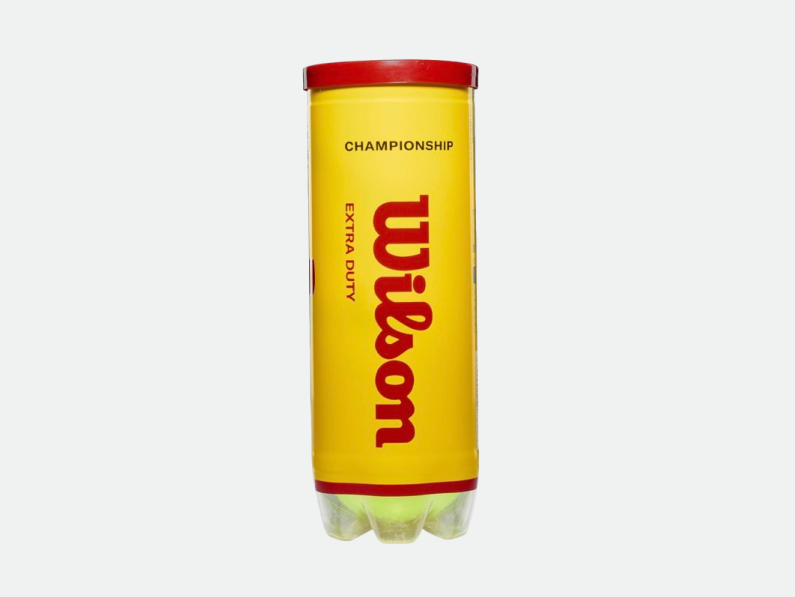
Stop buying canisters of three standard pressurized balls, hitting with them until they go flat in a week, and then playing with dead bounces. If you want to improve, you need volume. Buy a basket and a 60-pack of pressureless balls (like Tretorn Micro X). They don't lose bounce over time because they rely on a structural inner core rather than air pressure. You can practice your serve for a year without hitting a single dead ball.
The Catch to the Minimalist Approach
There is a downside to stripping away the gear consumerism. When you stop buying the "forgiving" rackets and the "spin-enhancing" strings, you lose your excuses.
When you hit a ball into the bottom of the net, you can no longer blame the tension or the frame. It was your footwork. It was your spacing. It was your technique.
That is a terrifying realization for most club players. It is much easier to buy a new $300 racket than it is to spend six weeks drilling your footwork to ensure you hit the ball in front of your body.
But gear cannot buy a rating. The industry wants you to believe that performance comes in a box. It doesn't. Mass protects your arm, soft strings give you depth, and everything else is just marketing noise designed to fund the pro tour.
Throw away the gadgets. Buy a heavy frame with soft strings, record your ugly footwork on video, and start doing the actual work.