Fear has a distinct rhythm. On Broadway, it usually beats in time with the conductor's baton, predictable and structured. But on the first Monday in May, inside the Metropolitan Museum of Art, the rhythm was entirely chaotic.
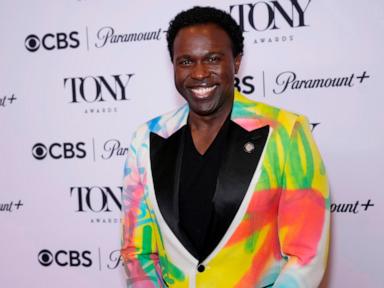
Joshua Henry stood at the summit of the grand staircase. He was wearing a blazing, unapologetically bright red suit. Below him sat a sea of the most famous, scrutinized faces on the planet. The brief was simple: lead a phalanx of dancers down the steps while belting out Whitney Houston’s "I Wanna Dance With Somebody."
Simple on paper. Terrifying in practice.
The steps of the Metropolitan Museum are iconic, but they were never engineered for a full-throttle musical theater number. They are wide, shallow, and stone-cold. To a man tasked with singing live while descending them in front of the global fashion elite, they looked like a vertical drop.
Consider the mathematics of a nightmare. One misstep, one catch of a polished shoe heel on the stone edge, and the performance transforms from an electrifying celebration into a viral catastrophe.
Tap, tap, tap. All the way down.
Henry knew the stakes. He didn't have the luxury of weeks of technical rehearsals to map out the geography of the descent. He had moments. So, as the music swelled and the lights hit the red fabric of his suit, he made a conscious choice. He kept his eyes up. He refused to look at the danger at his feet. Instead, he projected his voice into the cavernous hall, leaning entirely on instinct, muscle memory, and the raw vocal power that has made him a titan of the American stage.
He didn't fall. He soared. He shut the staircase down.
But the real complexity of a performer's life lies in the whiplash of the morning after.
The morning after the gala, the red suit was packed away. The adrenaline of the Whitney Houston tribute had faded into the standard fatigue of a working actor. Henry and his wife, Cathryn, were sitting in a standard New York hotel room, staring at a phone screen. They were FaceTiming their three young sons back home.
The theater world was buzzing. It was May 5, the morning the Tony Award nominations were to be announced live. For an actor starring in a critically lauded Broadway revival, this is the hour that dictates the next year of your career. It alters box office projections. It cements legacies.
Henry’s phone should have been tuned to the live broadcast. But his kids didn't care about the American Theatre Wing. They didn't care about categories or prestige. They wanted to know about the magic trick their dad had pulled off the night before. They wanted to hear about the big red suit and the giant staircase.
So, Henry stayed on the FaceTime call. He talked to his boys. He leaned into the quiet reality of being a father, letting the chaotic noise of the industry fade into the background.
By the time he logged off the call, the first announcement had already passed. He had completely missed his own category: Best Performance by an Actor in a Leading Role in a Musical.
He had to check a text message or a trade website to find out that he was now a four-time Tony nominee for his portrayal of Coalhouse Walker Jr. in Ragtime.
There is a profound irony in missing the pinnacle of professional validation because you are busy being a parent. For a younger artist, it might have felt like a missed moment. For the 41-year-old Henry, it felt exactly right. Perspective changes when you have people grounding you outside the theater doors. Success is no longer an isolated trophy; it is a shared household joy.
That exact grounding is what makes his current performance at the Vivian Beaumont Theater so devastatingly effective.
Ragtime is not a gentle musical. Based on E. L. Doctorow’s sprawling 1975 novel, with a book by the late Terrence McNally and a towering score by Lynn Ahrens and Stephen Flaherty, the show is a mirror held up to the American psyche. It tracks three distinct paths at the dawn of the twentieth century: a wealthy white family in New Rochelle, a Jewish immigrant designer escaping the tenements, and a brilliant Black ragtime pianist demanding dignity in a world determined to deny it to him.
Henry plays that pianist, Coalhouse Walker Jr. It is a role originally made legendary by Brian Stokes Mitchell in 1998, performing alongside Audra McDonald as Sarah. Those names are holy text in the Broadway community. To step into those shoes is its own kind of architectural terror, much like the Met Gala staircase.
On opening night, both Mitchell and McDonald were in the audience.
Imagine the weight of that moment. You are singing the notes that defined your youth, looking out into the dark, knowing the people who gave those notes life are watching you interpret them. Henry remembers listening to the original cast recording as a raw, young freshman at the Frost School of Music, dreaming of a future he wasn't sure he could claim. He remembers failing music theory classes, scheming, wondering if he belonged.
When the curtain fell on this revival, the legendary predecessors didn't just applaud; they offered warmth, validation, and a literal passing of the torch.
But the honor of the role is paired with a heavy emotional tax. Coalhouse’s journey is an arc of extreme choices. He begins the show wrapped in the smooth, syncopated rhythms of hope and success, only to see his life systematically dismantled by a vicious act of racist vandalism. When the system protects the perpetrators, Coalhouse radicalizes. He turns his back on the piano and takes up arms.
To play Coalhouse eight times a week is to live on the edge of a psychological cliff. Henry has to tap into a reservoir of grief and fury every single night, letting a New York Times-lauded performance emanate from his very core, before packing up and going home to be a patient father to three boys.
It is a grueling tightrope walk in a Broadway season that offers no safety nets. The current theatrical climate is brutal. Production costs are climbing, competition for tourist dollars is fierce, and weekly box office statements read like emergency room charts. Even shows that accumulate eleven Tony nominations, as Ragtime has, must fight for survival every Tuesday through Sunday.
The brilliance of the piece, and the reason audiences keep returning to the Vivian Beaumont, is its uncanny timeliness. The America of 1908 was a nation teetering on a fault line, asking massive, uncomfortable questions about immigration, race, equality, and national identity.
The parallel is obvious. We are asking those same questions right now, out in the streets and in the quiet of our own homes. When audiences look at Henry on that stage, they aren't looking at a historical costume drama. They are looking at themselves. They are watching a human being try to navigate a broken system without losing his soul.
The Tony Awards will happen on June 7. The statues will be handed out, the speeches will be made, and the industry will celebrate its survival for another year. Henry may win, or the ballot may swing elsewhere.
But the award is just the noise. The truth of the work remains in the discipline of the repeat.
The glamour of the Met Gala staircase is a three-minute illusion, captured in high-definition photographs and forgotten by the next cycle of the news feed. The real test is the stage at the Vivian Beaumont, where the lights come up, the 28-piece orchestra begins to play, and a man must stand before thousands of strangers to bare his chest and sing through the pain.
Joshua Henry will be there. Feet planted. Vocal cords ready.
Eyes up.