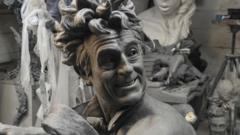
The bronze figure stands in Colwyn Bay, a seaside town in North Wales that rarely captures the global spotlight. It depicts a man in a dress, brandishing a rolling pin. To the casual observer, it is a quirky nod to a local boy made good. To those who understand the mechanics of British subversion, the unveiling of the Terry Jones statue is a final, defiant stand against a culture that has forgotten how to be truly absurd.
Terry Jones was not just the "quiet Python." He was the engine room of a comedic revolution that dismantled the very structure of television. While the world focused on John Cleese’s manic physical energy or Eric Idle’s sharp wordplay, Jones was the one insisting on a "stream of consciousness" format that abandoned the traditional punchline. He hated the idea that a joke should have a neat ending. Life doesn't have a punchline, so why should a sketch? The new monument in his hometown honors that refusal to play by the rules. Meanwhile, you can explore similar developments here: Why the Return of the Furthur Bus to San Francisco Matters Right Now.
The Architect of the Absurd
Most people remember Jones for his screeching "Pepperpots"—the middle-aged housewives with shrill voices and sensible shoes. But his contribution to the industry went far beyond drag. Jones was a scholar, a medievalist, and a director who understood that for comedy to work, the world around the joke had to feel absolutely real.
He didn't want Monty Python and the Holy Grail to look like a bright, clean Hollywood set. He wanted it to look filthy. He wanted the mud to look heavy and the armor to look rusted. By grounding the ridiculous in a gritty, historical reality, he made the surrealism hit twice as hard. This philosophy changed how we consume satire. Without Jones, there is no Spinal Tap, no The Office, and certainly no modern mockumentary. He proved that the more seriously you take the presentation, the funnier the breakdown becomes. To understand the full picture, we recommend the detailed analysis by Vanity Fair.
A Statue Built on Public Will
What makes this tribute significant isn't just the subject, but the source. This wasn't a corporate marketing stunt or a government-funded vanity project. The £120,000 required for the statue was raised through a grassroots campaign led by his family and supported by fans worldwide.
In an era where public art is often bogged down by bureaucratic committees and safe, soulless designs, the Colwyn Bay statue is a rare win for personality. The sculpture, created by Nick Elphick, captures the frantic, domestic energy Jones brought to his most famous roles. It serves as a physical reminder that the most lasting impact often comes from the fringes—from the poets and the weirdos who refuse to fit the mold.
The Problem With Modern Safety
The comedy industry today is paralyzed. Writers are terrified of the "wrong" take, and studios are obsessed with data-driven humor that offends no one and consequently moves no one. Jones operated in a different atmosphere. He and the Python crew were frequently in the crosshairs of censors and religious groups, most notably during the release of Life of Brian.
Jones didn't just weather the storm; he invited it. He understood that the role of the jester is to poke at the foundations of power. When he directed Life of Brian, he wasn't attacking faith; he was attacking the human tendency to follow blindly without thought. That distinction is lost on many today. We see the rolling pin and the dress and we laugh, but we forget the intellectual rigor that powered the performance.
The Welsh Connection
Jones always maintained a specific, grounded perspective that he attributed to his Welsh roots. Even though he moved to England as a child, he remained the Patron of the Theatr Colwyn. He never lost that sense of being an outsider looking in at the English establishment.
This outsider status allowed him to dissect British pomposity with a precision that a London insider might have lacked. He saw the absurdity in the class system because he wasn't entirely of it. The statue returns him to the soil that shaped that perspective. It is a homecoming for a man who spent his life wandering through the corridors of history and the chaotic landscapes of the human mind.
Beyond the Rolling Pin
We should be careful not to reduce Jones to a single character. His work as a historian was as vital as his work as a comedian. He wrote books on Chaucer that challenged the academic status quo, arguing that the Canterbury Tales were far more radical than people realized. He produced documentaries that stripped away the romanticized myths of the Crusades and the Middle Ages.
He lived a life of intense curiosity. This is the quality that is most absent in modern celebrity culture. Jones wasn't interested in being a "brand." He was interested in the truth, even if that truth was wrapped in a silly voice and a wig. He showed us that you could be a serious intellectual and a complete clown at the same time. There is no contradiction there, only a full life.
The Burden of the Legacy
As the bronze cools in Colwyn Bay, the comedy world faces a reckoning. The giants of the Python era are fading, and the landscape they left behind is increasingly fragmented. We have more content than ever, but less of it feels essential. We have "influencers" instead of icons.
The statue of Terry Jones isn't just a piece of art; it is a challenge. It asks if we are still capable of that level of bravery. It asks if we can still laugh at ourselves without checking the social media wind first. Jones knew that the most important thing a person could do was to be "very funny," not because it was easy, but because it was the only way to survive the crushing weight of reality.
The rolling pin is raised. The dress is on. The joke is serious. We would do well to remember why.