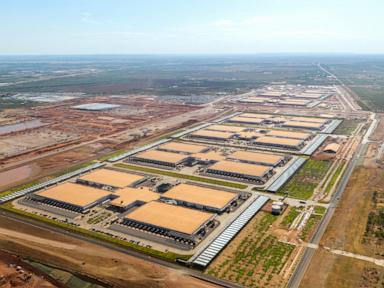
Texas Democrats think they just found the silver bullet to crack thirty years of Republican dominance.
Their strategy is simple. Point at the massive, windowless hyperscale data centers swallowing rural Texas land. Blame them for spiking residential electric bills. Blame them for draining local aquifers during summer droughts. Frame the Republican establishment as selling out Texas homeowners to Silicon Valley tech giants. You might also find this connected article useful: Virgin Media O2’s £800m Cost-Cutting Spree Isn’t a Turnaround Strategy It’s a Slow-Motion Surrender.
On a campaign mailer, it reads like political gold. In the real world of grid physics, municipal finance, and Texas voter psychology, it is an absolute catastrophe.
The mainstream political coverage treats this messaging pivot as a shrewd populist awakening. Pundits assume that tying AI server farms to the trauma of the 2021 Winter Storm Uri blackout will automatically deliver suburban and rural swing voters to the blue column. As discussed in recent reports by Harvard Business Review, the implications are widespread.
That assumption misses the entire structural reality of how the Texas power market works, who actually pays for grid upgrades, and why local county judges are begging for these facilities to break ground.
The Myth of the Grid-Breaking Server Farm
To understand why the anti-data-center populist pitch is flawed, you first have to understand what a modern hyperscale facility actually does on the Electric Reliability Council of Texas (ERCOT) grid.
Politicians love to paint data centers as mindless energy vampires sucking power away from air conditioners during a 105-degree August afternoon.
That is not how industrial load management works in Texas.
I have sat across the table from power developers and commercial off-takers negotiating multi-hundred-megawatt Power Purchase Agreements (PPAs) in the ERCOT market. These facilities do not just plug into the wall and hope for the best. Because ERCOT operates as an energy-only market with extreme price volatility—where wholesale prices can spike to the $5,000 per megawatt-hour cap during scarcity events—running an unhedged, inflexible data center is financial suicide.
Large-scale compute operators and crypto-mining facilities operate as controllable load resources.
When wholesale power prices surge because wind drops off at sunset or temperatures hit triple digits, these facilities curtail their operations. They power down non-essential compute loads, shift training runs to off-peak hours, or switch over to massive on-site battery energy storage systems (BESS) and natural gas backup generation.
By doing so, they act as a giant shock absorber for the Texas grid.
Even more counter-intuitive is the capital expenditure reality. Texas does not have enough dispatchable power plants, and building new natural gas peaker plants or utility-scale solar-plus-storage projects requires massive upfront financing. Banks will not lend hundreds of millions of dollars to build a new power plant based on the hope that residential demand will grow over the next twenty years. They lend money when a creditworthy counterparty—like Microsoft, Google, Meta, or Amazon—signs a fifteen-year off-take agreement before a single shovel hits the dirt.
Data centers are the exact reason new generation capacity is getting financed in ERCOT right now. If you choke off the data center pipeline through punitive state legislation or aggressive local moratoriums, you do not save megawatts for homeowners. You kill the financing mechanism for the next wave of Texas power plants.
The Rural Tax Base Reality Nobody Wants to Admit
Watch what happens when a big-city strategist rolls into a rural Texas county and tells voters that the new $800 million server campus down the road is their enemy.
The local county judge and the school board superintendent will quietly—or loudly—run them out of town.
Texas has no state income tax. Every single dollar that funds rural public schools, county road maintenance, sheriff departments, and volunteer fire stations comes from property taxes and local sales taxes. In dozens of rural counties across West Texas, the Panhandle, and the I-35 corridor, the local tax base has been shrinking for decades alongside agricultural margins.
A single hyperscale data center drops hundreds of millions of dollars of taxable real estate and server equipment onto the local appraisal rolls overnight.
And what do they demand in return from local taxpayers? Almost nothing.
- Zero strain on school districts: Unlike a new suburban housing development that brings 2,000 families and requires the school district to issue a $150 million bond for new classrooms, a data center employs 50 to 150 full-time technicians. It generates massive school tax revenue while adding virtually zero students to the district.
- Minimal road wear: Once construction wraps up, a data center generates less daily semi-truck traffic than a mid-sized regional grocery distribution center.
- Self-funded infrastructure: Developers routinely pay out of pocket for new electrical substations, high-voltage transmission interconnects, and private water treatment loops just to get their facilities energized on schedule.
When Democrats campaign against data centers in exurban and rural counties, they are effectively telling local voters to reject the largest property tax relief engine their community has ever seen. Even when companies negotiate Chapter 313 successors or local tax abatements, the remaining taxable value still dwarfs every other commercial enterprise in the county combined.
Does Data Center Growth Actually Raise Your Electric Bill?
This is the core question driving the political panic, and the honest answer is far more nuanced than either political party admits.
Your retail electricity bill in deregulated Texas markets (like Dallas-Fort Worth or Houston) is split into two primary buckets: the energy charge (what your Retail Electric Provider pays for wholesale power) and the Transmission and Distribution Utility (TDU) delivery charge (what companies like Oncor or CenterPoint charge to maintain the poles, wires, and transformers).
Data centers put upward pressure on the wholesale energy price during shoulder hours when renewable generation is low, and they require massive transmission buildouts. Under ERCOT's historic "postage stamp" transmission pricing model, the cost of building new high-voltage transmission lines is socialized across all ratepayers in the grid, regardless of who requested the line.
That is a legitimate policy flaw. Residential ratepayers should not subsidize the dedicated transmission infrastructure required to connect a multi-billion-dollar tech campus to the main grid.
However, the solution is targeted regulatory reform at the Public Utility Commission of Texas (PUCT)—specifically, shifting transmission interconnect costs directly onto large-load customers and requiring strict financial collateral before ERCOT studies their grid connection.
Instead of proposing surgical cost-allocation rules, political operatives are painting the entire industry as an existential threat. They are conflating transmission cost-allocation bugs with the existence of the industry itself. Worse, they are ignoring the fact that the primary drivers of recent Texas electric bill spikes have been extreme weather events, aging distribution infrastructure damaged by storms, and skyrocketing insurance and financing costs for utilities—not server racks in Midlothian or Temple.
The Water Panic vs. Closed-Loop Engineering
The second pillar of the anti-data-center crusade is water consumption. Critics love to cite eye-popping figures about millions of gallons of water evaporating into the Texas sky every day to cool overheated AI chips.
If you are looking at a legacy enterprise data center built in 2012, that criticism holds water. Older facilities relied heavily on evaporative cooling towers, which essentially boil off potable municipal water to reject heat. Building one of those in drought-stricken Central or West Texas is negligent.
But attacking the modern AI data center boom using 2012 cooling metrics is like attacking modern aviation safety by citing statistics from the 1970s.
The physics of high-density AI compute—where thermal design power per server rack has jumped from 10 kilowatts to over 100 kilowatts—has made traditional evaporative water cooling obsolete. Air and evaporated water simply cannot pull heat away from dense GPU clusters fast enough.
Modern facilities are rapidly transitioning to direct-to-chip liquid cooling and closed-loop dielectric immersion systems.
In a closed-loop liquid cooling system, the facility fills its pipes once—often using non-potable brackish groundwater or reclaimed municipal wastewater—and recirculates that exact same fluid endlessly through heat exchangers. Water consumption drops to near zero after the initial fill.
For politicians, screaming about water theft makes for an emotional thirty-second campaign ad. Yet the moment a developer sits down with a city council and presents the engineering specs for a closed-loop, zero-evaporation cooling system, the politician's talking point collapses on contact with reality.
Why Voters Won't Buy the Populist Pivot
Political strategists often fall in love with an issue because it polls well in focus groups when stripped of context. Ask any voter, "Do you want giant tech corporations raising your electric bill and using your water?" and 85 percent will say no.
Ask that same voter in Williamson, Bell, or Ellis County, "Do you want to block a $1 billion facility that will fund your local high school's new stadium, keep your county property taxes flat, and bring high-paying electrical engineering jobs to town?" and the numbers invert completely.
Furthermore, Texas voters possess a deep, culturally ingrained skepticism toward top-down economic intervention. For twenty years, the Texas economic pitch—championed by Republicans and quietly accepted by moderate business Democrats—has been simple: low taxes, predictable permitting, and open doors for capital investment.
When Texas Democrats pivot to an anti-infrastructure, anti-growth posture, they hand Republicans an effortless counter-narrative.
The GOP does not even have to defend tech billionaires. All they have to do is point at the Democratic platform and say: "They want to kill blue-collar construction jobs, block new power plant financing, and raise your local property taxes by chasing away commercial investment."
Think about who actually builds a data center. It is not a room full of San Francisco coders. A single multi-building campus requires three to five years of continuous work from thousands of union and non-union electricians, pipefitters, ironworkers, concrete pourers, HVAC specialists, and heavy equipment operators.
In Texas, organized labor—specifically the International Brotherhood of Electrical Workers (IBEW) and the building trades—is one of the most critical voting blocs and fundraising engines the Democratic Party has left. By declaring war on hyperscale data centers, party strategists are directly threatening the multi-year work pipelines of the exact blue-collar tradespeople they desperately need to turn out in November.
The Smart Play Everyone Is Ignoring
There is a massive, legitimate vulnerability in how Texas handles its infrastructure boom, and it has nothing to do with banning or demonizing data centers.
If opposition lawmakers actually wanted to win on this issue, they would stop attacking the buildings and start attacking ratepayer cross-subsidization and grid transparency.
- Mandate 100% Cost-Causation for Grid Upgrades: Force large-load facilities to pay upfront for every mile of new transmission line and every substation transformer required to serve them, eliminating the socialization of those costs onto residential TDU bills.
- Enforce Strict Collateral on ERCOT Queue Jumping: Require speculative data center developers to post massive, non-refundable financial security deposits to enter the ERCOT interconnection queue, purging phantom projects that clog up grid planning for real power generators.
- Ban Potable Water for Evaporative Cooling: Pass clean, simple legislation prohibiting new industrial facilities in drought-designated zones from using municipal drinking water for evaporative cooling, forcing immediate adoption of closed-loop or reclaimed-water systems.
- Demand On-Site Dispatchable Generation: Require any new facility over 100 megawatts to co-locate on-site battery storage or dispatchable generation capable of carrying at least 50 percent of its peak load during ERCOT Level 2 and Level 3 Energy Emergency Alerts.
Notice the difference. Every single one of those policies protects residential electric bills, safeguards municipal drinking water, strengthens grid reliability, and keeps the blue-collar construction boom intact.
The Cost of Misreading the Terrain
Politics rewards clarity, but energy economics punishes simplistic slogans.
The data center boom in Texas is not a passing fad, and it is not a conspiracy cooked up in a smoke-filled room in Austin. It is the physical manifestation of global capital chasing cheap land, abundant natural gas, massive wind and solar output, and fast permitting.
Texas Democrats have every right to hold state leadership accountable for grid fragility and rising utility fees. Those are real kitchen-table issues hurting working families across the state.
Turning data centers into the primary villain is a tactical blunder born from mistaking a Twitter outrage cycle for an electoral strategy. You cannot build a winning coalition in the fastest-growing state in America by campaigning against the physical infrastructure of the modern economy while simultaneously alienating the construction unions who build it and the rural counties who tax it.
Fix the transmission cost-allocation rules, enforce closed-loop water standards, and make industrial giants pay their own interconnect fees—or keep campaigning against the server farms and watch the very voters you are trying to win cash the tax checks anyway.