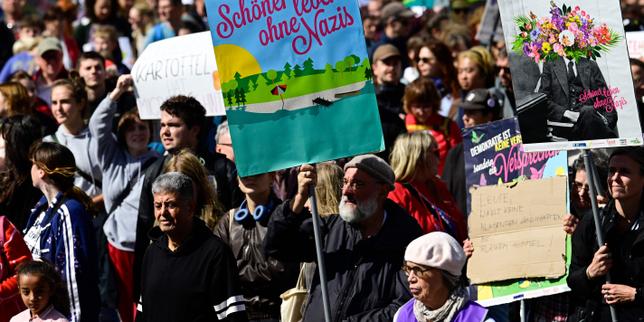
Thousands of citizens flooded the streets of Magdeburg on a Saturday afternoon, shouting slogans and carrying handmade placards. They were not celebrating. They were terrified.
With local elections looming in Saxony-Anhalt, the far-right Alternative for Germany (AfD) party stands on the brink of a historic electoral breakthrough. Roughly 6,000 demonstrators gathered near the city's historic cathedral, united by a single, desperate message: democracy is worth fighting for.
If you think this is just another ordinary regional vote, you are missing the bigger picture. This moment exposes deep, unhealed fractures within German society that have festered for decades.
The Anatomy of a Protest in Eastern Germany
Organized by a local civic collective operating under the banner "Saxony-Anhalt. Open to the World," the turnout was remarkably diverse. You saw teenagers marching alongside retirees. Teachers stood shoulder-to-shoulder with local business owners.
The atmosphere blended festival energy with a heavy dose of anxiety. Live music played, but the real heartbeat of the gathering came from the homemade signs bobbing in the crowd. Messages like "more love, less hate" and sharp ironies targeting nationalist rhetoric filled the air.
People are scared. They see public discourse shifting, and they want to draw a hard line against extremism.
Jeanette Becker, a teacher from nearby Stassfurt, spent her Friday night messaging acquaintances online, begging them to show up at the polls. She admitted to reporters that her daily life is surrounded by people expressing open sympathy for far-right talking points. For her, walking in Magdeburg wasn't symbolic. It was an act of survival for the political system she believes in.
Why Saxony-Anhalt is a Pressure Cooker
To understand why the AfD commands such fierce loyalty here, you have to look beyond simple campaign promises. You have to look at history.
Decades after the formal reunification of Germany, eastern states like Saxony-Anhalt still feel like second-class citizens. In the chaotic 1990s and 2000s, a massive exodus drained the region of ambitious youth. People left for Frankfurt, Munich, or Berlin.
Those who stayed behind often internalized a lingering sense of being invisible and undervalued. Wages lag behind western counterparts. Infrastructure feels neglected. When voters feel abandoned by the traditional political establishment, populist movements step into the vacuum with simple, aggressive answers.
The AfD capitalized on these economic anxieties, weaponizing grievances about immigration and cultural change. They painted themselves as the only voice for the forgotten east.
The Firewall Strategy and Its Cracks
For years, the political mainstream maintained a strict cordon sanitaire. Every major traditional party vowed never to form coalitions or govern alongside the far right.
That firewall is now trembling under the weight of actual math.
With poll numbers climbing past forty percent in certain regional projections, freezing out the AfD becomes nearly impossible if they sweep the legislature. Mainstream parties face an agonizing dilemma. Do they stick to their moral boundaries and risk total political paralysis, or do they find pragmatic ways to cope with a shifted reality?
So far, mainstream groups refuse to budge. The left-wing populist BSW party remains the sole exception, though even its members tear themselves apart internally over whether any cooperation is acceptable.
What Happens When the Ballots Open
Elections come and go, but the social friction in eastern Germany will not vanish when the polling stations close.
Protesters in Magdeburg proved that civil society is still breathing. They showed that opposition to the far right is organized, visible, and loud. Yet, marching past a cathedral for a single afternoon does not fix the structural disillusionment driving voters toward populist extremes.
If political leaders want to defuse this powder keg, stopping the surge requires more than moral outrage. It demands real investment in neglected regions, better economic prospects for families who stayed behind, and a serious rebuilding of trust.
Get involved in local civic groups, push your representatives to address structural inequality head-on, and stop treating regional extremism as a distant anomaly. The vote in Saxony-Anhalt is a warning siren for the entire continent.