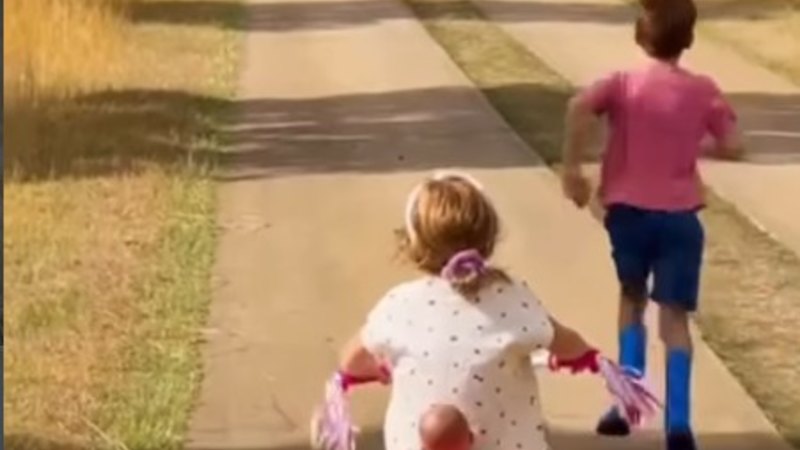
The rain against a Berkshire windowpane has a very particular sound. It is not the dramatic lash of a coastal storm nor the dry rattle of city grit against glass. It is a soft, persistent blurring of the world outside, a damp gray curtain that invites you to pull your wool cardigan a little tighter around your shoulders and listen for the sound of small footsteps racing down a hallway.
There is an art to disappearing in plain sight. For years, the public narrative surrounding the Duke and Duchess of Sussex has been written in high-contrast ink—headlines blaring exile, rebellion, royal rifts, and transatlantic flight. But public narratives are notoriously bad at capturing the quiet spaces. They miss the mundane poetry of ordinary afternoons. They miss what happens when the flashbulbs finally fade into a low hum, leaving behind the raw, unscripted geography of a young family trying to figure out what home actually feels like.
Consider what happens when a door closes.
For most of us, privacy is an unvalued default. We grumble when a neighbor mows their lawn too early or when a stranger glances at our grocery cart. We take for granted the absolute sovereign right to be unobserved, unjudged, and unrecorded. Now, invert that. Imagine every mundane gesture—wiping oatmeal off a high chair, chasing a toddler through wet grass, whispering a bedtime story—being weighed, parsed, and weaponized across millions of screens.
When Meghan, Duchess of Sussex, offered those brief, measured glimpses into family life in Britain during her earliest years within the royal orbit, the media machine reacted with predictable frenzy. Every image was dissected like a crime scene. Was the nursery too modern? Was the stroller too American? Was the smile too polished? We looked everywhere except at the human truth staring back from the frame: the dizzying, fragile transition of stepping out of an individual identity and into an ancient, immutable institution.
It is a heavy thing to marry into history.
Imagine walking into a room where every piece of furniture, every portrait on the wall, every inflection of speech carries three hundred years of accumulated expectation. You are not just marrying a person; you are marrying a monument. Every family argument has constitutional implications. Every holiday photo is a diplomatic dispatch.
In those early days, the glimpses of domestic life—a brief wave from a castle step, a tailored coat hiding the early curves of pregnancy, the breathless hush outside the Lindo Wing—were treated as public property long before they belonged to the people living them. The public wanted a fairy tale, complete with gilded carriages and perpetual serenity. But fairy tales are notoriously thin on plot once the wedding ends. Real life demands breakfast. Real life demands sleepless nights with an infant who refuses to acknowledge royal lineage or time zones.
There is a distinct kind of loneliness that comes with being intensely visible while remaining profoundly unknown.
Psychologists call it the spotlight effect, but on a global scale, it morphs into something heavier—an unyielding atmospheric pressure. Every gesture is magnified. When a young mother adjusts her child’s blanket in front of a battery of lenses, she is performing two jobs simultaneously: she is being a mother, and she is curating an empire's peace of mind. Those fleeting glimpses of British family life were never just photo opportunities. They were quiet negotiations for autonomy. They were tiny, desperate flares sent up from an island of isolation, signaling: We are here. We are real. We bleed, we laugh, we stumble just like you.
We forget how young they were when the storm hit.
We look at public figures as statues, impervious to weather. But beneath the wool and silk, beneath the immaculate titles and the orchestrated public appearances, there were two people trying to anchor themselves to one another while the ground shifted beneath their feet.
Think back to your own life’s major transitions. Moving to a new city, starting a high-stakes job, welcoming your first child. Now multiply that anxiety by ten thousand. Add a chorus of thousands of armchair critics who feel entitled to vote on your choice of nursery color or your posture during a church service. It is a wonder anyone survives such scrutiny with their empathy intact.
The irony of the modern celebrity-royal hybrid is that our collective obsession has driven them further away. The more we demanded access, the more fiercely they had to guard the gate. The glimpses we once received—the fleeting snapshots of a Windsor garden, the quiet introductions of a new life to a watching world—now read like historical artifacts from an era that could not sustain itself.
Yet, beneath the geopolitical fallout and the transatlantic relocation, the core of the story remains stubbornly intimate. It is about the universal human impulse to protect the ones we love.
When you strip away the titles, the crowns, the tabloid columns, and the palace intrigue, you are left with a universal scene: a mother looking down at her child, wondering what kind of world she is handing over to them. She is wondering if they will know the smell of rain on English grass or the comforting hush of an ancient library. She is calculating the cost of her own peace against the inheritance of her children.
We live in an age that consumes people whole and asks for seconds. We scroll through tragedy and triumph with the flick of a thumb, treating real lives like disposable streaming content. But every once in a while, a crack appears in the facade. A photograph catches an unscripted glance. A voice trembles slightly during an interview. And for a brief second, the armor slips.
We see the human being.
That is where the true story lives. Not in the palace press releases or the explosive tell-all interviews, but in the quiet spaces between the ticks of the clock. It lives in the courage it takes to walk away from a gilded cage because the air inside has grown too thin to breathe. It lives in the messy, beautiful, terrifying process of starting over, of trading the certainty of history for the wild, open expanse of the unknown.
The rain continues against the glass. The children are asleep. Somewhere across the ocean, old stones stand in the damp English mist, indifferent to the lives that once brushed against their walls. But the people who lived those lives have moved on, carrying the weight of the past into the promise of a different morning.
And as the light fades over a new horizon, we are left to wonder not about what they lost, but about what they finally found when the noise stopped.