The room smells of expensive wool, cold coffee, and the distinct, high-stakes anxiety of people who know their history too well. Outside, the Las Vegas desert presses against the glass like a furnace. Inside, hundreds of people sit in stiff chairs, waiting for a sentence to land. They are members of the Republican Jewish Coalition, an audience that occupies one of the most uniquely complex intersections in modern American politics. They carry generational memory like an open wound, and they measure every political speech not by the volume of the applause, but by the safety it promises.
Then J.D. Vance steps up to the microphone.
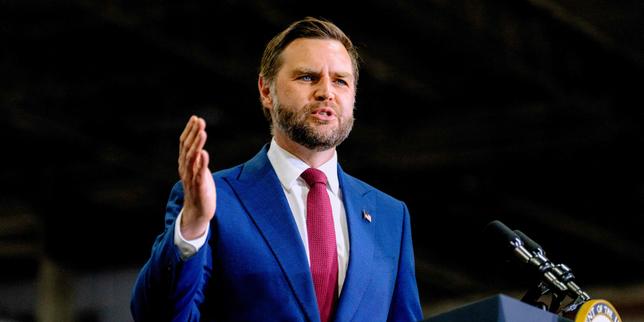
He does not bound across the stage with the practiced, athletic grace of an old-school campaigner. He walks like a man navigating a frozen lake, testing the ice beneath his boots with every step. He is young, bearded, wearing the dark suit of a corporate litigator turned populist tribune, and his face carries that permanent crease of skepticism that made him famous.
Listen closely to what happens next.
He has a difficult performance ahead of him. To understand why, you have to look past the television cameras and the cable news chyrons. You have to understand the tectonic plates shifting beneath the conservative movement. Vance represents an America First doctrine that is deeply suspicious of foreign entanglements, skeptical of traditional alliances, and driven by a raw, domestic grievance. For a room full of people whose political worldview is heavily anchored in the absolute, unshakeable security of the state of Israel and the preservation of a robust international order, that doctrine sounds less like a policy platform and more like a weather report predicting a hurricane.
The speech is sinuous. That is the word observers use. It twists. It turns. It offers reassurance with one hand while clutching a grenade of isolationist logic in the other.
Consider what it feels like to sit in that audience. Imagine you are an elderly man in the third row, your parents survivors of a world that tried to burn itself to ash. You believe, with every fiber of your being, that American power is the only thing keeping the dark at bay. When a rising star of the new right begins to talk about weary taxpayers and the limits of foreign commitments, your pulse quickens. You are listening for a dog whistle, or perhaps just a terrifying honesty. You are wondering if the party you have trusted is walking away from you.
Vance knows this. He feels the invisible temperature of the room drop. So he adjusts.
He speaks with a calculated softness. He leans into the podium. He praises the resilience of the Jewish people, acknowledges the horrors of October 7 with gravity, and tries to thread an impossibly narrow needle. He argues that true strength abroad comes from a secure and prosperous nation at home. It is a classic nationalist pivot. But for this specific crowd, the pivot feels like a pivot away from them.
The speech becomes an exercise in political acrobatics. He defends the administration’s past posture while subtly validating the restless base that wants America to pull up the drawbridge. He navigates the tension between traditional neoconservative interventionism and the new, muscular isolationism that now dictates the terms of engagement in the Republican Party.
It is messy. Politics usually is, despite what the press releases tell us.
We often make the mistake of treating political movements as monoliths, as if millions of people share a single brain and a single set of anxieties. But political coalitions are fragile marriages of convenience, stitched together by shared enemies and momentary hopes. The alliance between the modern populist right and conservative Jewish voters is one of the most fragile of all. It is built on shared cultural grievances and strong support for Israel, yet it is constantly threatened by diverging views on America's role in the world.
When Vance finishes, the applause is polite. It is not the roaring, floor-shaking ovation reserved for the undisputed titans of the party. It is the sound of a room processing complex data. People turn to each other in the aisles, whispering, furrowing their brows, trying to decide what just happened to them.
The desert wind outside continues to howl against the glass, indifferent to the speeches, the anxieties, and the fragile coalitions. Inside, the tightrope walker steps off the wire, leaving the audience to wonder if the rope was ever really secure at all.