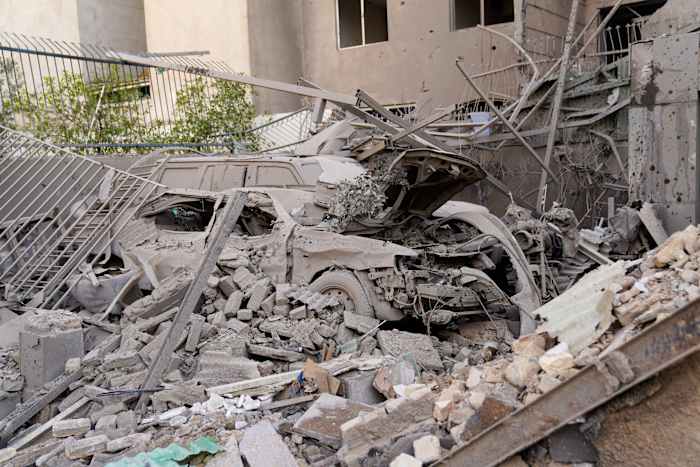
Donald Trump just threw the ultimate political Hail Mary. By ordering a massive joint strike with Israel against Iran—an operation dubbed "Epic Fury" that reportedly killed Supreme Leader Ali Khamenei—he isn't just trying to redraw the map of the Middle East. He's trying to save his own presidency from a domestic tailspin.
The timing is far from a coincidence. Before the missiles flew on February 28, 2026, the MAGA agenda was hitting a brick wall. The Supreme Court had just gutted his global tariff policy. The "Epstein files" were back in the news, dragging old scandals into the present. Even his base was starting to grumble about the lack of progress on the home front. In related updates, we also covered: The Sabotage of the Sultans.
Now, the conversation has shifted. Instead of talking about court losses or supermarket prices, the world is watching Tehran burn. But this isn't a guaranteed win. It's a high-stakes gamble that could either cement his legacy as a "consequential" leader or alienate the very "America First" voters who put him in the Oval Office.
The diversionary war theory
Let's be honest about what's happening here. When a president's domestic numbers sag and his legislative wins dry up, a foreign enemy is a convenient fix. It’s the oldest trick in the political playbook. Trump is betting that the "thunder of cruise missiles" will drown out the noise of his legal and political setbacks. Reuters has also covered this critical subject in extensive detail.
Think about the pressure he was under just days ago.
- The Supreme Court essentially killed his flagship trade strategy.
- Scrutiny over civil rights actions in Minneapolis was reaching a boiling point.
- The economy, despite the tough talk, hasn't felt "great" for many swing voters lately.
By pivoting to Iran, Trump forces his critics into a corner. If they oppose the war, he labels them "weak" or "pro-regime." If they support it, he takes the credit. It’s a classic "rally 'round the flag" maneuver designed to reset the narrative before the 2026 midterms.
A rift in the MAGA base
The biggest problem for Trump isn't the Democrats; it's his own supporters. For years, the core of the MAGA movement was built on a single promise: "No more foreign wars." Trump campaigned on bringing troops home and ending the "forever wars" of the Bush and Obama eras.
Suddenly, he's started a new one.
We’re already seeing the cracks. High-profile allies like Marjorie Taylor Greene have been vocal, essentially saying, "I didn't vote for this." Even Tucker Carlson has reportedly called the operation "disgusting." They see this as a betrayal of the isolationist "America First" spirit.
On the other side, you have the "Peace Through Strength" crowd. Figures like Mike Pompeo and various Fox News hosts are framing this as a necessary, surgical strike to prevent a nuclear Iran. They’re arguing that you can’t have "America First" if American cities are threatened by Iranian ICBMs—even if those missiles are, according to the Defense Intelligence Agency, still years away from being a real threat.
The ghost of Iraq and the $80 barrel
Trump claims he "obliterated" Iran's nuclear capabilities and that the war will be short. We’ve heard this story before. In 2003, the promise was a "cakewalk" in Iraq. We all know how that ended: twenty years of instability and trillions of dollars down the drain.
If this turns into a quagmire, the economic blowback will be immediate.
- Oil Prices: Brent crude already jumped 10% to $80 a barrel. If the Strait of Hormuz stays choked, $100 or $120 is easily on the table.
- Inflation: High energy costs mean higher grocery bills. You can't tell voters the economy is back while they're paying $5 for a gallon of gas.
- Military Overstretch: With the U.S. already tied up with commitments in Europe and watching China in the Pacific, a third front in the Middle East bleeds resources we might not have.
Trump’s gamble relies on the Iranian regime collapsing quickly. But history shows that when you "decapitate" a leadership, you often get chaos, not a pro-Western democracy. A power vacuum in Tehran could lead to a fragmented, even more dangerous region.
Is this actually about the midterms
Everything in D.C. eventually circles back to the ballot box. Trump knows the 2026 midterms are the "make or break" moment for his second term. If he loses the House or Senate, he’s a lame duck.
By manufacturing a crisis, he’s attempting to:
- Consolidate the GOP: Force wavering Republicans to stand behind the Commander-in-Chief.
- Distract from Scandals: Keep the Epstein headlines off the front page.
- Project Strength: Show the "strongman" persona that his core fans adore.
But voters are fickle. If the war stays on the news but doesn't improve their lives—or worse, makes their lives more expensive—the "Epic Fury" might just blow back on the White House.
If you want to understand where this is going, watch the gas pumps and the "America First" influencers on social media. If the base continues to revolt and the prices continue to climb, Trump’s gamble won't just fail in Iran; it’ll fail in the American heartland. Keep a close eye on the upcoming War Powers Resolution votes in Congress; that's where the real battle for the MAGA soul will be fought.