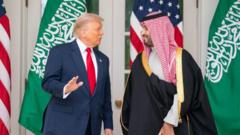
The United States officially signed a landmark civil nuclear cooperation pact with Saudi Arabia, and it marks a complete rewrite of Washington's nonproliferation handbook. Energy Secretary Chris Wright and Saudi Energy Minister Prince Abdulaziz bin Salman executed the 123 Agreement alongside a bilateral safeguards framework. The pact sets up a multibillion-dollar pipeline for American companies like Westinghouse to build reactors in the kingdom. But the real shockwave isn't about construction contracts or reactor design. It's about what the White House gave up to get the deal across the line.
For decades, the standard for any American civilian nuclear partnership was simple. If you wanted U.S. reactor tech, you signed away your right to enrich uranium or reprocess spent fuel on your own soil. That condition, famously dubbed the "gold standard" after the 2009 U.S.-UAE nuclear agreement, was meant to keep commercial energy programs from secretly turning into bomb factory setups. For another perspective, read: this related article.
With this new arrangement, Washington threw that gold standard out the window.
What Changed in the U.S. Saudi Civil Nuclear Deal
The agreement lays out a decades-long framework allowing U.S. firms to export civilian nuclear infrastructure to Riyadh. What makes this deal unprecedented is its route toward domestic enrichment. Instead of prohibiting Saudi Arabia from producing its own nuclear fuel, the pact paves the way for a jointly studied uranium enrichment facility built right inside the kingdom using U.S. technology. Related insight on the subject has been shared by Al Jazeera.
Crucially, the administration skipped demanding that Saudi Arabia sign the International Atomic Energy Agency's (IAEA) Additional Protocol. That protocol is the international gold standard for inspection power—it gives U.N. inspectors snap access to undeclared sites to ensure no one is secretly enriching military-grade material.
Instead, the White House opted for a tailored "bilateral safeguards agreement" monitored directly by U.S. entities.
Here is how the new agreement stacks up against previous U.S. nuclear benchmark pacts:
- UAE 123 Agreement (2009): Strict legally binding prohibition on domestic enrichment and reprocessing. Mandated IAEA Additional Protocol for unannounced snap inspections.
- Saudi Arabia 123 Agreement: Allows domestic uranium enrichment following a joint U.S.-Saudi study. Omits the IAEA Additional Protocol in favor of custom bilateral U.S. monitoring safeguards.
Taking away snap U.N. inspections while leaving the door open for centrifuges on Saudi soil is a massive policy shift. So why did Washington pivot?
Why Washington Broke With Decades of Precedent
U.S. negotiators didn't abandon traditional nonproliferation demands on a whim. The administration faced a hard geopolitics problem: Riyadh was going nuclear either way.
Crown Prince Mohammed bin Salman made it crystal clear to international diplomats that if the U.S. refused to help build their civil nuclear grid, they'd simply hand the contracts to China National Nuclear Corporation or Russia's Rosatom. Neither Beijing nor Moscow requires strict nonproliferation gold standards or intrusive inspector access. Had Russia or China stepped in, American industry would lose billions in exports, and Washington would have zero eyes inside Saudi facilities.
There is also a massive economic push behind the scenes. Saudi Arabia needs colossal power generation to run energy-hungry seawater desalination plants and power massive artificial intelligence data center hubs. Burning crude oil to power AI infrastructure costs the kingdom millions in lost oil export revenues every single day. They want nuclear power to free up domestic oil reserves for global markets.
Finally, politics shifted. Under previous negotiations, a civil nuclear deal was strictly conditioned on Saudi Arabia normalizing diplomatic relations with Israel. Trump severed that link, treating the nuclear framework as a standalone commercial and strategic pact.
The Real Proliferation Risks Ahead
Critics across Capitol Hill and foreign policy think tanks are raising red flags. The technical threshold between low-enriched uranium used for civilian reactors (3% to 5% purity) and weapons-grade material (above 90% purity) comes down to how long centrifuges spin.
Once a country masters the technical know-how to run enrichment centrifuges at scale, they've crossed the hardest technological hurdle in nuclear weapons development.
Crown Prince Mohammed bin Salman previously stated publicly that if Iran acquires a nuclear weapon, Saudi Arabia will move to build one as well. Handing domestic enrichment capabilities to a nation in a volatile region—without requiring the IAEA's most aggressive inspection tools—creates an immediate risk.
If Saudi Arabia is permitted to enrich fuel, regional rivals like Turkey or Egypt could demand the exact same concessions in future commercial energy deals, effectively dismantling the global nonproliferation framework bit by bit.
What Happens in Congress Right Now
The deal isn't fully set in stone yet. Under Section 123 of the U.S. Atomic Energy Act of 1954, the signed agreement must sit before Congress for 90 session days of formal review.
Congress doesn't technically need to pass an affirmative vote to approve it. Under standard rules, 123 agreements automatically go into effect when the 90 days expire unless lawmakers pass a joint resolution of disapproval.
Bipartisan pushback is already building. Lawmakers concerned about Middle East security are drafting resolutions to block or amend the deal to mandate the IAEA Additional Protocol. However, overriding a expected presidential veto takes a two-thirds supermajority in both the House and Senate—a hurdle that historically rarely succeeds on foreign policy matters.
If you're following energy markets or Middle East policy, keep your eyes on the Senate Foreign Relations Committee over the next two months. Watch whether lawmakers force an amendment requiring strict U.S.-managed joint venture control over any spinning centrifuges, or if the administration’s commercial argument wins the day untouched.