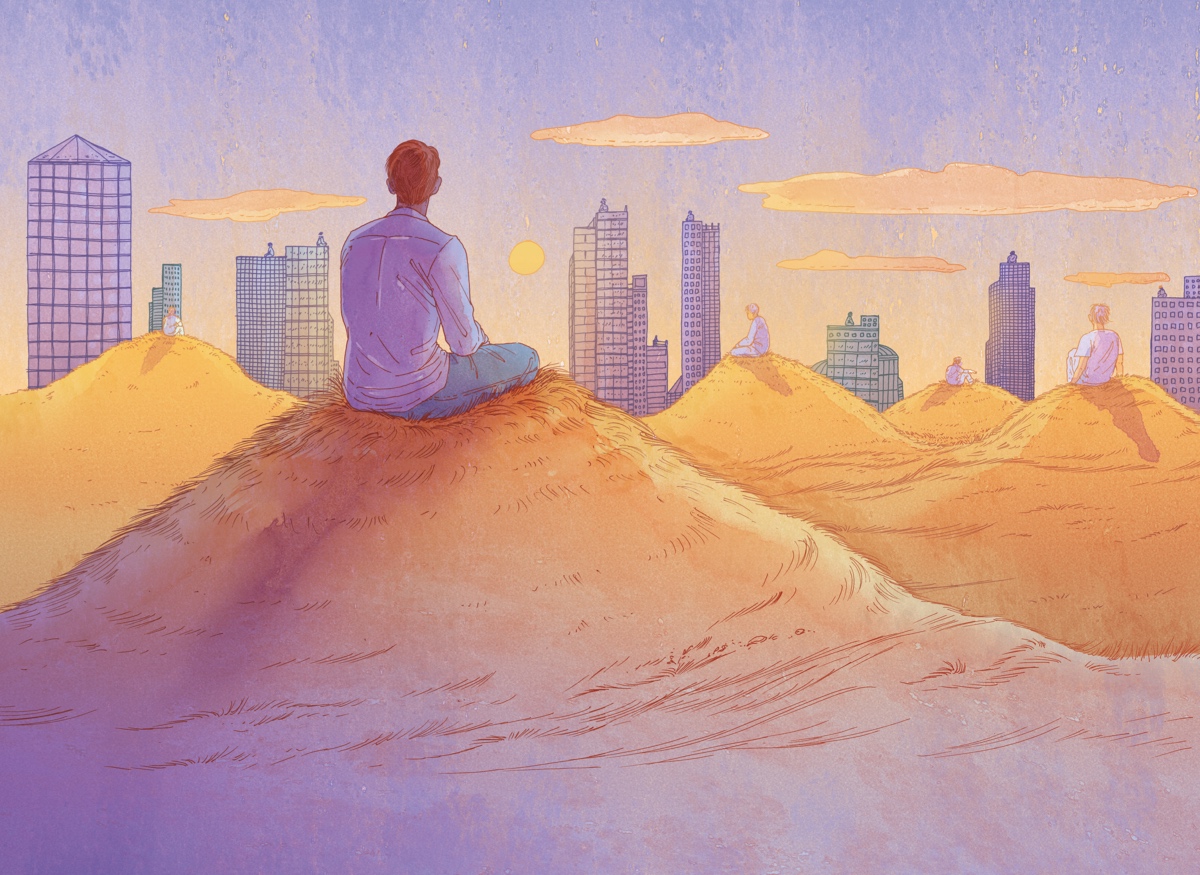
American men are disappearing into their own living rooms. It's a quiet, slow-motion disaster. We’ve reached a point where one in four men say they have no close friends. Not "few" friends. Zero. This isn't just about feeling a bit bored on a Friday night. It's a physical health crisis. Chronic isolation is as deadly as smoking 15 cigarettes a day. It wrecks your heart and inflames your brain.
Andrew McCarthy, the Brat Pack icon who spent decades running away from his own life, might have stumbled onto the most primitive solution we have. He didn't find it in a therapy office or a self-help app. He found it on the Camino de Santiago. He walked five hundred miles across Spain. Then he wrote about it. Most people look at his story and see a celebrity travelogue. They're wrong. It’s a blueprint for how men can stop being ghosts in their own lives.
Why Men Are Losing the Social Game
The statistics are grim. According to the Survey Center on American Life, the percentage of men with at least six close friends has plummeted from 33% in 1990 to just 9% today. We’re losing our "third places"—the bars, gyms, and clubs where guys used to just hang out without a formal invitation. Now, we have Discord and LinkedIn. It's not the same.
Men often rely on "side-by-side" intimacy. We don't usually sit across a table and talk about our feelings for two hours. We do stuff. We fix cars, we play sports, or we watch a game. When those activities vanish, the connection vanishes too. McCarthy’s "recovering loner" status hits home because he realized that his isolation wasn't a personality trait. It was a defense mechanism. He was protecting himself from the vulnerability of being seen.
The Alchemy of the Long Walk
McCarthy’s "cure" wasn't about the destination. It was about the rhythm. There’s something deeply psychological about walking long distances. It forces you out of your head and into your body. When you’re walking the Camino, or any long trail, the internal monologue finally shuts up because your feet hurt and you’re hungry.
This is where the magic happens for lonely men. On a trail, you meet people. You’re all moving in the same direction. The stakes are low. You share a meal, talk for twenty minutes, and maybe never see them again. Or maybe you walk together for three days. It’s low-pressure social interaction. It bypasses the "social anxiety" filter that keeps many men locked at home.
McCarthy found that by being alone in public—among other seekers—he actually learned how to be with people. He wasn't performing. He was just a guy with a backpack. That’s a massive lesson. Most men feel they have to provide, perform, or protect at all times. Stripping that away is terrifying but necessary.
The Myth of the Rugged Individual
We’ve been sold a lie. The "Lone Wolf" is a cool movie trope, but in the wild, a lone wolf is usually a dead wolf. American culture prizes independence to a fault. We think asking for a beer or a chat makes us look weak.
McCarthy’s journey proves the opposite. It takes more courage to admit you're lonely than to pretend you’re fine. He talks about "the walk" as a way to outrun his fears until they just got tired and gave up. That’s a visceral image. For many men, loneliness is tied to a fear of being "found out"—of people realizing we don't have it all figured out.
Digital Ghosting and the Screen Trap
Let's talk about why this is getting worse. Algorithms are designed to keep you lonely. They want you scrolling, not strolling. A 2023 study from the University of Glasgow found that heavy social media use is directly linked to increased feelings of social isolation in young adults.
We think we’re connecting because we’re "liking" a photo. We aren't. We’re just observing. McCarthy’s move was to disconnect entirely. He went to a place where his phone didn't matter. He traded the digital "feed" for real-world friction. Friction is good. Friction is how you know you’re alive. You need the wind, the rain, and the annoying guy at the hostel who snores. That’s the texture of life that a screen can't replicate.
Implementing the McCarthy Method Without Going to Spain
You don't need a plane ticket to Santiago to fix this. You don't need to be a millionaire actor. You need a shift in geography. If you’re feeling that "black hole" of isolation, the worst thing you can do is stay in your house.
- Start walking. Not for exercise, though that’s a perk. Walk to see things. Walk until you’re tired enough that your brain stops cycling through your failures.
- Find a "shoulder-to-shoulder" activity. Join a local hiking group, a Brazilian Jiu-Jitsu gym, or a woodworking class. It sounds cliché because it works.
- The 10-Minute Rule. If you think of a friend, text them. Don't overthink it. Don't wonder if you're "bothering" them. They’re probably lonely too.
- Volunteer for something physical. Build houses with Habitat for Humanity or help at a community garden. Men connect best when they have a common enemy or a common goal.
The Physiological Payoff
When you move your body, you change your chemistry. Exercise releases endorphins, but "green exercise"—moving in nature—lowers cortisol levels significantly more than a treadmill session. McCarthy wasn't just "finding himself." He was recalibrating his nervous system.
He discovered that his "loner" persona was just a shell. Underneath was a person who actually liked people. Most men think they’re introverts when they’re actually just out of practice. Socializing is a muscle. If you don't use it, it atrophies. It’s going to feel awkward when you start using it again. That’s fine. McCarthy felt awkward for the first hundred miles. Then he didn't.
Taking the First Step
Stop waiting for a "reunion" or a formal event to re-enter the world. The "cure" McCarthy found is accessible to anyone with a pair of boots and a willingness to be uncomfortable. Loneliness thrives in the dark and the quiet. It dies when you’re out in the sun, moving your legs, and saying "hello" to a stranger on a path.
Get out of the house. Walk until the city ends. Talk to someone you don't know. Do it again tomorrow. The Camino isn't a place in Spain; it's a state of mind where you decide that your own company isn't enough anymore. That's the only way back to the land of the living.
Go outside. Now.