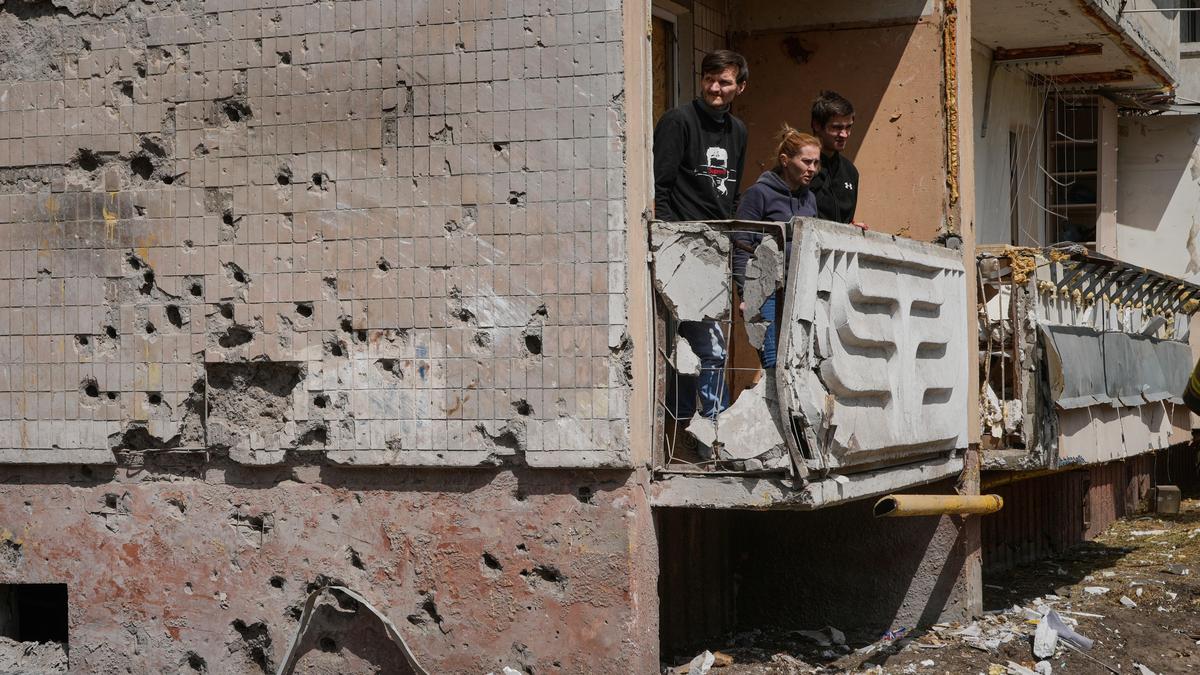
The coffee in the mug was likely still warm when the world split open. It is a mundane detail, the kind of domestic ghost that haunts the wreckage of a Kyiv apartment block. Somewhere on the fifth or ninth floor, a woman might have been reaching for a sweater because the morning chill hadn’t quite lifted. A child was probably arguing about finishing their cereal. These are the small, rhythmic pulses of a life lived in a city that has learned to breathe through the sirens. Then, the rhythm stopped.
Statistics have a way of numbing the soul. We hear "twenty-four dead" and our brains categorize it. We file it under the growing ledger of a long war. We see a number, not a face. But twenty-four is not a number. It is a symphony cut off in the middle of a bar. It is twenty-four sets of house keys that no longer have a door to unlock. It is twenty-four unmade beds that will stay that way.
The dust is the first thing that hits you. It isn’t like the dust under your sofa. This is the pulverized remains of a home—drywall, concrete, family photo albums, and memories—all ground into a gray, suffocating powder that coats the lungs and the lime trees lining the street. Rescue workers move through it like shadows. They don’t shout much anymore. They whisper. They listen for the sound of a scratch against a pipe or a muffled sob from beneath ten tons of shattered flooring.
The Anatomy of a Home
A modern apartment building is a marvel of interconnected lives. You share a wall with a retired teacher who plays the piano at 4:00 PM. You share a floor with a young couple whose dog barks at the mailman. You are separated by mere inches of brick and mortar, bound together by the communal hum of the elevator and the smell of frying onions in the hallway.
When a missile strikes, that interconnectedness becomes a trap. The physics of it are brutal. The impact doesn’t just break things; it folds them. Imagine taking a deck of cards and squeezing it until the middle bursts outward. That is what happens to a residential structure. The "pancake effect" leaves no pockets of air, no room for a miracle.
Consider a hypothetical resident—let's call him Viktor. Viktor spent thirty years at the local waterworks. He bought his apartment in 1994, proud of the parquet floors he laid himself. To the world, Viktor is now a statistic in a death toll report. To the building, he was the man who always held the door open. When the ceiling gave way, the parquet floors he loved didn't just break; they vanished into the maw of the crater.
The tragedy of the twenty-fourth victim isn't just that they died. It is that they were found last.
For days, the number sat at twenty-three. For days, one family waited behind the police tape, eyes fixed on the yellow cranes. They knew. In the hollowed-out silence of their hearts, they already knew. But as long as that number stayed at twenty-three, there was a sliver of impossible hope, a jagged piece of glass they clung to until their hands bled. Finding the twenty-fourth body provides a terrible, crushing clarity. It is the closing of a door that no one wanted to shut.
The Weight of the Invisible
We talk about "infrastructure damage" as if we are discussing pipes and wires. We aren't. We are talking about the infrastructure of the human spirit. Every time a building like this is leveled, the city loses more than a landmark. It loses a repository of history.
Kyiv is a city of layers. There are the ancient catacombs, the Soviet monoliths, and the glass-fronted symbols of a European future. When an apartment block in a quiet neighborhood is targeted, it sends a vibration through every other floorboard in the city. People look at their own ceilings. They wonder about the weight of the concrete above their heads. They ask the question that has no good answer: Why them and not me?
Survivors often speak of the sound. It isn't just a bang. It is a roar that feels like it’s coming from inside your own skull. It’s the sound of a thousand glass windows shattering simultaneously—a crystalline scream. Then, the silence. That silence is the most terrifying part. It is the sound of a neighborhood holding its breath, waiting for the screams to start, or worse, realizing they won't.
The logistics of recovery are a grim ballet. Digging through rubble isn't a matter of brute force. It is a delicate, agonizingly slow process. If you move the wrong beam, the whole pile shifts, crushing anyone who might still be clinging to life in a crawlspace. The rescuers work in shifts, their neon vests stained with the gray soot of the building's remains. They find shoes. They find half-burned books. They find a child’s teddy bear, perfectly clean, sitting atop a jagged slab of stone as if it were waiting for its owner to come back from the park.
The Ledger of Loss
Beyond the immediate gore and the smoke, there is the slow-motion disaster of the displaced. For every one of the twenty-four who perished, there are hundreds whose lives have been fractured. They stand on the sidewalk in their pajamas, wrapped in foil blankets, watching their entire existence be hauled away in dumpsters.
Everything you own defines your place in the world. Your birth certificate. Your grandmother’s earrings. The laptop with the photos of your wedding. When these things are vaporized, you become a ghost in your own city. You are alive, but the evidence of your life has been erased.
The world looks at the headline—"Death Toll Rises to 24"—and perhaps they feel a flicker of pity before scrolling to the next story. But for the people on that street, twenty-four is a hole in the universe. It is twenty-four chairs that will be empty at the next dinner table. It is twenty-four birthdays that will never be celebrated.
There is a specific kind of grief that comes from state-sponsored violence. It isn't like a natural disaster. You can't be angry at the wind or the tectonic plates. This was a choice. Someone, somewhere, looked at a map and decided that this specific coordinate, this specific collection of kitchens and bedrooms, was a legitimate target. That realization adds a layer of acid to the sorrow. It turns grief into something sharper, something that doesn't just ache, but burns.
The Resilience of the Ruin
Yet, if you walk a few blocks away from the crater, you see something almost offensive in its persistence. A café is open. A man is walking a golden retriever. A woman is selling tulips from a plastic bucket.
This isn't indifference. It is defiance.
In Kyiv, continuing to live is a form of warfare. Every cup of coffee brewed is a middle finger to the forces that want the city to stop. The people here have learned to compartmentalize the horror. They acknowledge the twenty-four, they mourn them, they help dig them out, and then they go back to work. They have to. If they don't, the rubble wins.
The story of the Kyiv apartment building isn't just a story of death. It is a story of what remains when everything else is stripped away. It is the story of the neighbors who brought hot tea to the rescuers at 3:00 AM. It is the story of the volunteers who organized housing for the survivors before the dust had even settled. It is the story of a city that refuses to be turned into a graveyard.
We focus on the falling buildings because they are spectacular in their destruction. They make for good photography. But the real story is in the rebuilding—not just of the walls, but of the people. The twenty-fourth victim has been found, and the recovery mission is officially over. The cranes will eventually leave. The debris will be cleared.
But the air will always be a little heavier on that corner. The silence will be a little deeper.
The next time you see a number in a headline, try to hear the sound of a key turning in a lock. Try to smell the coffee that never got drank. Try to feel the weight of a life that was lived in the inches between those walls. Twenty-four isn't a final count. It is twenty-four separate worlds that ended on a Tuesday morning, leaving the rest of us to figure out how to live in a world that allowed it to happen.
The sunflowers will grow back in the window boxes of the nearby buildings, and the sirens will eventually fall silent, but the city will never forget the names it had to write in the dust.