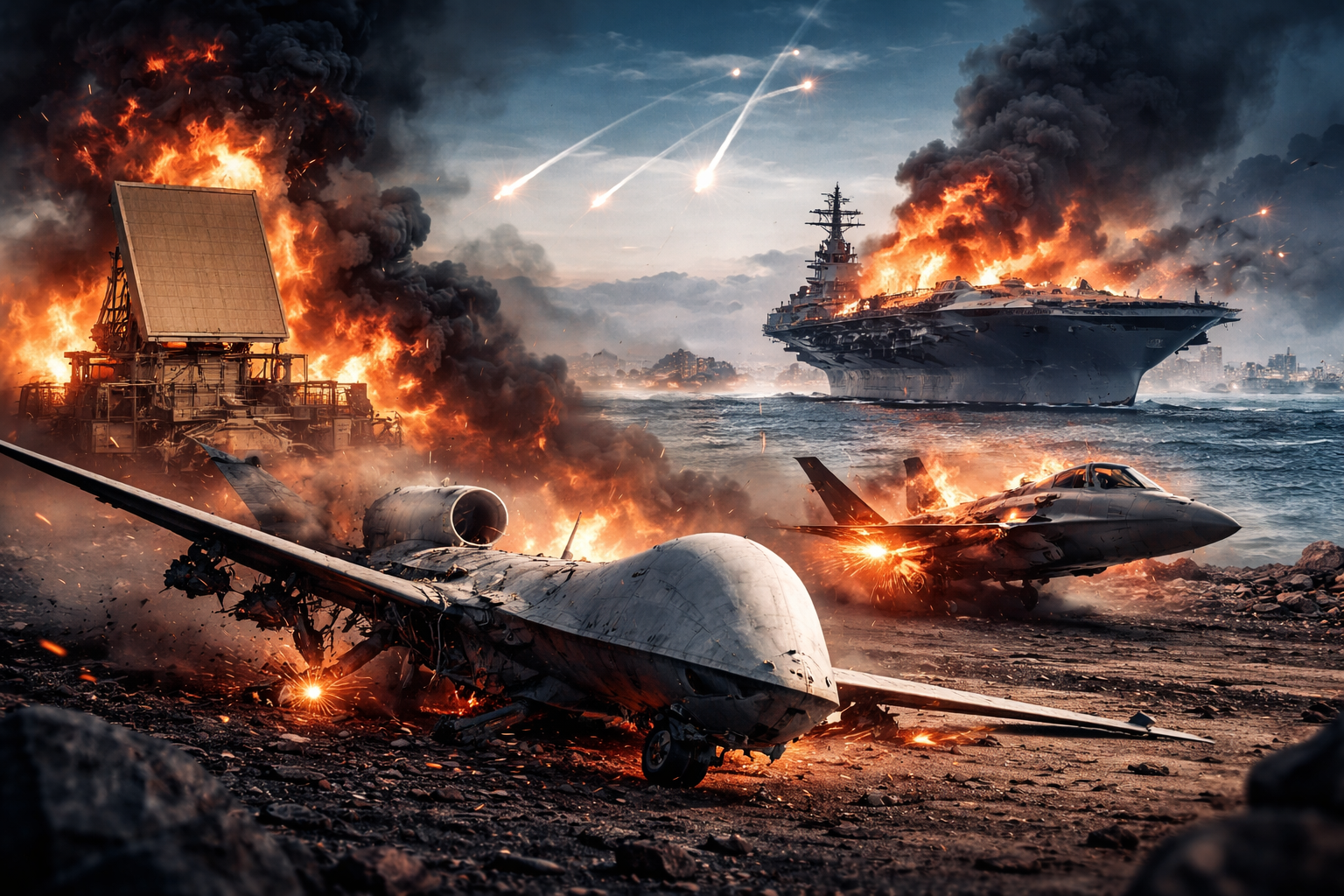
The first thing you lose isn’t your life. It is the silence. In the high deserts where the air tastes like oxidized copper and sun-bleached grit, silence is the only luxury a soldier truly owns. Then, the sky begins to scream.
We often talk about war in the language of inventory. We count the charred husks of Humvees. We tally the jagged holes in hangar roofs. We list the "losses" as if they are items on a misplaced grocery receipt. But a list of damage is a hollow thing. It doesn't tell you about the vibration in a young specialist’s marrow when a drone, no larger than a lawnmower and costing less than a used sedan, beats its wings against the atmosphere.
For twenty-one days, the inventory grew. But the story isn't in the ledger. It’s in the dust.
The Ghost in the Radar
Imagine a radar screen. It is a masterpiece of twentieth-century engineering, a glowing eye designed to spot a supersonic jet or a massive ballistic missile. It is looking for eagles. Instead, it is being pecked to death by a thousand starlings.
The assault began not with a grand declaration, but with a series of persistent, buzzing shadows. These were the "one-way attack" munitions—low-cost, high-impact drones that turned the sky over U.S. positions into a frantic shooting gallery. When we look at the official list of military losses, we see "minor damage to infrastructure." What that actually means is a shattered dining facility where, minutes before, soldiers were calling home. It means a maintenance shed reduced to toothpicks, erasing the tools needed to keep the remaining fleet alive.
Consider the logic of the asymmetric. A million-dollar interceptor missile is launched to swat down a drone built in a garage. The math is brutal. It is a war of exhaustion. For three weeks, the rhythm never broke. Every time the sun dipped below the horizon, the nervous system of the base would tighten. Sleep became a transactional commodity, traded for minutes of hyper-vigilance.
The Invisible Wound
We have become very good at counting the dead. We are less practiced at counting the changed.
During this twenty-one-day window, the reports filtered out in clinical bursts: "Traumatic Brain Injuries (TBI) suspected." It sounds clean. It sounds like something a bandage can fix. It isn't. A TBI is an invisible tectonic shift inside the skull. When a rocket slams into a concrete barrier fifty yards away, the shockwave doesn't just move the air. It moves the brain. It ripples through the soft tissue like a stone dropped into a dark pool.
One hypothetical soldier—let’s call him Miller—doesn't have a scratch on him. He isn't on the "major casualties" list. But Miller can’t remember his sister’s middle name anymore. He smells burnt toast when there is no kitchen for miles. His hands, once steady enough to calibrate delicate optics, now carry a persistent, rhythmic twitch.
The "full list of losses" rarely includes the decades of veteran care that follow a three-week barrage. It doesn't include the lost sleep of a thousand families watching the news tickers. We focus on the scorched paint on an MQ-9 Reaper drone, forgetting that the machine is replaceable. The man operating the sensor, watching the horizon for the next flicker of fire, is not.
The Architecture of the Siege
The damage to physical assets follows a chillingly predictable pattern. First, the eyes are targeted. Radars and communication towers are the high-priority "hardware" losses. Without them, a multi-billion dollar base becomes a blind giant.
In one particular week of the assault, the focus shifted to logistics. Fuel bladders. Hangar bays. The mundane stuff of war. If you can’t fuel the birds, the birds don't fly. The competitor articles will tell you that "six facilities sustained moderate damage." Translate that: the air conditioning units that keep the server racks from melting in the 110-degree heat were shredded by shrapnel. Suddenly, the most advanced fighting force in history is fighting the heat as much as the enemy.
It is a slow-motion strangulation. The damage isn't designed to end the presence of the U.S. military in a single afternoon. It is designed to make that presence expensive. Politically expensive. Emotionally expensive. Logistically impossible.
The Logic of the Low-Cost
Why does it work? Because the technology has shifted the "value" of a hit.
In the old paradigm, you needed a bomber and a pilot to destroy a command center. Now, you need a GPS coordinate and a few thousand dollars' worth of fiberglass and electronics. During those twenty-one days, the frequency of the attacks created a "saturation" effect. When thirty projectiles are in the air at once, the defense systems—no matter how robust—become a funnel that is too narrow for the volume of water being poured through it.
The losses weren't just the buildings. The loss was the illusion of total sanctuary. The realization that there is no "rear" in modern conflict. Every square inch of a base is the front line when the threat comes from the clouds.
The Weight of the Ledger
If you look at the final tally, the numbers seem manageable. A dozen drones. A few dozen rockets. A list of repairs that would fit on a single page of a Pentagon budget.
But look closer at the human cost buried in the "minor" categories. Every siren that went off in those twenty-one days is a memory etched into the nervous system of a nineteen-year-old. Every "non-critical" injury is a life redirected. The damage to the U.S. military isn't just found in the twisted metal of a destroyed Humvee or the cratered tarmac of an airfield.
The real loss is the peace of the desert. It is the understanding that the rules of engagement have been rewritten by the cheap, the small, and the persistent.
The twenty-one days ended, but the dust hasn't settled. It just hangs there, shimmering in the heat, waiting for the next sound to break the silence.
The list is never truly full. It is just waiting for the next entry.
Would you like me to look into the specific technological countermeasures being developed to intercept low-cost drones?


