The air in Boston on a marathon Monday doesn't just sit; it vibrates. It is a thick, electric soup of liniment oil, salt spray, and the desperate, rhythmic thud of thirty thousand heartbeats trying to outrun their own limitations. For months, the athletes have lived by the clock. They have measured their lives in four-ounce increments of electrolyte water and the precise degradation of the rubber on their soles. When you are twenty-four miles into the Boston Marathon, the world has shrunk to the width of the yellow line on the pavement. Your family, your job, and your mortgage have vanished. There is only the breath, the burn, and the finish line.
Then, the script breaks.
For Matthew Teague, the 2023 race was the culmination of a grueling journey. He was on pace. He was hitting his splits. But near the end of the course, the mechanical rhythm of the race shattered. He saw a man collapsed. This wasn't the typical stagger of a runner who had hit "the wall"—the physiological point where glycogen stores are depleted and the body begins to cannibalize itself. This was different. This was a total system failure.
In that moment, the marathon stops being a race and becomes a mirror.
The Math of Sacrifice
To understand why stopping is an act of quiet heroism, you have to look at the cold, hard data of the Boston Marathon. This is not a fun run. To even stand on the starting line in Hopkinton, most runners have to meet rigorous qualifying standards. For a man in the 18-34 age bracket, that means running a previous marathon in under 3 hours and zero minutes. That is a pace of 6:52 per mile, maintained for 26.2 miles.
When a runner like Teague or the others who joined him—men who had spent thousands of dollars on travel, gear, and entry fees—decides to halt their momentum, they aren't just losing a few seconds. They are discarding a year of their life. They are choosing to "DNF" (Did Not Finish) or ruin a hard-earned personal best.
Statistics from the Boston Athletic Association show that in a typical year, only a small fraction of the field fails to finish. Most of those are due to personal injury. It is exceedingly rare to see a healthy, high-performing runner voluntarily terminate their race to act as a human crutch for a stranger. Yet, that is exactly what happened. Teague and another runner, Simon Shaitel, didn't check their watches. They checked the pulse of the man on the ground.
The Invisible Stakes
We often talk about sportsmanship as a polite handshake after a game. In the middle of a marathon, sportsmanship is a visceral, messy, and physically painful choice. Imagine your quadriceps screaming, feeling as though someone is driving hot needles into the muscle fibers. Every time you stop moving, the lactic acid settles like concrete. Starting again is twice as hard as never stopping at all.
The man they found was struggling. He wasn't just tired; he was disoriented. In the medical world, this is often the onset of severe hyponatremia or heat stroke, conditions where the brain begins to swell or the internal organs begin to cook.
Consider a hypothetical runner named Elias. Elias has trained for three years to break the four-hour mark. He is at mile 25.2. He can see the Citgo sign. He can almost hear the roar of the crowd on Boylston Street. If he stops to help a stranger, his dream dies. If he keeps running, he might be the one who calls for a medic at the finish line, but by then, it might be too late for the man on the asphalt.
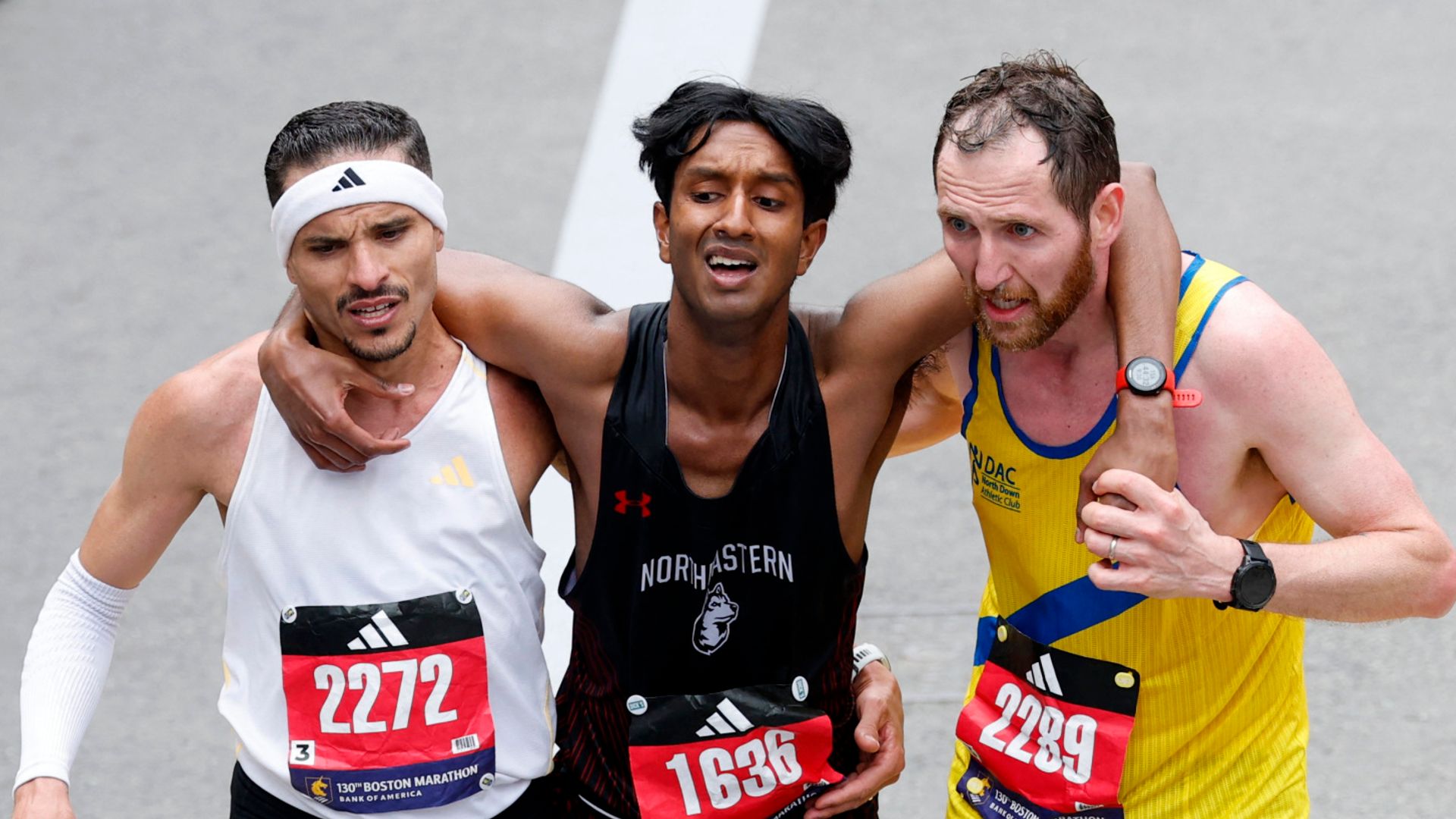
Teague and Shaitel didn't have a meeting. They didn't weigh the pros and cons. They reached down, hooked the man’s arms over their shoulders, and became his skeleton.
The Weight of a Stranger
A human body in collapse is surprisingly heavy. It is "dead weight" in the most literal sense—the muscles are no longer firing to support the frame. Carrying a grown man for the final stretch of a marathon is a feat of strength that defies the endurance-focused physiology of a long-distance runner.
The crowd watched as this three-headed silhouette moved toward the finish. It was a slow, agonizing shuffle. In those moments, the "race" was happening all around them. Sub-three-hour runners streaked past, their eyes fixed forward, their faces masks of agony. They weren't bad people; they were simply still trapped in the logic of the marathon.
But for the men holding up their fallen comrade, the logic had shifted. They were no longer competing against the clock. They were competing against gravity and the fragility of the human spirit.
Historically, the Boston Marathon is a place of profound struggle. It is the site of the 1967 breakthrough where Kathrine Switzer defied the ban on women runners. It is the site of the 2013 tragedy that turned the finish line into a battlefield. The pavement there is soaked in more than just sweat; it is a repository for the city's collective resilience. When these men chose to sacrifice their times, they were tapping into a tradition that says the person next to you is more important than the medal waiting for you.
Beyond the Finish Line
What does it cost to be kind?
In the world of elite amateur athletics, the cost is quantifiable. It’s the $250 carbon-plated shoes that are now scuffed and worn out for a "slow" time. It’s the missed Boston Qualification (BQ) for the following year. It’s the explanation you have to give to your coworkers who ask, "So, how did you do?"
But there is a hidden dividend.
The man they helped didn't just reach the finish line; he survived. In the medical tents located just past the timing mats, volunteers deal with everything from blisters to cardiac arrest. Because those runners stopped, the man was handed off to professionals minutes sooner than he would have been if he’d been left to crawl or wait for a mobile unit.
We live in a culture that obsessively tracks "the win." We have apps that tell us our pace, our heart rate variability, and our sleep quality. We are optimized. We are efficient. We are focused. But the marathon reminds us that optimization is a lonely pursuit.
The real story isn't that a man finished the race. It’s that two other men decided that finishing didn't matter unless they did it together. They turned a solitary endurance sport into a team rescue mission.
As they crossed the line, the chips in their shoes beeped, recording times that would never make the front page of a sports section. The data will show they finished hundreds, perhaps thousands, of places behind the winner. The spreadsheets will mark them as average.
The clock keeps ticking, indifferent to why someone slows down. The wind still whips off the Charles River, chilling the sweat on the skin of those who linger. But as the sun sets over Copley Square, the metal of the medals begins to cool, and the soreness in the legs begins to fade, a different kind of memory takes hold. It is the memory of the weight of a stranger’s arm, the sound of a shared struggle, and the realization that the most important mile isn't the one you run for yourself, but the one you walk for someone else.
The finish line is just a piece of painted rubber on the road. The true end of the race is where your ego stops and your humanity begins.