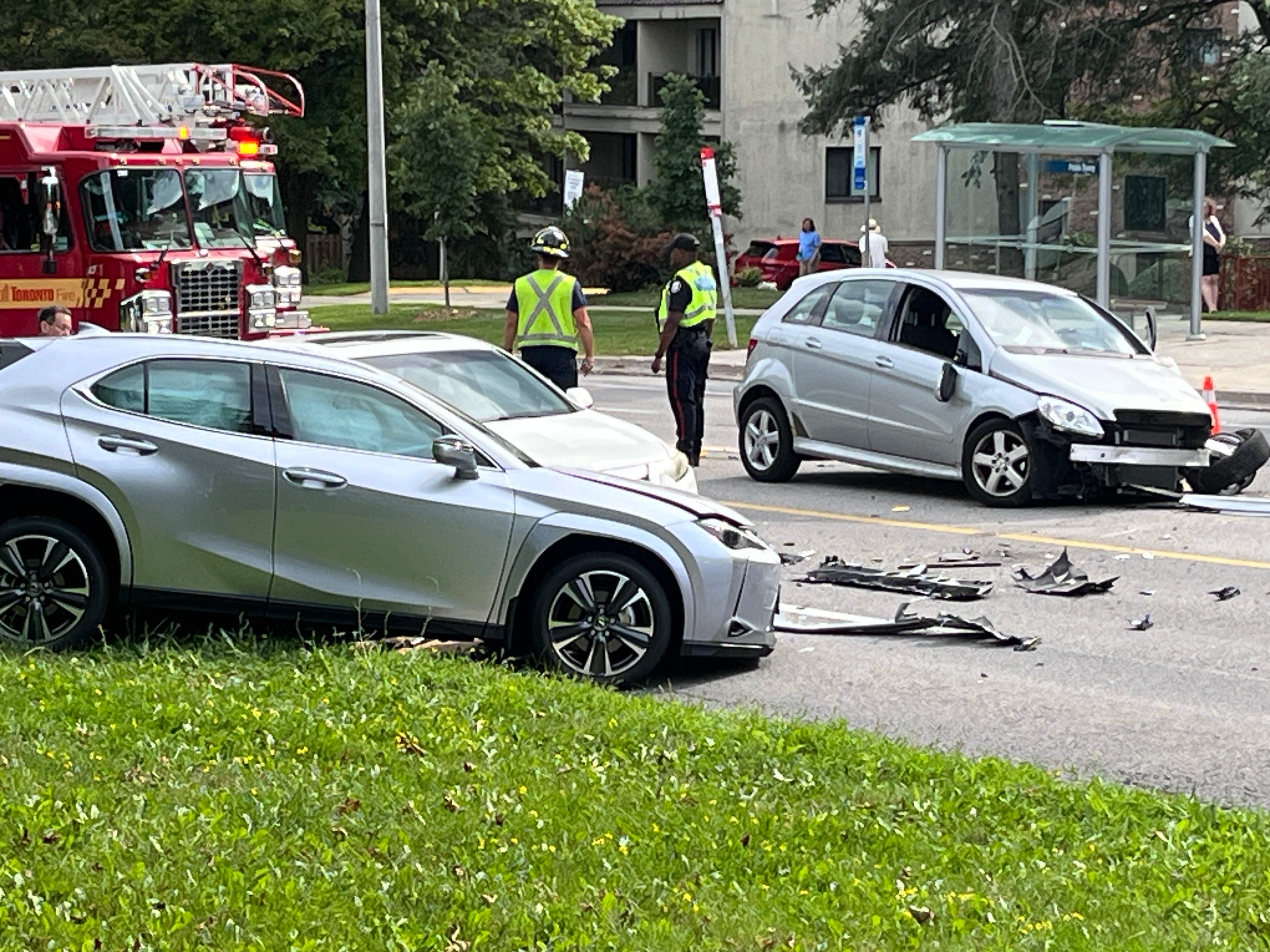
Standard traffic reporting treats urban collisions as isolated anomalies, stochastic misfortunate events with no predictable architecture. When a multi-vehicle crash shuts down a major arterial roadway such as Don Mills Road, news outlets typically reduce the incident to a casualty count, a road closure radius, and a generic police appeal for witnesses. This journalistic framework obscures the mechanical, systemic, and kinetic realities of urban transport networks. Urban infrastructure is a tightly coupled physical system operating under high utilization rates. Evaluating collisions through the lens of systems engineering reveals that multi-vehicle incidents are the logical outcomes of velocity distributions, reaction time thresholds, and geometric constraints within high-density corridors.
The primary variables governing urban intersection and corridor collisions can be categorized into three distinct operational domains: kinetic energy dissipation, spatial capacity limits, and driver cognitive load.
Kinetic energy scales quadratically with velocity through the classic formula where energy equals one-half mass multiplied by velocity squared. In urban arterial environments with posted limits between 50 and 60 kilometers per hour, passenger vehicles possess immense destructive capacity. When three vehicles interact during a collision sequence near intersections like Don Mills Road and Mogul Drive, the event is rarely a simultaneous three-way impact. Instead, it manifests as a primary kinetic transfer followed by secondary and tertiary collisions as momentum distributes across differing vectors. The severity of injuries, such as those requiring transport to designated trauma centers, correlates directly with the deceleration G-force experienced by the occupants rather than vehicle deformation alone. When delta-v exceeds structural crush zones, human tissue absorbs the residual kinetic load, resulting in serious non-life-threatening or critical trauma.
Spatial capacity limitations dictate the probability of secondary impacts. Urban arterial corridors operate under high volume-to-capacity ratios during afternoon peak periods. When a lead vehicle initiates an emergency braking maneuver or experiences a sudden directional deviation, the available stopping distance for trailing vehicles is a function of perception-reaction time and braking deceleration rates. Under optimal dry asphalt conditions, a driver requires approximately 1.5 seconds to perceive a hazard and initiate braking, plus an additional stopping distance governed by tire-to-road friction coefficients. If the spatial buffer between vehicles falls below this dynamic threshold, a rear-end compression wave ripples backward instantly. When multiple lanes are occupied, this compression wave often forces drivers into adjacent lanes, converting a simple rear-end conflict into a multi-directional multi-vehicle collision that physically blocks the corridor.
Cognitive load theory explains the human element in these mechanical failures. Urban corridors feature high visual and operational entropy. Traffic signals, pedestrian movements, commercial entrances, and lane-merge conflicts bombard the driver's working memory. As cognitive load approaches maximum capacity, hazard detection latency increases significantly. A driver processing navigation cues or managing cabin distractions experiences tunnel vision, dropping peripheral hazard identification. When an unexpected deceleration occurs ahead, the delayed reaction time compresses the already narrow safety margins of high-density traffic streams.
The economic and logistical fallout of these incidents follows a predictable cost function. Road closures force municipal transit and freight logistics to reroute onto secondary residential or collector streets that lack the geometric capacity to handle arterial volume. This induces localized gridlock, extending delays across the broader municipal grid. Emergency response deployment requires the coordination of fire, paramedic, and municipal police services, locking up critical public resources and delaying clearance times. The duration of the road closure is directly proportional to the complexity of collision reconstruction and environmental hazard mitigation, such as fluid spill cleanup and structural debris removal.
Municipalities attempt to mitigate these systemic failures through reactive infrastructure adjustments, such as signal timing optimizations and localized speed reductions. However, these measures fail to address the core vulnerability of mixed-mode urban arterials: the inherent friction between high-throughput vehicular movement and complex local access points. True risk reduction requires shifting from retrospective incident reporting to predictive corridor management, utilizing automated speed enforcement, dynamic lane control, and physical separation of high-speed traffic from turning movements. Without structural modifications to how urban corridors handle kinetic throughput, multi-vehicle trauma events will remain an inevitable tax on high-density transit networks.