For years, municipal planners treated white roofs as the ultimate urban savior against rising temperatures. Paint a surface bright white, bounce solar radiation back into the atmosphere, and watch the ambient heat dissipate. Then a University of Hawaii study quietly dismantled that simplistic narrative. Researchers tracking rooftop microclimates in Honolulu discovered that living vegetation outperformed high-albedo coatings by margins that engineering textbooks refused to predict.
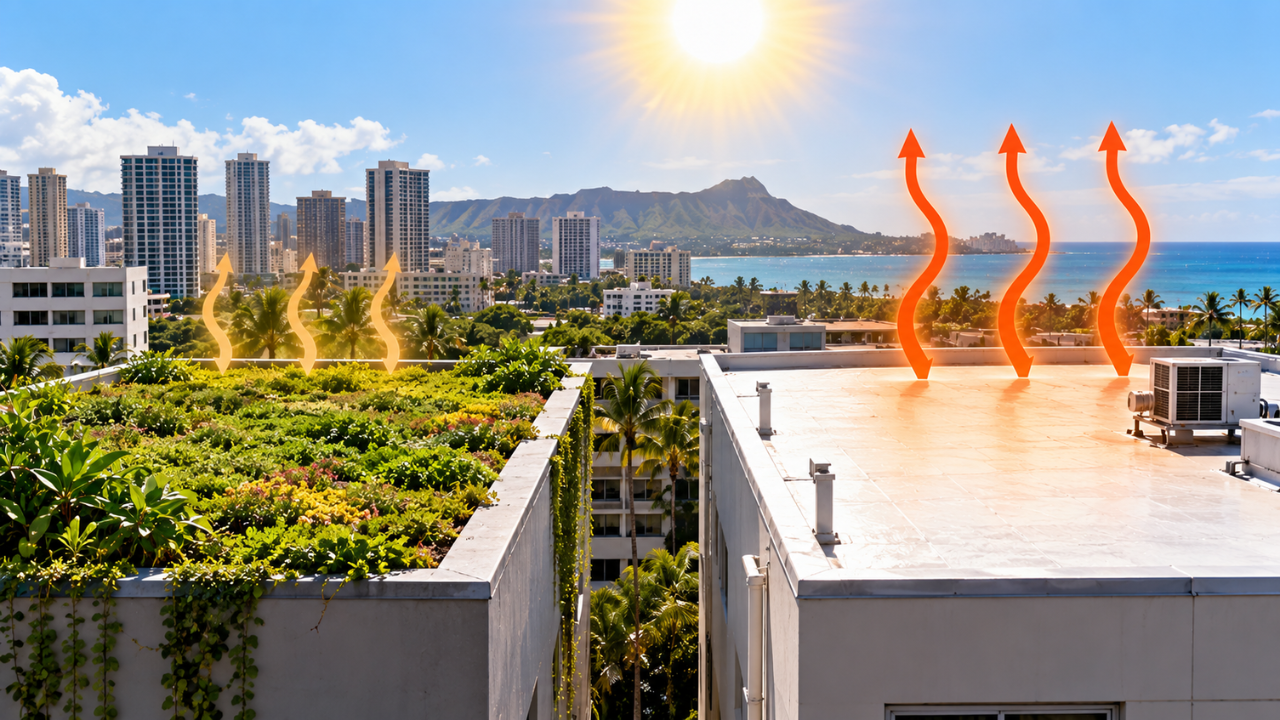
The primary takeaway is stark. Under direct tropical sunlight, a modest green roof setup stayed significantly cooler than its white-painted counterpart, driving surface temperatures down by more than 18 degrees Fahrenheit at peak intensity. Yet municipal building codes across the globe continue to prioritize cheap chemical coatings over living infrastructure, clinging to spreadsheets that ignore thermodynamic reality. If you enjoyed this article, you might want to check out: this related article.
Understanding why white roofs fail under severe urban heat requires looking past corporate marketing claims and examining the physics of the boundary layer. White roofs rely purely on reflection. They do not absorb thermal energy, but they do nothing to actively remove heat from the surrounding air. When thousands of surrounding buildings reflect that radiation sideways into narrow urban corridors, pedestrian zones turn into convection ovens.
Vegetated roofs operate through an entirely different physical mechanism known as evapotranspiration. Plants draw moisture from underlying substrate layers and transpire water vapor through their leaves. Phase change requires thermal energy. As water converts from liquid to gas, it actively pulls heat directly out of the ambient air. For another angle on this story, refer to the latest update from MarketWatch.
The Honolulu Blueprint
The empirical foundation for this shift came from a localized testbed deployed atop an eleven-story building in Waikiki. Researchers constructed side-by-side planter modules to measure thermal performance across continuous diurnal cycles.
The data recorded during those testing windows exposed severe performance ceilings in standard white membranes.
- Surface Temperature Extremes: Conventional white roof surfaces peaked at a blistering 113 degrees Fahrenheit, while adjacent planted modules capped out at 94.5 degrees.
- Air Column Cooling: At two feet above the installation, ambient air temperatures over the green plots registered nearly 17 degrees cooler than the air hovering above the white reflective coating.
- Thermal Inertia: Planted systems delayed peak heat absorption by up to three hours, acting as heavy thermal insulation that stopped heat transfer into building cores.
These numbers expose the limitation of relying on albedo alone. White roofs stop solar absorption at the boundary line, but they provide zero thermal mass. Once ambient air temperatures surpass skin temperature, reflective surfaces fail to offer meaningful environmental relief.
The Economic Friction Holding Back Living Architecture
If green infrastructure offers superior thermal performance, why aren't commercial districts covered in sedum and native grasses? The answer lies in upfront capital expenditure, structural engineering constraints, and maintenance neglect.
Retrofitting a standard commercial structure to support saturated growing media requires extensive structural reinforcement. A wet green roof adds significant dead load to a building frame. Building owners face high initial installation costs, specialized waterproofing requirements, and long-term irrigation management expenses.
Consider a hypothetical commercial tower in downtown Honolulu. Implementing a full green roof conversion across ten thousand square feet might require an initial capital outlay three to four times higher than simply hiring contractors to spray elastomeric white coating across the deck. Corporate balance sheets favor the immediate, low-cost compliance option over a forty-year lifecycle investment that reduces city-wide energy demands.
Maintenance represents another major hurdle. White roofs require periodic pressure washing to maintain high solar reflectance. Green roofs require botanical management, weed control, drainage inspections, and reliable irrigation systems during extended dry spells. When property managers cut operational budgets, rooftop flora is usually the first casualty.
Rethinking Urban Microclimates
Municipal policy makers must look past the initial line-item expense of living roofs. The urban heat island effect is no longer a localized inconvenience; it is a public health crisis that drives extreme energy consumption through runaway air conditioning demands. When every building in a district radiates trapped heat upward, the local energy grid strains under the load.
Cooling a city requires shifting the fundamental energy balance of the built environment. Reflective coatings bounce energy around, but vegetation consumes it. Until city planners rewrite zoning incentives to reward active thermal dissipation over passive reflection, urban centers will remain locked in a cycle of artificial cooling that generates more waste heat than it solves.
The data from the tropics provides a clear directive. Concrete jungles cannot cool themselves with white paint alone.
Honolulu Cool Roofs for Hawaii Homes
This video provides a localized overview of how reflective roofing strategies interact with residential property management and cooling loads in the Hawaiian climate.
http://googleusercontent.com/youtube_content/1