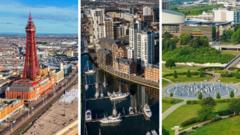
The UK City of Culture 2029 shortlist represents a high-stakes capital allocation exercise where the primary asset is not artistic merit, but the potential for multi-decade urban regeneration. For the nine finalists—Blackpool, Ipswich, Milton Keynes, and others—the competition serves as a catalyst for infrastructure acceleration and brand repositioning. The success of a bid depends on a city’s ability to demonstrate that a temporary surge in cultural programming can trigger permanent shifts in local economic multipliers.
The Economic Multiplier of Cultural Designation
The designation operates as a decentralized stimulus package. Unlike direct central government grants for infrastructure, the City of Culture title functions as a signaling mechanism to private equity and institutional investors. The logic follows a three-stage value capture model:
- Sentiment Shift: A successful bid reduces the "perception discount" that often suppresses property values and business investment in post-industrial or overlooked regions.
- Public-Private Alignment: The bidding process forces local authorities, educational institutions, and private enterprises to synchronize their long-term development plans under a single 12-month delivery window.
- Capital Velocity: Increased footfall during the event year accelerates the transition of high-street retail toward experience-based economies, providing a proof-of-concept for permanent commercial developments.
The Department for Culture, Media and Sport (DCMS) evaluates these bids based on their capacity to solve specific socio-economic bottlenecks. For Blackpool, the objective is the diversification of a seasonal tourism model. For Milton Keynes, it is the creation of a distinct civic identity to match its rapid population growth. For Ipswich, it is the revitalization of a historic port town facing competition from larger regional hubs.
Structural Analysis of the 2029 Shortlist
The shortlist reflects a deliberate geographic and economic spread, aimed at addressing the "levelling up" agenda through distinct urban archetypes. Each finalist occupies a specific niche in the UK's economic geography.
The Post-Industrial Rebirth: Blackpool
Blackpool’s bid is a play for systemic renewal. The city faces high levels of deprivation and a transient population. Here, the culture title is a tool for social engineering. By investing in cultural infrastructure, the city aims to improve "place-stickiness"—the ability to retain young talent and skilled workers who would otherwise migrate to Manchester or London. The ROI in Blackpool is measured in health outcomes and educational attainment rather than just ticket sales.
The Planned City Evolution: Milton Keynes
Milton Keynes represents a different challenge: the "Soul-less Suburb" stigma. Despite being one of the fastest-growing economies in the UK, it lacks the deep-time cultural resonance of traditional cities. Its bid focuses on the "City as a Canvas" logic, using its unique grid system and modernist architecture to host large-scale digital and outdoor arts. The strategic goal is to transform from a logistics and tech hub into a lifestyle destination, thereby attracting the high-value "creative class."
The Maritime Pivot: Ipswich and Teesside
Coastal and estuary towns like Ipswich and the Teesside cluster are fighting the decline of traditional manufacturing and port activities. Their bids are centered on the "Blue Economy"—linking maritime heritage with modern renewable energy and digital sectors. The cultural program acts as a bridge, rebranding industrial zones as creative quarters to encourage the growth of tech startups and boutique hospitality.
The Cost Function of Cultural Bidding
Participating in the City of Culture competition is not a zero-cost exercise. The "Bid Cost" includes millions of pounds in consultancy fees, marketing, and the diverted labor of council officials. If a city fails to win, this expenditure is often viewed as a sunk cost, yet the strategic value lies in the "Residual Planning Benefit."
The bidding process requires cities to conduct a comprehensive audit of their cultural assets and infrastructure deficits. This data remains useful for future Levelling Up Fund applications or private sector pitches, even without the 2029 title. However, the risk of "Aspiration Inflation" is real; cities may over-promise on legacy outcomes to win the bid, leading to a "White Elephant" effect where expensive venues sit empty once the festival year concludes.
Logic of the Selection Criteria
The DCMS judging panel utilizes a rigorous framework that prioritizes "Deliverability" and "Legacy Impact." A city with a world-class artistic vision but poor transport links will lose to a city with a modest program and a robust rail upgrade plan. The selection logic is governed by three primary variables:
- Financial Leverage: The ratio of requested government funding to committed private sector sponsorship.
- Social Connectivity: The degree to which the cultural program reaches "cold spots"—neighborhoods with historically low engagement in the arts.
- Infrastructure Elasticity: The city’s ability to handle a 20-30% spike in annual visitors without a collapse in local services.
The Hull and Coventry Benchmarks
To understand the 2029 trajectory, one must look at the quantitative outcomes of previous winners. Hull (2017) saw an estimated £3.4 billion in investment following its win, with 1 in 4 businesses reporting increased turnover. Coventry (2021) faced the headwind of a global pandemic but still managed to secure over £170 million in additional investment for the city center.
However, these successes are balanced by the reality of "Displacement Effects." Often, the economic activity generated by a City of Culture is not entirely new; it is simply moved from neighboring towns or other sectors of the economy. A rigorous analyst must distinguish between "Gross Value Added" (GVA) and "Net Regional Benefit."
Strategic Vulnerabilities in the Current Bidding Process
The 2029 competition occurs in a period of extreme fiscal constraint for local authorities. Several UK councils have effectively declared bankruptcy (Section 114 notices) in recent years. This creates a paradox: the cities that need the cultural stimulus most are often the ones least able to afford the initial investment required to host it.
The sustainability of the model is threatened by:
- Operating Cost Volatility: Inflation in construction and labor markets makes it difficult to budget for an event three years in advance.
- Political Instability: Changes in local or national government can lead to the withdrawal of support for long-term cultural projects.
- Community Cynicism: If the benefits of the designation do not "trickle down" to the average resident in the form of jobs or improved public spaces, the project loses its social license to operate.
The Mechanics of the "Legacy Year"
The most critical phase of the 2029 cycle is not the year itself, but the three years following it. Successful cities like Liverpool (European Capital of Culture 2008) used the title to pivot their entire economic identity. The "Legacy Year" requires a transition from one-off event funding to sustainable, commercial revenue streams.
This transition involves:
- Endowment Funding: Setting aside a portion of the bid budget to maintain cultural organizations post-2029.
- Institutional Integration: Embedding cultural requirements into local planning laws to ensure new developments include public art or community spaces.
- Tourism Retention: Converting one-time visitors into repeat tourists through a permanent improvement in the "City Brand."
Evaluating the 2029 Finalists' Probability of Success
While the official shortlist is public, the internal "Probability of Win" (PoW) for each city is dictated by their alignment with the current national industrial strategy.
- Blackpool has a high PoW if the government prioritizes social cohesion and the "left-behind" narrative.
- Milton Keynes gains an edge if the focus shifts to the "Innovation Economy" and digital arts.
- Ipswich and the Teesside entries are strong contenders if the panel emphasizes maritime regeneration and regional rebalancing.
The selection of the winner in late 2025 will be a definitive signal of where the UK intends to place its strategic bets for the end of the decade.
The Strategic Play for 2029 Stakeholders
Local authorities currently on the shortlist must pivot from "Visionary Marketing" to "Execution Modeling." The next twelve months require a shift in focus toward the following three operational pillars:
- Risk Mitigation Plans: Address the Section 114 risk head-on by ring-fencing cultural budgets through independent charitable trusts or private sector partnerships. This de-risks the project for the central government.
- Granular Data Capture: Implement baseline metrics now for footfall, spend per head, and local sentiment. The ability to prove impact in real-time is a significant competitive advantage in the final judging round.
- Cross-Regional Collaboration: Instead of viewing neighboring cities as rivals, finalists should build "Corridor Strategies" that demonstrate how their win will benefit the wider regional economy. This increases the political value of the bid.
The 2029 designation is not a trophy; it is a leveraged buyout of a city’s future. The winner will be the entity that proves it can convert a year of performances into a decade of productivity.
Would you like me to analyze the specific infrastructure spend proposed by any of these finalists?