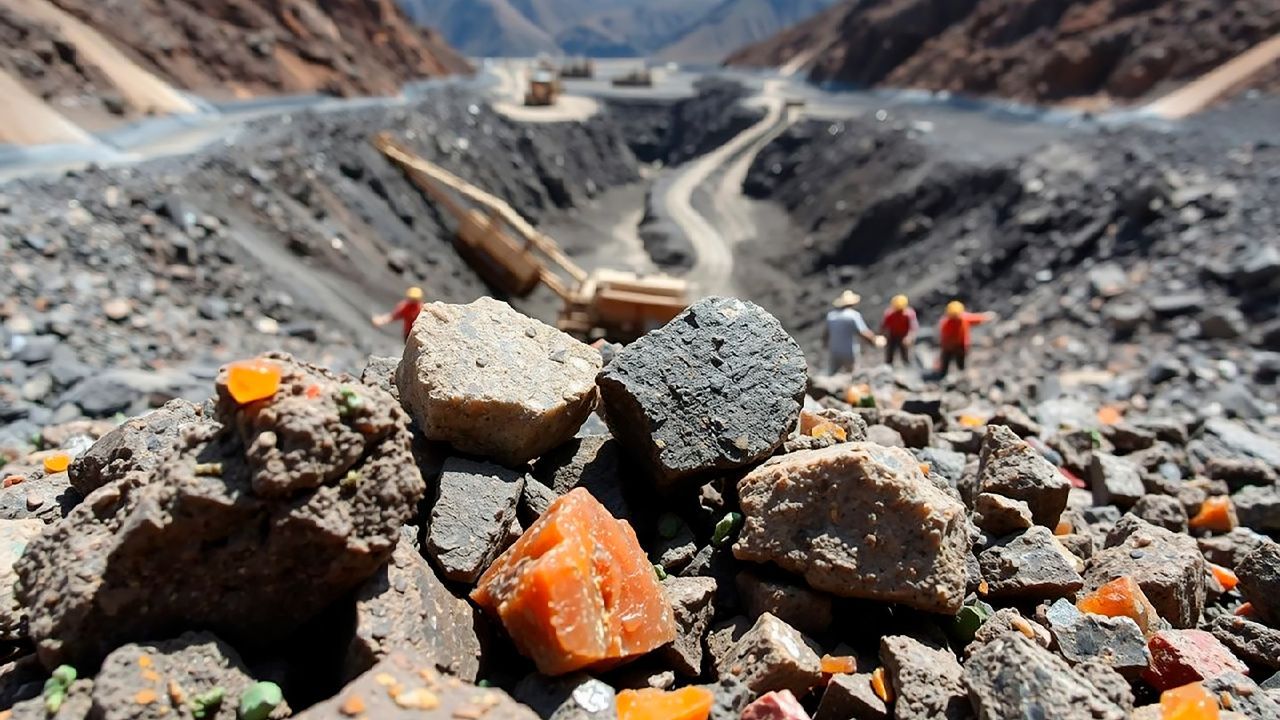
Geopolitics is a dirty business but the quest for clean energy is even dirtier. You've likely seen the headlines about Washington and Pretoria trading barbs over foreign policy. One day it's a dispute over naval exercises, the next it's a clash at the International Court of Justice. You’d think the two countries were on the verge of a total breakup. Yet, beneath that surface-level friction, the US government is quietly cutting checks to South African mining ventures.
The US isn't doing this because they've suddenly forgotten their political grievances. They’re doing it because they’re terrified of China’s stranglehold on the minerals that power your smartphone, your EV battery, and every advanced missile system in the Pentagon's shed. Washington's backing of the Phalaborwa Rare Earths project is a cold, calculated move in a high-stakes game of resource security.
China currently controls about 60% of global rare earth production and nearly 90% of the processing capacity. If Beijing decides to flip the switch tomorrow, the West’s "green revolution" grinds to a halt. South Africa holds a key to breaking that monopoly. Even when the diplomacy gets ugly, the raw math of the supply chain wins every time.
Breaking the Chinese monopoly on magnet metals
The project at the heart of this deal isn't a traditional deep-level mine. It’s actually a massive cleanup job that happens to be a goldmine for tech. Rainbow Rare Earths is working on recovering minerals from phosphogypsum stacks in Phalaborwa. These stacks are essentially industrial waste piles left over from decades of fertilizer production.
Traditional mining is expensive and ecologically taxing. Processing waste is faster and cheaper. The US International Development Finance Corporation (DFC) didn't just stumble into this. They’re providing millions in funding because the Phalaborwa site is rich in neodymium and praseodymium. These are the "magnet metals" essential for permanent magnets in wind turbines and electric vehicle motors.
Don't let the name fool you. Rare earths aren't actually that rare in the earth's crust. They're just incredibly difficult to find in concentrations that make sense to dig up. Finding them in a pile of waste that's already been extracted is like finding a chest of gold in a junkyard. It cuts out the years of exploratory drilling and the massive carbon footprint of traditional pit mining.
When national security outweighs political posturing
The tension between the Biden administration and the African National Congress (ANC) isn't a secret. South Africa’s refusal to condemn certain global conflicts and its growing ties with the BRICS bloc have ruffled feathers in D.C. Some lawmakers in the US have even pushed to review the African Growth and Opportunity Act (AGOA), which gives South African goods preferential access to US markets.
So why keep the money flowing?
Because the US Department of Defense knows that without a diversified supply of dysprosium and terbium, they can't build F-35 fighter jets. National security isn't just about troop counts anymore. It's about who owns the periodic table.
I’ve watched these trade dynamics for years. Politicians love to bark about "shared values" and "diplomatic alignment" when things are going well. But when they need 17 specific elements to keep their economy from collapsing, those "values" become secondary to "volumes." South Africa is one of the few places outside of China with the geological potential and the existing infrastructure to move the needle.
The DFC’s investment is a hedge. It’s a way for Washington to say, "We don't like your voting record at the UN, but we really like your rocks."
The hidden cost of the green transition
We often talk about EVs as "zero-emission" vehicles. That's true at the tailpipe, but the front end of the life cycle is a different story. The processing of rare earths is notoriously toxic. In China, loose environmental regulations allowed for years of "acid leaching" that devastated local water tables.
South Africa has a chance to do this differently. By using more advanced, closed-loop chemical processes on existing waste, the Phalaborwa project aims to be a "cleaner" source of these metals. This matters for US companies like Tesla or GM. They're under intense pressure from consumers and regulators to prove their supply chains aren't destroying the planet or utilizing forced labor.
It’s a massive branding opportunity for South Africa. If they can position themselves as the "ethical" alternative to Chinese minerals, the investment will keep coming, regardless of what's happening at the embassies.
Why this isn't just another mining deal
Most people think mining is just about digging a hole and selling the dirt. It’s not. It’s about the "midstream"—the separation and refining of those metals into usable oxides. This is where China has truly won the game so far. They don't just have the mines; they have the refineries.
The US support for Rainbow Rare Earths is specifically aimed at creating a supply chain that bypasses the Chinese mainland. The goal is to ship concentrate to a refinery in a friendly jurisdiction, or better yet, build that capacity in South Africa or the US.
This isn't a short-term play. We're looking at a ten-to-twenty-year horizon. The Phalaborwa project is expected to produce rare earths at a cost that competes with Chinese operations. That’s the holy grail. If you can’t beat China on price, you’re just subsidizing a hobby. But if you can match their costs while providing a more stable geopolitical partnership, you change the world.
The risk of getting it wrong
There are plenty of ways this could go sideways. South Africa’s energy crisis is a huge hurdle. You can’t run high-tech processing plants on a grid that shuts off for six hours a day. Eskom, the state power utility, has been a nightmare for industrial growth.
Then there’s the regulatory environment. The South African government has a habit of changing the rules on mining ownership and BEE (Black Economic Empowerment) requirements. While these policies have important social goals, the lack of consistency often scares away the kind of massive capital needed for these projects.
If I were an investor, I'd be watching the upcoming South African elections and the subsequent policy shifts very closely. The US government has deep pockets, but private equity is a lot more skittish.
What this means for you
You might think a mining project in the Limpopo province doesn't affect your life. You’re wrong.
The price you pay for your next car and the speed of the global shift away from fossil fuels depend on these deals. If the West fails to secure these minerals, "going green" will become a luxury reserved for the ultra-wealthy.
It also signals a shift in how the US interacts with the world. We’re moving away from "free trade" and toward "friend-shoring." The US is willing to overlook a lot of diplomatic friction if a country is a "friend" with the right resources.
If you're looking to track this, don't just watch the diplomatic cables. Watch the DFC's project list. Watch the quarterly reports from companies like Rainbow Rare Earths and Pensana. The real history of the 21st century is being written in the mud and the waste piles, not the marble halls of the UN.
Stop thinking about foreign policy as a series of speeches. Think of it as a series of procurement orders. The US hasn't "forgiven" South Africa for its recent political stances. They've just realized they can't afford to be enemies with their supplier.
Keep an eye on the progress at Phalaborwa. If they hit their production targets by 2026, it will be the first major crack in the Chinese rare earth wall. That's worth more to Washington than a thousand diplomatic apologies.
The next step is simple. If you're an investor, look into the junior miners with South African assets. If you're a policy wonk, start advocating for more "mineral diplomacy." The era of ignoring the dirt beneath our feet is officially over.