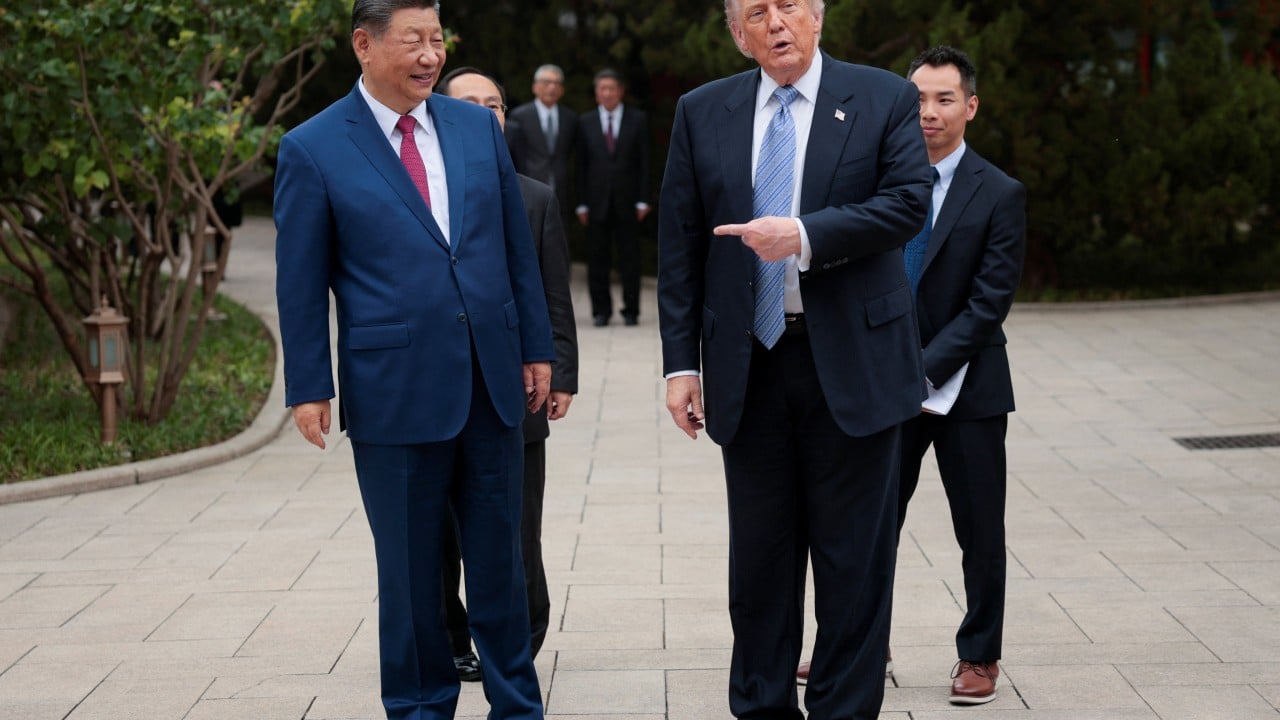
Don't buy the spin coming out of the latest Washington and Beijing press readouts. If you look at the headlines following President Donald Trump’s high-stakes mid-May summit in Beijing, you'd think we just witnessed a massive breakthrough in the tech trade war. The White House triumphantly announced that China agreed to address American shortages of critical minerals like yttrium, scandium, neodymium, and indium. They're calling it a win. Beijing responded with a loud, calculated silence.
It's all optics. In other updates, we also covered: Stop Rewarding the Curious and Start Firing Your Resistors.
The reality is that neither side actually gave up any real ground on the things that matter most: advanced technology and the minerals required to build it. Instead, they just got better at tiptoeing around the friction points to avoid an all-out economic meltdown. If you're running a business dependent on semiconductors, aerospace components, or AI data center infrastructure, you can't afford to mistake this temporary diplomatic sigh of relief for actual structural stability. The core conflict is completely untouched.
The Illusion of Eased Export Controls
Let's look at what actually changed, and more importantly, what didn't. Washington's official fact sheet boasts that Beijing will help mitigate supply shortages. But look closer at the language. The White House completely dropped its previous, aggressive demands for the total elimination of Chinese mineral restrictions. That's a massive, quiet concession. It's a tacit admission that the US simply doesn't have the leverage to force China's hand. The Wall Street Journal has analyzed this critical topic in great detail.
China's Ministry of Commerce hasn't modified its regulatory framework one bit. Their export licensing system, implemented heavily after a wave of bilateral tariffs, remains completely intact. They didn't scrap the rules; they just hinted at a bit of tactical flexibility for compliant, civilian use.
I've talked to supply chain managers who have been dealing with these bottlenecks for over a year. They'll tell you that getting a license from Beijing for commercial electronics or standard automotive parts might get slightly easier this month. But if your business touches dual-use technology—anything with potential military, aerospace, or advanced defense applications—good luck. The bureaucratic wall isn't coming down.
China still holds more than 90% of global rare earth refining capacity. They control roughly 70% of global indium production. They didn't spend decades building a complete vertical monopoly on extraction, separation, and metallization just to give it away during a comfortable weekend summit in Beijing.
Why Indium is the Real Battlefield
Everyone loves to talk about generic rare earths, but you need to watch indium. Its explicit inclusion in recent diplomatic discussions tells you exactly where the tech war is heading. Indium isn't just an obscure element on the periodic table; it's the lifeblood of next-generation AI hardware.
Specifically, indium phosphide is the foundational material for photonic chips. These semiconductors process data using light instead of electrical currents. If we're going to keep up with the absurd power and speed demands of modern AI data center infrastructure, silicon isn't going to cut it. Photonic chips are the future, and China basically owns the raw material needed to make them.
Since Beijing tightened the screws on indium exports, global shipments have tanked. US imports of Chinese indium plummeted by more than 77% over a multi-year squeeze, dropping China's share of the US indium market to under 10%. This forces American tech firms to scramble for alternative, more expensive processing pipelines in Japan, South Korea, and Canada.
Look at companies like Coherent Corp, which commands a massive 40% global market share in indium phosphide optical components. They've been aggressively scaling up a six-inch wafer line in Sherman, Texas. Constrained licensing means higher input costs, unpredictable allocation bottlenecks, and constant anxiety over capacity expansion. The same goes for competitors like Lumentum Holdings. The Beijing summit didn't fix this for them. It just kept the problem from getting catastrophically worse today.
The Trade Deal Diversion
To understand why the tech and mineral conversation was so muted in Beijing, you have to look at what both sides used as a distraction. The big headline-grabber was agriculture. China agreed to buy at least $17 billion annually in US agricultural products through 2028.
It’s a classic political trade-off. Beijing throws a financial bone to American agricultural exporters, which gives Washington a visible victory to take home to voters. In exchange, the US keeps a lid on escalating tariffs, keeping them close to the baseline caps discussed in places like Kuala Lumpur, where total tariffs averaged around 39%.
But notice what's missing from the bargain. There's no structural change to industrial policy. There's no relaxation of US export bans on high-end Nvidia AI chips to China. There's no dismantling of China's state-backed rare earth conglomerates like JL MAG Rare-Earth Co.
It's a managed pause. The two nations even agreed to set up intergovernmental Trade and Investment Councils. Sounds fancy, right? It's really just a formal mechanism to shift from "crisis-style response" to institutionalized bickering. It gives businesses a tiny bit of predictability, but it doesn't solve the underlying problem that the world's two largest economies are fundamentally decoupling their high-tech supply chains.
The Defensive Scramble Outside of China
Washington knows it's playing a weak hand in the short term. You can't replicate a 30-year industrial monopoly overnight. The Department of Defense has poured hundreds of millions of dollars into domestic rare earth processing, and the US Export-Import Bank is looking at nearly $780 million in financing for a processing facility in Nebraska. But building a competitive, clean, and fully operational domestic mining and refining ecosystem will take a decade or more.
Because domestic efforts are slow, the real strategy is shifting to mini-lateral alliances. Look at what happened right after the Beijing summit. US officials immediately jetted off to New Delhi for a Quad Foreign Ministers' meeting to sign a massive bilateral India-US framework on critical minerals and rare earths.
This isn't a coincidence. It's the Pax Silica strategy in action. The goal is to create a secure, innovation-driven trading bloc with allies to counter China's monopoly. They are trying to stitch together a supply chain where India handles raw extraction and initial processing, western nations provide the capital and advanced manufacturing, and member states bypass the Chinese ecosystem entirely.
It's a smart long-term play, but it doesn't solve the immediate operational risk for tech companies in 2026.
How Tech and Supply Chain Leaders Should Act Now
If you're sitting in a boardroom waiting for diplomacy to stabilize your raw material inputs, you're making a dangerous mistake. Relying on the political mood in Washington or Beijing is a terrible business strategy. Here is what you actually need to do right now to insulate your operations.
- Audit down to the isotope: Don't just trust your Tier 1 or Tier 2 suppliers when they say their components are compliant. You need to know exactly where the raw yttrium, neodymium, or indium in your components was mined and refined. If it passed through a Chinese state-owned enterprise, assume it's at risk of sudden licensing denials.
- Lock in multi-year alternative supply contracts: Yes, sourcing refined materials from places like South Korea, Japan, or Canada is more expensive than buying directly from Chinese suppliers. Pay the premium anyway. Treat that extra cost as an insurance policy against a sudden geopolitical flare-up.
- Design out the risk: If you have R&D teams developing next-generation hardware, task them with engineering alternatives that minimize or entirely avoid the most volatile heavy rare earths. Tesla did this with their EV motors; your hardware engineering teams should be doing the same for data center components and optical links.
- Leverage the Pax Silica framework: Keep a close eye on the newly signed US-India frameworks and Quad investment tools. There is going to be significant government financing, subsidized loans, and political backing for companies that move their supply chains into these allied corridors. Get your foot in the door early.
The Beijing summit proved that neither superpower wants an immediate economic collapse. They'll smile for the cameras, sign agricultural agreements, and pretend the mineral crisis is handled. But the structural tech war isn't over—it's just getting started. If your supply chain relies on the goodwill of a foreign adversary's licensing office, you're exposed. Stop watching the politicians and start rebuilding your supply architecture.