You don't normally see a country's health minister begging a judge for forgiveness over a biosecurity project, but that's exactly what just happened in Nairobi.
Kenya Health Minister Aden Duale had to swallow his pride in open court, issuing a sweeping apology after being slapped with a contempt of court charge. His crime? Letting the US military keep building a controversial 50-bed Ebola quarantine facility at the Laikipia Air Base in Nanyuki, completely ignoring a High Court order to freeze the project.
This isn't just a local legal spat. It's a messy collision of local sovereignty, deep-seated fears of viral outbreaks, and the raw mechanics of American geopolitical influence. If you're wondering why Kenyans are furious enough to riot over a medical site meant for Americans, you have to look at what's happening right across the border.
The backroom deal that sparked a crisis
The trouble started in May 2026, when the Trump administration dropped a bombshell policy shift. Instead of flying American personnel exposed to Ebola back to US soil, Washington decided it would quarantine them abroad. They chose Kenya as the dumping ground.
The plan was simple on paper. Build a high-tech, 50-bed isolation facility inside a Kenyan airbase, staff it with American medical experts, and use it to hold US citizens evacuated from the neighboring Democratic Republic of Congo, where a massive Ebola outbreak has already infected over 1,000 people and killed hundreds. The US threw in $13.5 million for Kenya's own virus readiness to sweeten the deal.
But Kenyan activists and legal watchdogs noticed a massive red flag. The entire deal was cooked up in secret.
The Law Society of Kenya and the Katiba Institute immediately sued the government. They argued that Kenya's healthcare infrastructure is already buckling under everyday pressures. Bringing a deadly hemorrhagic fever into the country on purpose, without public consultation, seemed like madness.
On May 29, the High Court agreed and ordered a total halt to construction until the lawsuit could be fully heard.
Tents, tech, and total defiance
Here's where the story gets ugly. The Kenyan government basically told its own judicial system to get lost.
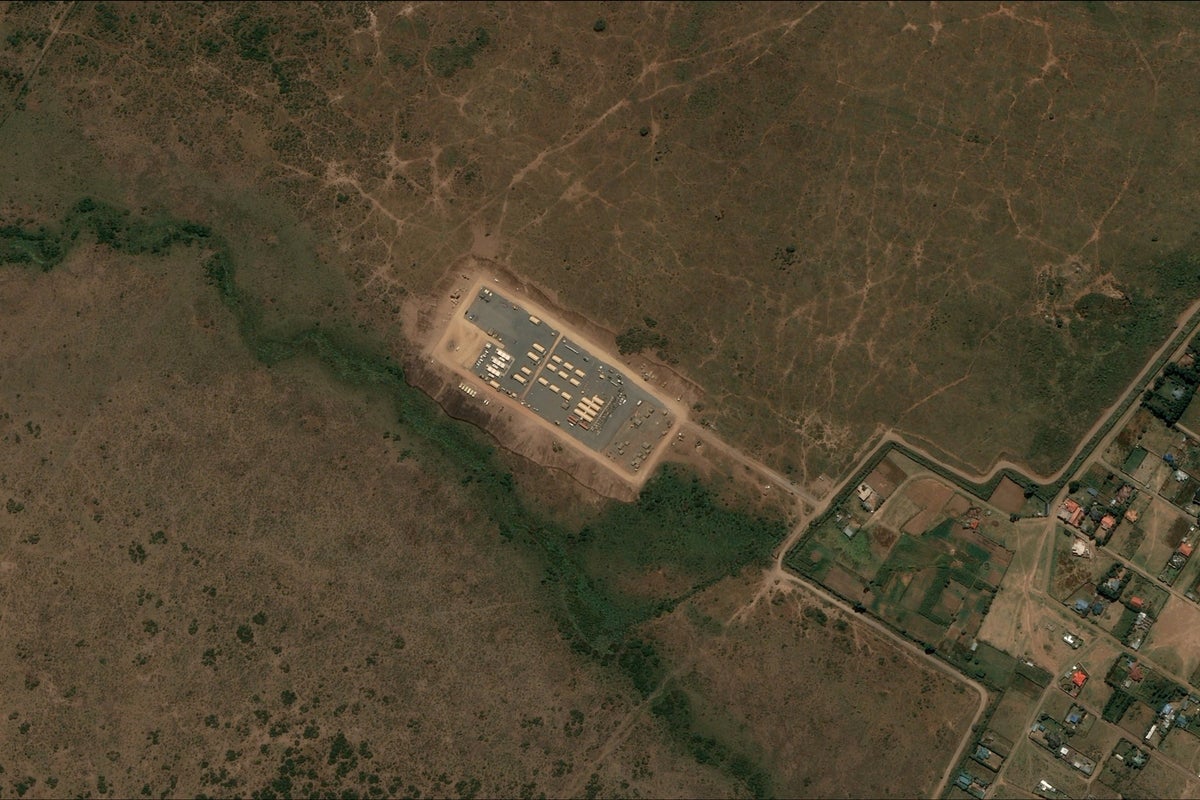
Satellite imagery from June 22 showed active construction continuing at the Nanyuki site. Paved roads were laid down, military-grade isolation tents went up, and specialized medical equipment kept arriving on US flights. Duale even told parliament earlier in the month that the state had no intention of stopping.
Local residents weren't having it. When the community realized the court order was being ignored, angry protests erupted outside the Laikipia base.
The state's response was brutal. Police cracked down on demonstrators with tear gas and live ammunition. Three local protesters have been shot dead since the unrest began.
The optics are terrible for President William Ruto's administration. To ordinary Kenyans, it looks like their government is willing to kill its own citizens to protect an unapproved American military project.
Dr. Davji Atellah, a leading voice for the Kenya Medical Practitioners, Pharmacists and Dentists Union, captured the national mood perfectly with a blunt reality check: "If it is too dangerous for America, it is too dangerous for Kenya."
Sovereignty vs the dollar
Duale's sudden courtroom retreat on Tuesday wasn't a change of heart. It was basic self-preservation. A contempt charge in Kenya carries a maximum six-month prison sentence, and the High Court was clearly ready to make an example out of him.
The minister promised an immediate and complete halt to all site prep at Laikipia. Yet, even while apologizing, he kept defending the American site, calling local fears "scientifically unfounded" and insisting the facility poses no risk of leaking the virus into nearby villages.
Honestly, the scientific argument misses the bigger picture. This isn't just about biosecurity protocols or air filtration systems. It's about a deep psychological scar. The arrangement feels aggressively colonial to a lot of people in East Africa. The US gets to keep its own homeland safe from a terrifying virus by leveraging cash to push the biological risk onto a developing nation.
Kenya has never had a single recorded case of Ebola. For a local population watching medical workers die of the virus in the DRC, the idea of importing potential carriers for $13.5 million feels like a terrible gamble.
Where the project goes from here
The immediate next steps aren't up to the health ministry or the US embassy. The battle moves entirely to the courts.
If you are tracking this situation, watch the substantive hearing of the Katiba Institute petition. The court will have to rule on whether the executive branch violated the constitution by bypassing public participation on a major national security issue.
For the US State Department, the options are shrinking. They've stated publicly that they are working with Kenyan authorities to resolve objections, but they underestimated the power of local pushback. If the Kenyan High Court permanently blocks the Laikipia facility, Washington will either have to find a more compliant regional ally or abandon its plan to outsource its bio-containment responsibilities.
The immediate lesson here is clear. You can't just build an international quarantine center via backroom executive orders and expect the public to accept it quietly. Until the legal system finishes parsing the data and the raw anger cools down, those tents in Nanyuki are going to sit completely empty.


