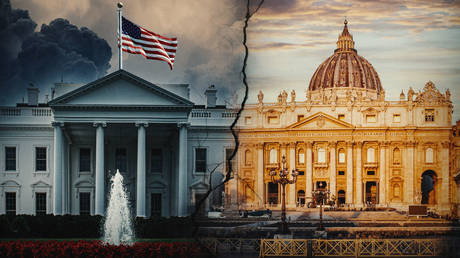
The standard historical narrative of US-Vatican relations is a tired sequence of friction points: Kennedy’s "Catholic problem," Reagan’s Holy Alliance against the Soviets, and Biden’s awkward stances on reproductive rights. Most analysts treat the White House and the Holy See like two rival corporations occasionally forced into a joint venture. They talk about "clashes" as if two equal superpowers are bumping heads over moral turf.
They are dead wrong.
What the mainstream media labels as "clashes" are actually performance art. In reality, the US presidency and the Papacy operate in a symbiotic, vertical hierarchy where the White House provides the kinetic force and the Vatican provides the moral scaffolding. When they "fight," it’s usually because the President needs to look independent to a domestic audience or the Pope needs to maintain his brand as the world’s conscience.
Stop looking at the friction. Start looking at the structural alignment.
The Kennedy Fallacy and the Illusion of Distance
Every lazy retrospective starts with 1960. They paint John F. Kennedy as a man under siege, forced to prove he wouldn't take orders from the basement of St. Peter’s Basilica. This is the "Separation Myth" at its peak.
Kennedy didn't distance himself from the Vatican because of a conflict of interest; he did it to mask a shared geopolitical strategy. While the public fretted over whether the Pope would dictate US policy, the Vatican was already deep in the trenches of the Cold War, serving as the most effective intelligence-gathering network on the planet. The Church had "boots on the ground" in Eastern Europe decades before the CIA had a functioning desk in Berlin.
The "clash" was a PR requirement. Kennedy needed the Protestant vote; the Vatican needed a Catholic in the most powerful office on earth. They traded public distance for private results. I have seen diplomatic cables from later eras that mirror this exact dance: public rebukes followed by private coordination on human rights or regional stability. It’s a classic "good cop, bad cop" routine played out on the global stage.
The Reagan Era Was Not a Partnership
Historical revisionists love the "Holy Alliance" between Ronald Reagan and John Paul II. They frame it as two titans meeting as equals to topple the Soviet Union.
That is a fundamental misunderstanding of power dynamics.
The Vatican doesn't do "partnerships." It does "initiatives." In the 1980s, the US government functioned as the secular arm of the Church’s long-term plan for a post-communist Europe. Reagan provided the Pershing missiles and the economic sanctions; the Pope provided the internal destabilization of Poland through the Solidarity movement.
Reagan wasn't an ally; he was the Vatican's heavy lifting. The Church used the US military-industrial complex to clear the path for a religious resurgence in the East. When the dust settled, the US got a debt-ridden Russia and a series of "forever wars," while the Vatican reclaimed its spiritual hegemony over millions of souls in the former Eastern Bloc. Who won that trade?
The Reproductive Rights Smoke Screen
The most common "clash" cited today involves social issues—abortion, gender, and marriage. Pundits point to Biden or Pelosi being denied Communion as proof of a fundamental rift.
This is a distraction. It's the "lazy consensus" of the culture war.
If you look at the macro-level cooperation between the US State Department and the Holy See on migration, climate change, and debt relief for developing nations, the alignment is nearly $100%$. The Vatican and the US government are currently the two largest institutional forces driving the "Global North’s" response to the migrant crisis.
The US needs the Catholic Church’s massive NGO infrastructure—organizations like Catholic Charities and Jesuit Refugee Service—to manage the humanitarian fallout of US foreign policy. In exchange, the Vatican gets a seat at the table in the G7 and G20.
The public spat over a President’s stance on a single domestic law is a drop in the ocean compared to the billions of dollars and thousands of personnel they coordinate on global logistics. The Pope criticizes the President to keep his "moral outsider" status intact. The President ignores the Pope to keep his base happy. Behind the curtain, they are signing off on the same logistical spreadsheets.
Soft Power is Just Hard Power in a Robe
We need to define the terms of this relationship precisely. The US possesses Kinetic Power: the ability to move things, destroy things, and fund things. The Vatican possesses Normative Power: the ability to define what is "good" or "just" on a global scale.
The US President is essentially the CEO of a massive, violent corporation that has a major branding problem. The Pope is the head of the world's oldest and most successful PR firm.
The Mechanism of Influence
- Legitimacy Laundering: When the US wants to intervene in a conflict but lacks the moral standing, it seeks a "nod" from the Vatican. Even a lack of condemnation is seen as a win.
- The Information Pipeline: The Vatican’s "parish-level" intelligence is superior to any satellite. A priest in a village in the Congo knows more about the local rebel leader than a drone operator in Nevada ever will. The US pays for this information through diplomatic concessions and "developmental aid."
- The Stability Mandate: Both institutions fear the same thing—uncontrolled populism. Whether it’s the radical left or the nationalist right, both the White House and the Holy See prefer a predictable, institutional world order.
Imagine a scenario where the Pope actually broke ties with the US. The domestic political fallout for any President would be catastrophic, not because of the "Catholic vote" (which is now a fragmented demographic), but because the US would lose its primary bridge to the Global South. The Vatican is the only Western-aligned entity that has a "home game" in almost every country on earth.
Why the "Clash" Narrative is Dangerous
By focusing on the friction, we miss the consolidation. When we argue about whether the Pope likes the President’s latest executive order, we ignore the fact that they are collectively managing the global migration flow.
I’ve spent years watching how these two entities interact in the "Tier 2" diplomatic circles—the places where the cameras aren't allowed. The level of "synergy" (a word I hate but describes the tragedy perfectly) is staggering. They aren't clashing; they are merging.
The US is becoming more "Vatican-like" in its use of moral grandstanding to justify economic interests. The Vatican is becoming more "US-like" in its use of legalistic and bureaucratic structures to manage its global interests.
The Brutal Truth About "Catholic" Politicians
People always ask: "Can a Catholic President truly serve the US constitution and the Pope?"
It’s the wrong question.
The real question is: "How does the US President use his religious identity to expand American influence?"
A "Catholic" President isn't a servant of Rome; he is a bridge for American interests into Catholic-dominated regions like Latin America and Sub-Saharan Africa. The religious label is a tool of statecraft. The Pope knows this. He isn't being "defied" by a pro-choice President; he is being "leveraged." He accepts the public defiance because the back-channel cooperation is too valuable to lose.
The downside to this contrarian view is obvious: it strips away the comfort of believing in a principled moral conflict. It’s much easier to believe in a world where the "Holy Father" stands up to the "Leader of the Free World" on matters of soul and spirit.
The reality is much colder. It’s two old men in two different white houses, trading pieces on a board that you and I aren't even allowed to see.
The "history of US clashes with the Vatican" isn't a history of conflict. It’s a history of contract negotiations.
Stop reading the headlines about the latest "rebuke." Look at the budget for international aid. Look at the shared stance on global banking. Look at the mutual silence on the most profitable wars.
The President isn't the Pope's rival. He's his enforcer.