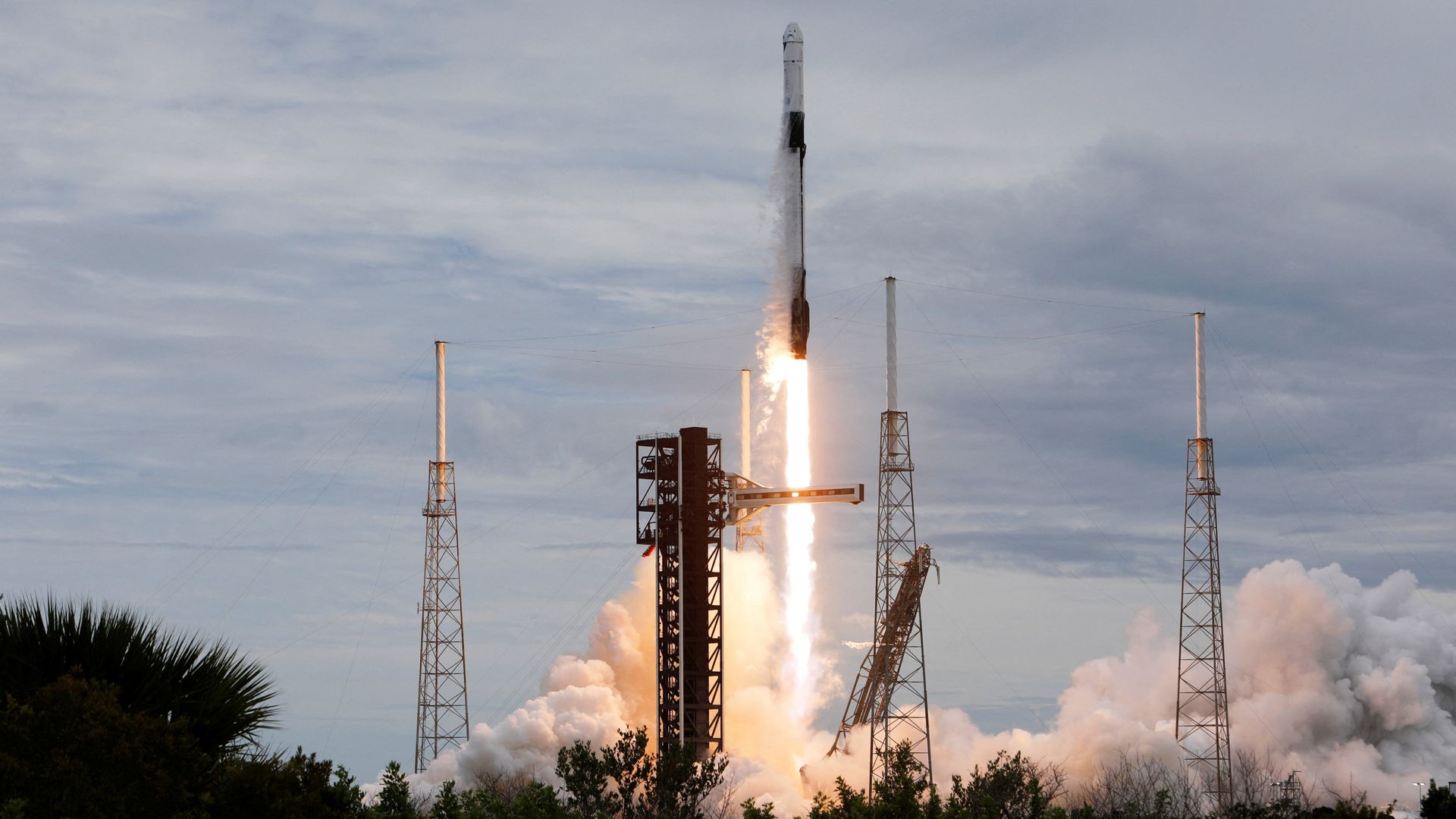
Gravity is an honest critic. It does not care about your intentions, your titles, or the centuries of inherited doubt that told people who look like you that the atmosphere was a ceiling rather than a door. Gravity simply pulls.
And then, every once in a while, a human being looks back at the earth, ignites millions of pounds of controlled explosion beneath their boots, and proves that the downward pull is merely a suggestion we have agreed to challenge.
Picture the interior of a capsule moments before ignition. The air smells of ozone, manufactured oxygen, and the sharp, metallic tang of absolute focus. Your heart is not beating; it is hammering against your ribs like a trapped bird. Outside, the sky transitions from the familiar bruised blue of an afternoon into the bruised black of the vacuum. You are strapped into a seat engineered to withstand forces that would liquefy ordinary confidence.
This is the reality of modern commercial spaceflight, stripped of the glossy corporate PR and reduced to its raw, vibrating components. When SpaceX launched its historic flight carrying the first Black female commander to lead a space mission, the headlines buzzed with words like milestones, records, and speed. They noted that the capsule shattered a United States orbital speed record, slicing through the thermosphere at velocities that boggle the rational mind.
Numbers are cold things. They tell you that a vehicle moved at seventeen thousand miles per hour. They tell you that an altitude of hundreds of miles was reached in mere minutes. But numbers do not capture the trembling silence in the control room. They do not capture the small, steady breath taken by a commander who spent decades studying the mathematics of survival, knowing that every single variable—every microsecond of engine burn, every fraction of a degree in reentry angle—stood between a triumph of human engineering and a tragedy of gravity's revenge.
To understand why this flight matters, you have to look backward before you look up.
For generations, the cosmos was mapped by a very narrow demographic. The pioneers of early flight wore flat-top haircuts, spoke in crisp mid-Atlantic accents, and walked through doors that had been propped open exclusively for them. Behind every famous face in archival footage, however, stood uncelebrated calculators, mathematicians, and engineers who solved equations by hand on chalkboards because electronic computers were still rooms full of vacuum tubes. They were women who crossed segregated campuses, men who built careers in the margins, and dreamers who watched the horizon and wondered why it belonged to someone else.
When the hatch closed on this recent mission, it was not merely a mechanical closure. It was the sealing of a generational promise.
Consider what happens inside the human brain when the visual confirmation of a barrier finally shatters. A child sitting in a living room in an overlooked neighborhood, staring at a screen while a rocket punches a hole in the stratosphere, does not calculate Mach numbers. They register a simple, foundational truth: There is a seat for me here. That is the invisible stake of this achievement. It is not just about how fast a capsule can travel around the planet; it is about how quickly a culture can expand its collective imagination.
The speed record itself is a masterclass in physics and software coordination. Imagine trying to thread a needle while riding a bullet. Now imagine that the needle is moving at orbital velocity, and missing it means burning up in the friction of atmospheric reentry. The Falcon 9 booster and Dragon spacecraft operated as an integrated nervous system, a testament to what happens when brilliant minds spend decades refining the brutal geometry of rocket science. Every valve, every sensor, every line of flight software was tuned to an exquisite, unforgiving pitch.
Yet, machinery is nothing without the soul that commands it.
Leadership in the upper reaches of the atmosphere is not about barking orders. It is about stillness in the storm. When alarms chirp and the capsule shudders under the violence of max Q—that point of maximum aerodynamic pressure where the air itself seems to push back with malicious intent—the commander must remain the eye of the hurricane. A heartbeat too fast, a micro-adjustment too aggressive, and the trajectory frays.
There is a profound vulnerability in being the first. You carry not only your own ambitions, but the weight of every future traveler who will be measured by your performance. If you succeed, you open a door. If you stumble, the cynics rush forward to weld it shut for another generation. That burden is heavier than any G-force generated by a rocket motor.
And yet, she flew.
As the capsule crested its peak and began its descent, painting the windows with the incandescent plasma fire of atmospheric friction, the world below kept turning, mostly unaware of the drama unfolding forty miles above the clouds. Traffic crawled on urban highways. Coffee cups rattled on commuter trains. People argued over dinner tables, trapped in the petty gravity of everyday life.
Up there, none of that mattered. There were only stars, equations, and the steady, rhythmic breathing of a crew that had touched the edge of the infinite and returned to tell the tale.
We measure progress in milestones, but we remember it in moments. The streak of white fire across the morning sky will fade from memory. The speed record will, inevitably, be broken by another capsule, another engine, another generation of dreamers standing on the shoulders of the ones who came before.
The record is temporary. The shift in perspective is permanent.
Night falls over the launch site long after the telemetry screens have gone dark and the engineers have packed their laptops. The pad is quiet now, save for the metallic ping of cooling steel contracting in the midnight air. Somewhere out in the vast, silent dark, a small metal vessel circles our fragile blue marble, carrying the footprints of a new era, leaving a trail of fire written across the history of human courage.