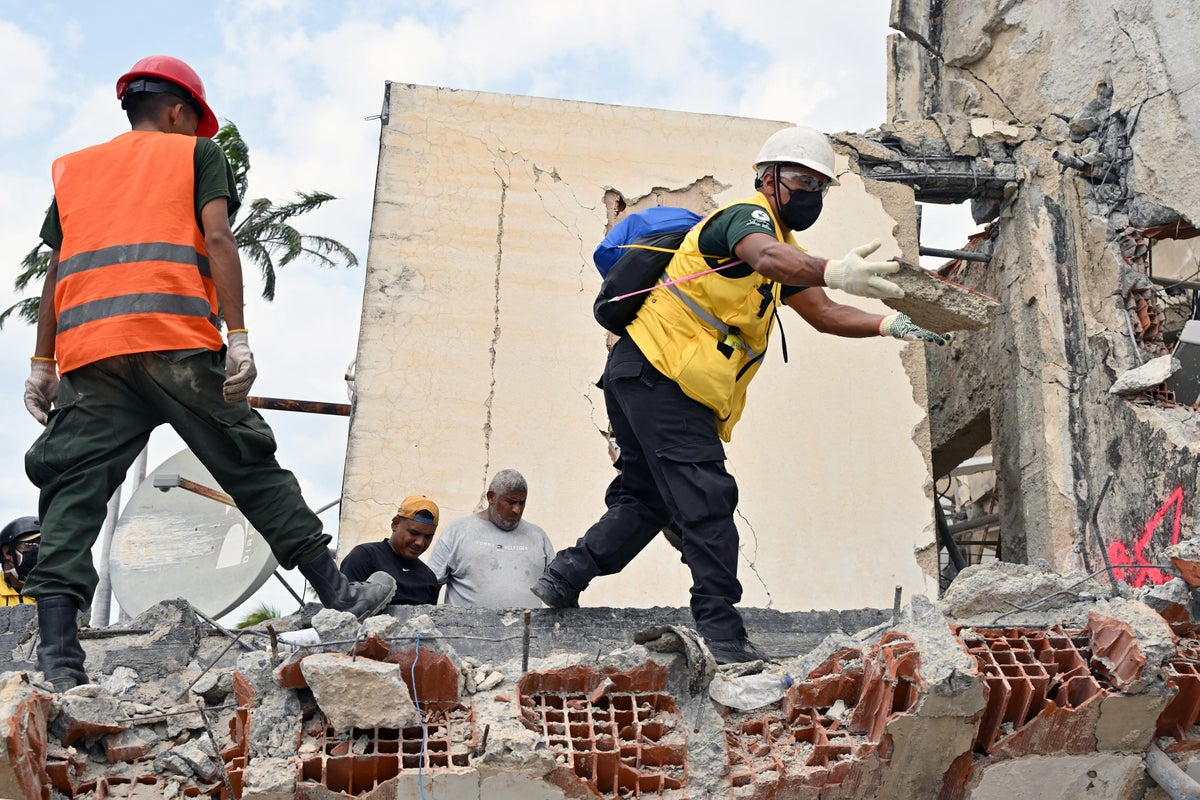
Disaster reporting follows a script so predictable you could automate it with a basic spreadsheet.
An earthquake strikes. Media outlets rush to frame the fallout through a purely political lens. They hyper-focus on bureaucratic finger-pointing, lambasting the acting president's immediate response crisis management while treating the structural devastation as an unpredictable act of God.
This lazy consensus is wrong.
The standard critique—that the unfolding tragedy in Venezuela is primarily a failure of swift political leadership during the initial 48 hours—misses the entire point. It treats the symptom as the disease. The truth is much more uncomfortable: disaster response in a severely hyper-inflated, sanctioned economy is not an operational puzzle to be solved by better optics or a more charismatic leader. It is an engineering and capital allocation mathematical mathematical certainty.
When your baseline infrastructure has been starved of maintenance capital for fifteen years, a crisis does not create new faults. It simply accelerates the inevitable collapse of systems that were already mathematically guaranteed to fail.
The Logistics Illusion
Mainstream commentary loves to obsess over the "speed" of rescue deployments. Outlets demand to know why heavy machinery wasn't on-site within hours, or why distribution networks look chaotic.
Here is what decades of supply chain analysis tells us: you cannot optimize a logistics network that lacks foundational inputs.
When an economy lacks stable fuel reserves, standardized spare parts for heavy machinery, and a functional domestic grid, the physical movement of goods grinds to a halt regardless of who sits in the presidential palace.
Imagine a scenario where a state-of-the-art rescue team is ready to deploy, but forty percent of the regional transit fleet is sidelined because basic components like tires or hydraulic fluids cannot be imported due to financial gridlock. No amount of political willpower or structural restructuring fixes that bottleneck on Day One.
True systemic resilience is built during the boring, non-headlining years preceding a tremor. It is found in building codes, concrete curing standards, and decentralized utility redundancies.
Focusing the entire critique on an acting president's press conferences or immediate deployment orders is a form of intellectual theater. It satisfies the need for a clear villain while completely ignoring the structural mathematics of engineering failures.
The Misallocation of Global Outrage
International observers frequently ask: How can the state response be improved right now?
The premise of the question is fundamentally flawed. You cannot improve a broken engine while it is burning. The brutal reality of emergency management in resource-constrained environments is that triage requires letting certain systems fail completely to save others.
If a nation's financial mechanisms are cut off from international clearing systems, sourcing specialized deep-rubble radar or seismic structural engineering expertise on short notice becomes an insurmountable hurdle. The bottleneck is not a lack of administrative intent; it is a hard wall of operational friction.
The standard playbook says to pour short-term humanitarian aid into the zone and call it a day. But history shows that uncoordinated, short-term aid surges often choke local distribution channels, creating massive logistical traffic jams that delay actual structural recovery.
Instead of demanding rapid, superficial deployments to look good on international news feeds, the focus must shift to structural realities:
- Decentralized Asset Management: Local municipal authorities must have autonomous control over emergency machinery rather than waiting for centralized ministerial sign-offs.
- Engineering Sovereignty: Building codes must be enforced through independent, non-state auditing firms to eliminate the corruption that leads to substandard concrete mixtures in high-density urban areas.
- Infrastructure Clearinghouses: Establishing ring-fenced, apolitical financial channels solely dedicated to infrastructure maintenance before disasters strike, ensuring that spare parts for critical water and power systems are always stockpiled.
Stop looking at the podium. Look at the concrete. The failure did not happen when the ground shook; it happened every single day over the last two decades when structural maintenance was treated as an optional luxury rather than a hard physical necessity.