The internet loves a predictable narrative.
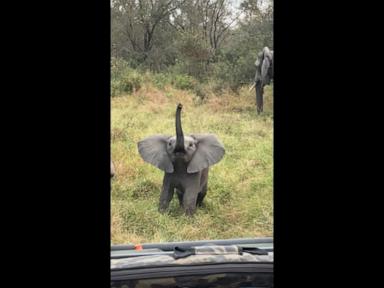
A tourist Jeep sits on a dusty track in the Serengeti or Kruger National Park. A baby elephant, barely tall enough to reach the vehicle's bumper, flares its ears, shakes its head, and stumbles forward in a frantic mini-charge. The tourists giggle. The camera shakes. The video racks up five million views on TikTok with a caption about how "adorable" or "feisty" the little guy is.
It is a comforting, anthropomorphic lie.
What the casual viewer sees as a cute temper tantrum is actually a highly coordinated, evolutionarily sophisticated tactical drill. That "baby" isn't playing. It is executing a lethal threat assessment under the direct supervision of a multi-ton matriarchal firing squad.
The media treats these encounters as blooper reels. Safari operators market them as whimsical close encounters. They are wrong. When you laugh at a charging calf, you are misreading the basic tenets of megafauna behavior and putting human lives at risk.
The Myth of the Cute Mock Charge
Mainstream travel writing treats elephant charges like a binary system: there are "mock" charges (harmless bluffing) and "real" charges (dangerous aggression). This classification is lazy and fundamentally flawed.
In mammalian biology, a mock charge by a juvenile is never just a bluff. It is a calibrating exercise.
I have spent over a decade tracking large mammals across East Africa. I have watched naive tourists urge their drivers to get closer to a calf because it looks "peaceful." What they fail to realize is that an elephant’s comfort zone is not a fixed geographic radius. It is a shifting psychological boundary governed by the herd's collective stress level.
When a juvenile elephant charges a vehicle, it is testing three critical variables:
- The Threat's Threshold: How close can an unknown object get before the herd needs to deploy lethal force?
- The Object’s Reaction: Does the massive metal machine flee, freeze, or advance?
- Its Own Kinetic Power: The calf is learning how to transfer its growing body weight into forward momentum to maximize psychological terror.
The calf is the scout. It is the lowest-stakes asset the herd has to test the perimeter. While you are busy filming the baby's flaring ears, the adult cows are positioning themselves to the flanks. They are watching your vehicle's exhaust. They are listening to the pitch of your engine. If the calf’s test reveals that your vehicle is unpredictable or aggressive, the situation transforms from a viral video into a trampling in less than four seconds.
The Mechanics of Megafauna Deterrence
To understand why the "cute baby elephant" trope is dangerous, we have to look at the physics and sociology of the herd.
[Calf Advances] ---> [Measures Vehicle Response] ---> [Adults Assess Risk]
                                                              |
    +---------------------------------------------------------+
    |
    v
[Vehicle Retreats = Calf Wins / Vehicle Advances = Adult Intervention]
Elephants operate under a strict matriarchy. Survival depends on total compliance with the oldest cow's signals. A calf does not wander off to charge a 4x4 on a whim. It does so because the matriarch has permitted a controlled escalation.
Anatomy of an Escalation
Let us break down what is actually happening during these viral encounters, moving past the superficial "angry baby" narrative.
- The Displacement Activity: Before the charge, the calf will often pluck grass nervously or swing its trunk. Tourists think it is playing. Zoologists know this is displacement behavior—the displacement of intense anxiety before a violent action.
- The Ear Flanneling: The calf spreads its ears wide to appear larger. If the ears are pinned back against the head, the mock stage is already over; it is a full-blown attack.
- The Silent Feedback Loop: Throughout the entire display, the calf emits low-frequency infrasound communications. These rumbles travel through the ground and are picked up by the sensitive pads on the adult elephants' feet miles away. The herd knows exactly how terrified or confident that calf is, even if they are standing behind a thicket fifty yards out.
The downside to acknowledging this reality is obvious: it strips the romance out of the safari industry. If operators admit that every close-range juvenile charge is a high-risk tactical evaluation, they can no longer park their vehicles fifteen feet from a herd to secure a five-star TripAdvisor review. They have to enforce mandatory buffer zones. That means fewer dramatic close-up photos, unhappy influencers, and lower profit margins.
But the alternative is the continued commodification of animal aggression, which invariably ends with a crushed chassis or a dead elephant.
Dismantling the Safari Industry's Lies
The safari industrial complex relies on the illusion of human dominance wrapped in ecological harmony. They want you to believe the animals view vehicles as benign rocks.
That is a dangerous falsehood. Elephants are highly cognitive historical actors. They remember individual vehicle shapes, engine sounds, and even the scent profiles of specific tour companies. If a community of elephants has historical trauma from poaching or aggressive herding outside park boundaries, their calves will display heightened, hyper-aggressive testing behavior inside the park.
When a guide tells you, "Don't worry, he's just showing off," that guide is demonstrating a catastrophic lack of expertise. He is prioritizing your tips over your survival.
True authority in the bush means recognizing that a three-hundred-pound calf moving at twenty miles per hour carries enough kinetic energy to shatter a human femur. More importantly, it means acknowledging that the calf’s mother is standing right behind the acacia tree, weighing nine thousand pounds, and capable of overturning an open-sided Toyota Land Cruiser without breaking her stride.
Stop Laughing, Start Backing Up
If you find yourself in a situation where a juvenile elephant begins to charge your vehicle, change your perspective immediately. Dismantle the premise that you are watching a comedy. You are a participant in a wild predator-prey psychological standoff.
Do not lift your camera. Do not make high-pitched cooing noises.
Order your driver to shift into reverse immediately and back away slowly, maintaining a steady engine RPM. Do not rev the engine violently; sudden acoustic spikes can trigger an panic-driven defensive strike from the hidden matriarch. You need to show the calf that its tactical test was successful: it moved forward, and the intruder retreated. You must validate its dominance to guarantee your own safety.
The next time a video of a "feisty baby elephant" populates your feed, resist the urge to click the heart icon. Recognize it for what it truly is: a frontline soldier practicing the art of territorial defense, while a group of oblivious primates sits in the kill zone, laughing at their own impending extinction.