The classroom smells of damp wool, cheap floor wax, and the distinct metallic tang of anticipation. Outside, the Hong Kong humidity presses against the windowpanes like a wet palm, blurring the concrete towers of the city into gray smudges. Inside, thirty pairs of eyes are fixed not on the chalkboard, but on a blue-and-white cable trailing into a silver satellite dish mounted on the roof.
Children do not usually hold their breath for physics. Yet today is different.
Somewhere four hundred kilometers above their heads, hurtling through the vacuum at twenty-eight thousand kilometers an hour, a person who shares their dialect, their crowded neighborhoods, and their early memories of typhoons is looking down through a double-paned window.
Darkness. Silence. Then, a voice crackles through the tinny ceiling speakers.
"Can you hear me down there?"
It is a simple question. But in that second, the ceiling of the classroom simply ceases to exist.
We spend most of our lives looking sideways. We stare at screens glowing in our laps, or we look out at the crowded streets, measuring our horizons by the height of the nearest high-rise. Hong Kong is a vertical city born of necessity, where millions of people stack themselves in the sky because there is nowhere else to go.
We know how to build upward. We do not often know how to look out.
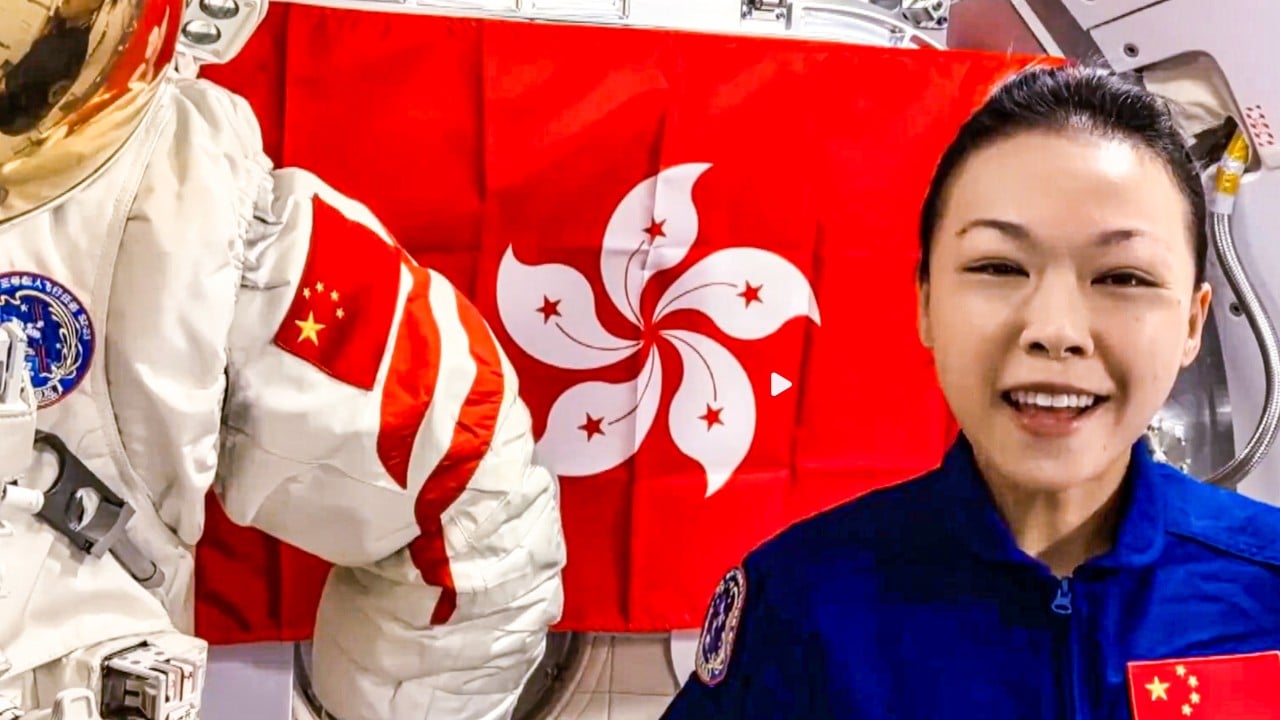
Consider what happens next: a face appears on the projector screen, floating. Literally floating. A strand of dark hair drifts lazily across a crewmember's forehead, defying gravity in slow motion.
This is not a television broadcast recorded weeks ago in a sanitized studio in Houston or Baikonur. This is happening right now. The light hitting the children's retinas traveled to an orbiting outpost and bounced back down through the ionosphere in less than a second.
When a nation or a city sends its first representative into the star-strewn dark, something fundamental shifts in the local psyche. It is easy to view space exploration as an expensive abstraction—a Cold War relic fought with rockets and spreadsheets. We read the dry bulletins about orbital mechanics and payload capacities, and our eyes glaze over.
Numbers are cold. Distance is an insult.
When you hear a local accent speaking from a tin can falling around the Earth, the abstract becomes flesh.
(Note: The historical milestone referenced here is Hong Kong’s first astronaut participating in a live, interactive space lecture for local students on a Wednesday, bridging the gap between orbital science and foundational classroom curiosity.)
I remember staring at grainy satellite photographs as a child, wondering what the curve of the horizon actually felt like. Books lied. They told you the world was round, but the floorboards under your sneakers felt stubbornly flat.
You cannot argue with a floating pen.
During the live downlink, the astronaut—selected from the elite ranks of China’s space program—demonstrates the bizarre physics of microgravity. Water does not pour; it gathers into quivering, translucent spheres that cling to a fingertip like liquid glass. A heavy metal ball bearing does not drop with a thud; it orbits a floating plastic toy in slow, hypnotic loops.
A twelve-year-old girl in the front row raises her hand. She has memorized formulas for terminal velocity, but today she asks something entirely different.
"What does the city look like when you pass over at night?"
The screen pauses. The astronaut smiles—a genuine, lopsided grin of someone remembering home from the edge of the abyss.
"At night," the voice says softly, "Hong Kong looks like a handful of spilled diamonds dropped onto black velvet. You can see the harbor carved out by the lights. For a moment, you can see the whole world at once, and it feels very, very small."
Silence blankets the classroom. Even the boy who was tapping his pencil stops.
In that single answer, the vastness of the cosmos shrinks. Space is no longer an empty wasteland belonging only to superpowers and science fiction writers. It belongs, briefly, to the girl in the front row whose fingers are stained with blue ink.
We live in an era obsessed with division. We draw lines on maps, build walls in legislatures, and argue fiercely over who owns a patch of dirt down here in the mud.
Orbit doesn't care about borders.
From the vantage point of the Tiangong space station, Hong Kong is not a political talking point. It is a cluster of photons blinking against the dark side of a blue marble. The atmospheric haze swallows the boundaries effortlessly.
This is the hidden gift of these orbital lectures. They smuggle philosophy into a science lesson. They teach children that perspective is a muscle, and it only grows when you stretch it past the things you can touch.
When the live feed finally stutters and cuts out—swallowed by the curvature of the Earth as the station dips out of signal range—the screen goes black.
The room stays quiet for a long, heavy beat.
Then, the bell rings. The spell breaks. The damp wool smell returns, and the hum of the city outside surges back through the glass.
The children pack their bags, chatter erupts, and someone drops a metal ruler on the linoleum with a sharp clatter. Gravity has returned, stubborn and absolute.
But nobody looks at the ceiling the same way again. Somewhere up there, moving faster than a speeding bullet, a window is still open.