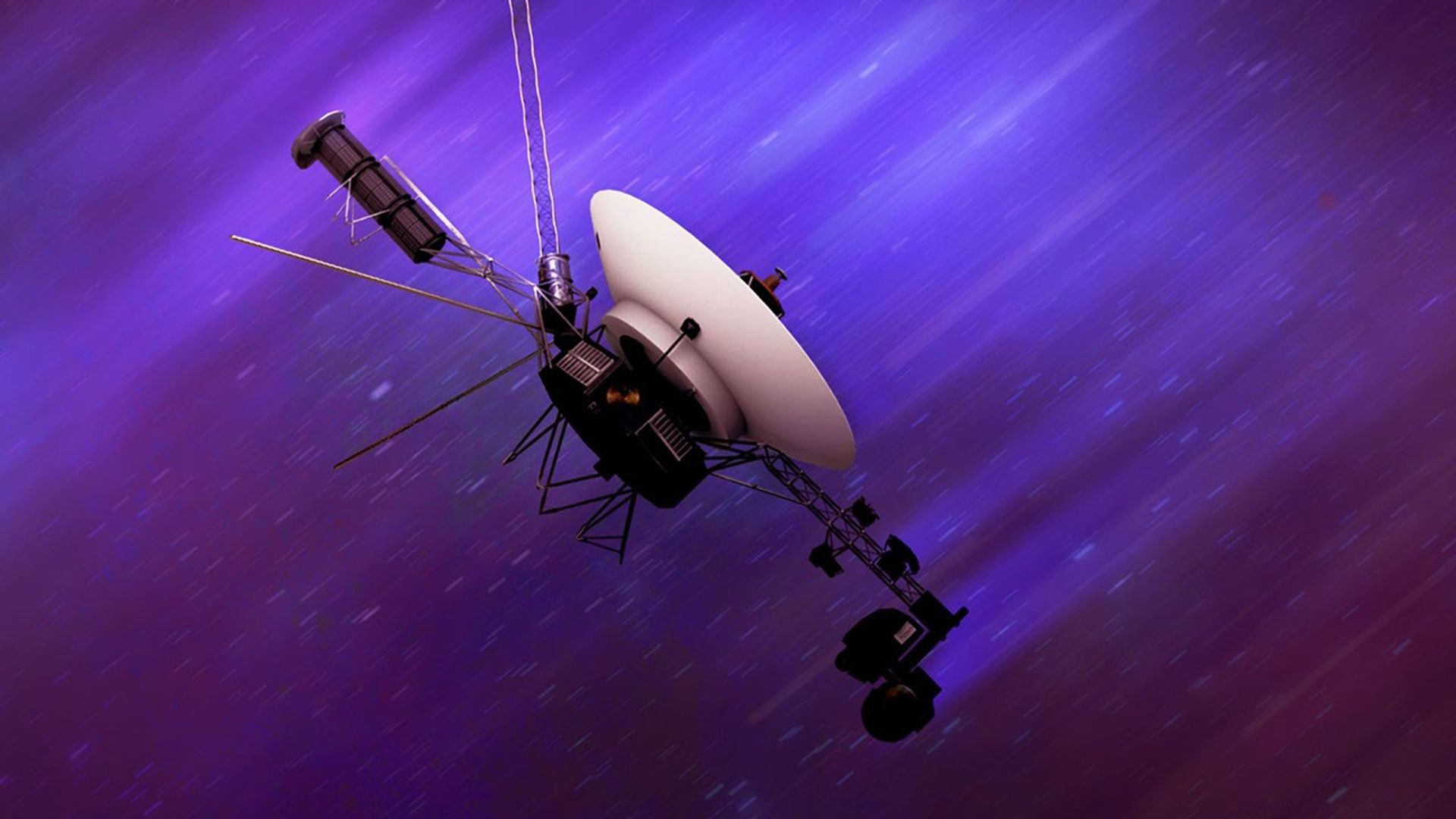
Reaching a distance of one light-day from Earth—roughly 25.9 billion kilometers (16.1 billion miles)—marks a fundamental phase shift in human engineering. After 49 years of continuous flight since its September 1977 launch, Voyager 1 now operates across a communications barrier where a single command-and-response cycle requires 48 hours of round-trip light time (RTLT). At this threshold, real-time spacecraft management ceases to exist. Ground controllers at NASA's Jet Propulsion Laboratory (JPL) no longer pilot a vehicle; they execute asynchronous state-machine interventions across a decaying hardware platform operating in the interstellar medium.
The Kinematics of the One Light-Day Threshold
The speed of light in a vacuum ($c \approx 299,792,458$ meters per second) is an immutable physical constant. Over 86,400 seconds—one standard Earth solar day—an electromagnetic signal travels exactly $2.5902 \times 10^{10}$ kilometers. Converting this metric into astronomical units (AU), where $1\text{ AU} \approx 149,597,870.7$ kilometers, places the threshold at approximately 173.14 AU.
Voyager 1 achieved this velocity profile not through continuous propulsion, but through orbital mechanics—specifically, gravity-assist maneuvers at Jupiter (1979) and Saturn (1980). By stealing a fraction of orbital angular momentum from both gas giants, the spacecraft reached a hyperbolic excess velocity ($v_{\infty}$) of roughly 17 kilometers per second relative to the Sun. Because solar gravity weakens according to the inverse-square law ($F = G \frac{Mm}{r^2}$), Voyager 1 is still decelerating slightly, asymptotically approaching its terminal interstellar velocity of approximately 16.9 kilometers per second (3.57 AU per year).
This trajectory yields a linear expansion of the communications bottleneck:
- Launch to Jupiter (1977–1979): RTLT remained under 90 minutes, permitting tactical trajectory adjustments within a single shift.
- Heliopause Crossing (2012 at ~121 AU): RTLT reached approximately 33.5 hours, forcing multi-day diagnostic loops.
- The One Light-Day Milestone (November 2026 at ~173.14 AU): RTLT hits exactly 48.0 hours, establishing a two-day minimum latency floor for every telemetry verification, fault recovery, and instrument command.
The Asynchronous Command and Control Architecture
Managing a spacecraft across a 48-hour communications gap invalidates standard aerospace telemetry protocols. When an anomaly occurs aboard Voyager 1, the fault happens 24 hours before Deep Space Network (DSN) antennas on Earth detect the carrier signal drop or bit-error spike. By the time engineers diagnose the root cause, formulate a mitigation sequence, validate it on ground testbeds, and radiate the uplink, the spacecraft has operated in an altered state for well over two full days.
The Three-Phase Fault Recovery Loop
To prevent catastrophic loss of mission during multi-day blind windows, JPL flight teams rely on deterministic onboard fault-protection routines paired with rigid ground verification protocols.
- Autonomous Hardware Safing: Voyager 1 utilizes three dual-redundant computer subsystems: the Computer Command Subsystem (CCS), the Flight Data Subsystem (FDS), and the Attitude and Articulation Control Subsystem (AACS). If voltage sags, temperatures drop below threshold, or gyroscopic drift exceeds tolerances, onboard firmware automatically switches to backup hardware strings without waiting for Earth intervention.
- State Reconstruction via Bit-Level Forensics: Because downlink bandwidth is severely constrained—typically 160 bits per second (bps) for engineering and science telemetry—ground teams cannot request full memory dumps casually. Engineers reconstruct the spacecraft's internal state by analyzing sparse status flags and comparing memory register readouts against historical baselines.
- Blind Uplink Validation: Commands are transmitted at S-band (2.1 GHz) using high-power 20-kilowatt to 100-kilowatt transmitters at DSN complexes in Goldstone, Madrid, and Canberra. Because no handshake confirmation is possible during transmission, commands must be mathematically verified on the ground to ensure they will not trigger unintended state transitions upon arrival 24 hours later.
The fragility of this loop was demonstrated during the November 2023 FDS memory corruption event, when a single degraded memory chip rendered telemetry unreadable. Resolving that fault required months of incremental code relocation across remaining functional memory banks—an exercise executed entirely via multi-day round-trip signals.
The Link Budget and Signal Attenuation Physics
Communicating across 25.9 billion kilometers obeys the inverse-square law of electromagnetic radiation. As Voyager 1's 3.7-meter parabolic High-Gain Antenna (HGA) transmits at X-band (8.4 GHz), the radio beam spreads over an immense spherical surface area ($A = 4\pi r^2$).
Voyager 1's traveling-wave tube amplifier (TWTA) outputs roughly 20 watts of radio-frequency power—less than a standard refrigerator light bulb. By the time that wavefront reaches Earth, the received power density at a 70-meter DSN dish is approximately $10^{-22}$ watts (a tenth of an attowatt).
Capturing this signal requires extreme signal-to-noise ratio (SNR) engineering:
- Cryogenic Receiver Amplification: DSN dishes utilize maser and high-electron-mobility transistor (HEMT) amplifiers cooled to roughly 4 Kelvin using liquid helium to suppress internal thermal noise.
- Arraying Multiple Antennas: To compensate for diminishing signal strength as distance increases, NASA frequently arrays multiple 34-meter Beam Waveguide antennas alongside a 70-meter dish, combining their phases electronically to boost effective aperture area.
- Pointing Precision: The HGA beamwidth at X-band is roughly 0.5 degrees. If the AACS fails to keep the dish locked onto Earth's position within a fraction of a degree, the downlink drops below the DSN noise floor instantly, severing contact permanently.
Thermodynamic Decay and Power Rationing
Voyager 1's operational lifespan is governed not by fuel reserves, but by nuclear decay. The spacecraft is powered by three MHW-RTG (Multi-Hundred-Watt Radioisotope Thermoelectric Generators) fueled by Plutonium-238.
Pu-238 has a radioactive half-life of 87.7 years. At launch in 1977, the three RTGs generated approximately 470 watts of electrical power. After 49 years, radioactive decay has reduced the thermal output by roughly 32 percent. Combined with the gradual degradation of the silicon-germanium thermocouples that convert heat into electricity, total available electrical power has fallen below 225 watts—a loss of roughly 4 watts per year.
The Power-Thermal Tradeoff Matrix
Every watt shut off to preserve bus voltage creates a secondary thermodynamic risk. Waste heat from active instruments and electronics keeps the spacecraft's propellant lines above the freezing point of hydrazine ($2^\circ\text{C}$ / $35.6^\circ\text{F}$).
- Instrument Shedding: Engineers have systematically deactivated non-essential subsystems, including the Imaging Science Subsystem (cameras), Ultraviolet Spectrometer, and heaters for the remaining fields-and-particles instruments.
- Propellant Line Freezing: Without active heaters, the hydrazine lines feeding the attitude-control thrusters rely entirely on conductive heat from the remaining core electronics. If the lines freeze, the spacecraft loses roll, pitch, and yaw stabilization, causing the HGA to drift off-Earth.
- Thruster Clogging: In 2017 and again in 2024, engineers had to switch between primary and backup thruster sets—and even revive dormant trajectory-correction thrusters—because silicon dioxide residue from propellant tank bladders had accumulated inside the narrow capillary tubes, reducing thrust efficiency.
Scientific Yield in the Interstellar Medium
Despite running on fewer than half its original instruments, Voyager 1 remains the sole operational in-situ sensor platform sampling the local interstellar medium (LISM) beyond the heliopause. Its surviving suite—the Cosmic Ray Subsystem (CRS), Low-Energy Charged Particles (LECP), Magnetometer (MAG), and Plasma Wave Subsystem (PWS)—provides empirical measurements that remote telescopes cannot replicate.
Data transmitted across the one light-day threshold has overturned several baseline astrophysical models:
- Magnetic Field Alignment: Models predicted that the interstellar magnetic field outside the heliopause would differ sharply in direction from the solar magnetic field inside the heliosheath. MAG measurements revealed that the interstellar field aligns closely with the solar field, indicating complex magnetic draping along the heliopause boundary.
- Plasma Density Gradients: PWS detections of electron plasma oscillations confirmed that the interstellar medium just beyond the heliopause is significantly denser than predicted—roughly 0.04 to 0.12 electrons per cubic centimeter—and exhibits persistent pressure waves generated by solar coronal mass ejections propagating outward into interstellar space.
- Galactic Cosmic Ray Filtering: CRS and LECP data demonstrated that the heliosphere acts as a massive magnetic shield, deflecting roughly 70 percent of low-energy galactic cosmic rays before they ever reach the inner solar system.
Strategic Limits and Terminal Trajectory
No engineering intervention can alter the thermodynamic trajectory of Voyager 1. By the early 2030s, available RTG power will drop below the minimum threshold required to sustain the X-band transmitter and the central computers simultaneously. Ground controllers will face a binary choice: shed the final scientific instruments to extend engineering telemetry by a few months, or allow the main bus voltage to collapse under full load.
Once the transmitter falls silent, Voyager 1 will transition from an active observatory into an inert ballistic artifact. Driven by momentum alone, it will pass within 1.6 light-years of the star Gliese 445 in roughly 40,000 years, continuing its orbit around the center of the Milky Way indefinitely. For current deep-space mission architects, the operational lesson of the one light-day milestone is absolute: beyond 150 AU, ground-in-the-loop control is obsolete. Future interstellar precursor missions must abandon command-driven architectures in favor of fully autonomous, self-healing onboard artificial intelligence capable of diagnosing hardware degradation, rerouting power buses, and repointing high-gain optics without waiting two days for instructions from Earth.