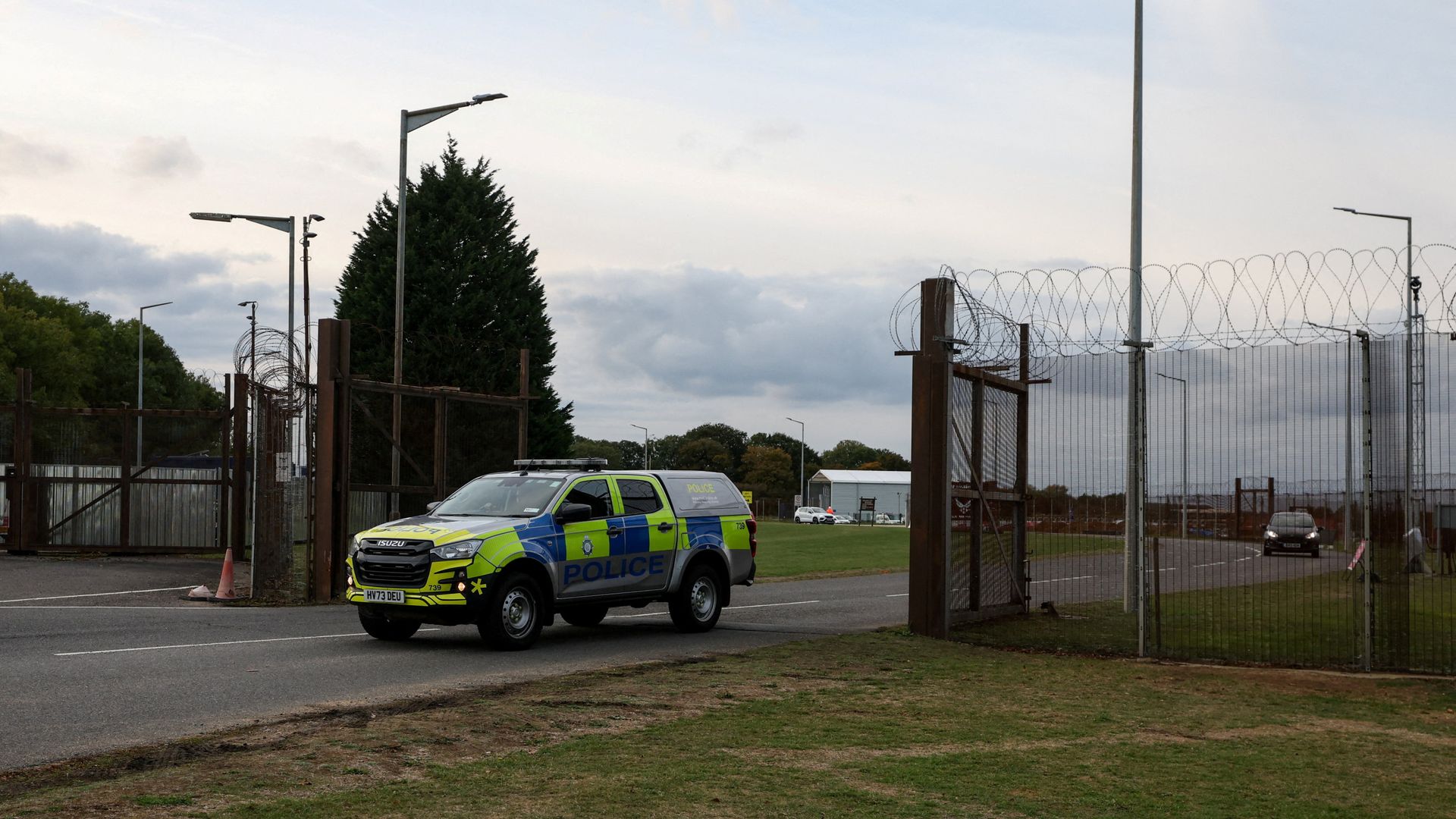
The arrest of two individuals within the secure perimeter of RAF Molesworth highlights structural vulnerabilities in military installations housing allied intelligence operations. Operating under the jurisdiction of United Kingdom counter-terrorism policing, the incident involving two UK-resident Latvian nationals underscores a persistent challenge in national security infrastructure: the friction between physical perimeter integrity and active threat detection.
RAF Molesworth, located in Cambridgeshire, functions as a critical node for North Atlantic Treaty Organization (NATO) intelligence architecture, hosting the Intelligence Fusion Centre and the United States Joint Intelligence Operations Center, Europe. Because the facility houses high-value intelligence assets, any unauthorized physical penetration exposes operational risks that extend far beyond standard civil trespassing infractions.
The Mechanics of Perimeter Breach
Physical security architecture relies on a defense-in-depth model, typically segmented into distinct layers:
- Outer Boundary: Passive deterrence measures, including fencing, signage, and natural or cleared buffer zones.
- Detection Systems: Closed-circuit television (CCTV) arrays, ground-penetrating radar, infrared motion sensors, and acoustic or seismic tripwires.
- Response Force: Mobile patrols and quick-reaction security elements capable of intercepting intruders before critical assets are compromised.
In the Molesworth incident, reports indicate that a small hole cut into the perimeter fence served as the primary vector of entry. The subsequent discovery of an abandoned vehicle near the site suggests a tactical footprint involving vehicular transit followed by manual infiltration.
When a physical barrier experiences a localized failure, the security system's efficacy depends entirely on the latency of its detection and response loops. An intruder who breaches the fence during early morning hours exploits reduced visibility and human response times. If the automated detection layer fails to cue the response force instantaneously, an actionable window opens for unauthorized reconnaissance or sabotage.
Investigatory Protocols and Attribution Challenges
Counter-terrorism investigators face a complex diagnostic challenge when evaluating unauthorized entries into sensitive defense sites. The primary analytical objective is determining intent, which typically bifurcates into three primary hypotheses:
- Hostile State Reconnaissance: Probing actions executed by actors linked to foreign intelligence services to map security response times, blind spots, electronic signatures, and access routes for future operations.
- Opportunistic Criminal Activity: Non-political transgressions, such as theft of valuable copper, scrap, or military-grade surplus, driven by economic motives rather than geopolitical objectives.
- Inadvertent Intrusion: Accidental breach resulting from disorientation, intoxication, or sheer negligence without malicious intent.
Distinguishing among these vectors requires forensic exploitation of recovered artifacts, including electronic devices, vehicle telemetry, digital footprints, and communication metadata. The decision by authorities to release the suspects on bail while maintaining strict investigative conditions reflects the methodical nature of gathering digital and physical evidence to substantiate or refute potential state-sponsored motives.
Systemic Implications for Allied Defense Sites
The incident at Molesworth follows a pattern of heightened security alerts across European and British military installations. These events force a reassessment of resource allocation within base defense frameworks. Fixed installations cannot rely solely on passive physical barriers like chain-link fencing.
To mitigate perimeter vulnerabilities, facility operators must transition toward predictive and adaptive security models:
- Smart Perimeter Integration: Upgrading static fences with fiber-optic strain sensors that instantly locate and classify physical impacts or cutting attempts.
- Automated Aerial Surveillance: Integrating tethered or automated drone patrols programmed to investigate anomalous sensor alerts before human patrols deploy.
- Redundant Access Control: Implementing inner-zone compartmentalization so that a breach of the outer fence does not grant unhindered access to sensitive operational buildings.
The legal and operational fallout from the Molesworth breach will ultimately depend on the digital evidence recovered from the suspects and their abandoned transport. Regardless of the final investigative findings, the event serves as an empirical stress test for the physical resilience of allied intelligence hubs.