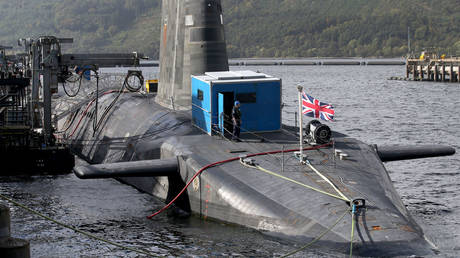
Modern naval warfare has a dirty secret. While defense budgets pour billions into hypersonic interceptors and stealth surface combatants, the silent service operating beneath the waves faces a stark operational vulnerability. Royal Navy attack submarines, engineered to hunt hostile vessels and gather intelligence in contested waters, currently rely on makeshift tactical adaptations when confronting aerial surveillance and modern drones. Recent reporting highlighted a striking reality regarding these multi-billion-dollar vessels relying on low-tech measures like fire hoses for local defense against persistent small drones.
This mismatch between exorbitant capital investment and tactical reality reveals deeper fractures in modern defense procurement. When an astute-class submarine surfaces or operates at periscope depth, it enters a domain dominated by cheap, off-the-shelf commercial technology that outpaces traditional military timelines. Understanding how Britain arrived at this junction requires examining the intersection of asymmetric threats, legacy platform design, and the slow grind of defense acquisition.
The Evolution of Submarine Vulnerability
Submarines were never designed to fight the sky. For over a century, the core doctrine governing undersea warfare relied on a simple premise: remaining hidden was the ultimate defense. By diving deep and minimizing acoustic signatures, a submarine effectively vanished from the tactical picture. Surface threats mattered only insofar as they could drop depth charges or ping active sonar from afar.
Today, that paradigm has shifted fundamentally. Ubiquitous aerial surveillance has transformed the littoral environment. Cheap commercial quadcopters equipped with high-resolution optical and thermal sensors can loiter above periscope depth, tracking surface wakes or mast signatures with ease. Even more concerning is the proliferation of loitering munitions and small kamikaze drones capable of targeting exposed optical masts, communication arrays, and periscopes.
When a submarine needs to ventilate its diesel engines or transmit large packets of data via satellite links, it must raise masts above the water. In narrow choke points like the GIUK gap or the shallow waters of the Baltic and North Seas, these transmission windows expose the vessel to persistent observation. If an adversary spots the telltale wake or mast, closing the distance with a drone swarm becomes trivial.
The Royal Navy finds itself adapting improvised methods because naval architecture moves at glacial speeds compared to consumer electronics. Designing, testing, and fielding a dedicated, integrated counter-drone defense system for a nuclear submarine takes years of trials, bureaucratic sign-offs, and budgetary allocations. Meanwhile, commercial drone capabilities double every eighteen months. Crews operating in the field cannot wait for a decade-long procurement cycle to address an immediate tactical hazard.
The Constraints of Nuclear Engineering
Fixing this problem is not as simple as welding a heavy weapon system to the deck of a submarine. Nuclear-powered attack submarines are marvels of tight spatial engineering and hydrodynamic optimization. Every square inch of the outer hull and sail is accounted for to minimize drag, reduce acoustic noise, and withstand extreme pressures during deep dives.
Adding external hardware introduces massive engineering challenges. A dedicated anti-air missile launcher or heavy automated cannon requires hull penetrations, structural reinforcement, and sophisticated power management systems. More importantly, any structure mounted on the exterior alters the acoustic profile of the vessel. In submarine warfare, noise is a death sentence. A poorly designed sensor housing or weapon mount can create flow turbulence, generating a distinct acoustic signature that enemy passive sonar arrays can pick up from tens of miles away.
Furthermore, submarines operate with lean crews where every sailor has a specialized, critical station. Manning a dedicated anti-drone watch station on the bridge during periscope depth operations pulls personnel away from navigation, sonar monitoring, or weapons control. When a vessel must defend itself while vulnerable at the surface, the response must rely on existing systems and available crew members.
This brings the operational reality back to improvisation. Using high-pressure water streams from deck-mounted fire hoses to destabilize or swamp approaching low-altitude drones is a crude solution, but it requires no hull modifications, introduces zero acoustic signature once stowed, and utilizes existing shipboard infrastructure. It represents the ultimate expression of tactical pragmatism in the face of an evolving threat matrix.
The Procurement Paradox
The reliance on makeshift defense measures exposes systemic flaws in how modern defense ministries approach rapid technological adaptation. Traditional defense primes excel at building massive platforms like aircraft carriers, destroyers, and nuclear submarines over decades. However, they struggle immensely with the iterative, rapid-cycle development required to counter commercial drone technology.
When a commercial drone can be modified in a garage to drop a shaped charge or transmit encrypted video feeds, fighting it with a multi-year acquisition program is a losing battle. The military needs agile procurement pathways that can source commercial off-the-shelf counter-measures, radio-frequency jammers, and directed-energy prototypes and place them into the hands of sailors within months rather than decades.
Without these structural reforms, elite crews on world-class platforms will continue bridging critical capability gaps with whatever tools are close to hand. The ingenuity of sailors should be commended, but it should never serve as a substitute for proper institutional preparation.
Navigating the Future Undersea
The challenges facing British subsurface forces are not isolated. Navies globally are grappling with the democratization of aerial reconnaissance and precision strike capabilities. As autonomous underwater and aerial systems proliferate, the traditional sanctuary of the deep ocean is shrinking.
Addressing this vulnerability requires a fundamental shift in how the defense establishment views littoral operations. It demands investment in non-kinetic disruption technologies, such as directional electronic warfare suites that can blind or sever control links of approaching drones without requiring crew members to expose themselves on the outer deck with a fire hose.
Until those systems become standard equipment across the fleet, the silent service will continue to rely on discipline, situational awareness, and a heavy dose of maritime pragmatism to navigate an increasingly crowded and hostile sky.