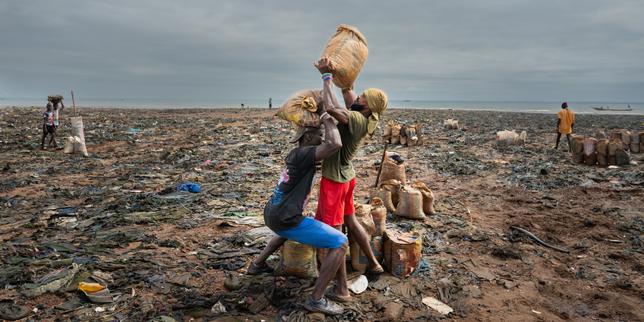
The floor remembers.
Long after the clouds have burned away and the slate-grey sky of Freetown remembers its blue, the concrete inside Aminata’s kitchen stays damp. It is a slick, stubborn film that smells of old engine oil, rotting vegetation, and the quiet decay of things that have been underwater too many times to count.
She doesn't mop it anymore. There is no point. Within an hour, the dampness bleeds back through the pores of the foundation, rising like a cold sweat from the earth below.
To understand what is happening on the coast of Sierra Leone, you have to stop looking at weather reports as distant arithmetic. You have to look at a kitchen floor. You have to watch how water behaves when it is cornered.
For years, the maps have told a tidy lie. They draw a clean blue line for the Atlantic Ocean and a solid brown line for the shore, as if the two things agreed on a border. But borders are human inventions. Water respects only gravity, and gravity is currently pointing straight at the fragile, densely packed informal settlements spilling down the hillsides of West Africa's capital toward the sea.
Here, in the sprawling slums that fringe the peninsula, the ocean is not a view. It is an occupant.
Every rainy season arrives with more teeth than the last. The storms do not simply fall; they hammer. They tear down the red clay of the deforested hills, turning footpaths into churning brown rivers of mud and human waste. This is the first vice. The mountain dumps its water downward, roaring through narrow alleys with enough force to flip cars and swallow children.
Then, meeting it halfway, comes the second vice. The Atlantic rises.
Driven by thermal expansion and melting ice thousands of miles away, the ocean pushes inland, refusing to recede at low tide the way it used to when Aminata was a girl. The drainage canals, choked with plastic bottles and discarded packaging, choke entirely. The runoff from the hills has nowhere to go. The sea has nowhere to go.
And so they meet in the middle. Inside living rooms. Inside bedrooms. Inside the narrow spaces where families sleep shoulder-to-shoulder under corrugated iron roofs that drum like machine guns when the squalls hit.
Consider what happens to a community when its own footprint becomes a trap.
In public policy circles, experts call this coastal vulnerability combined with rapid urbanization. They speak in percentages of sea-level rise, millimeter increments of annual change, and storm surge modeling. They talk about the loss of mangrove ecosystems—nature's original shock absorbers—which have been cleared away to make room for more shacks, more docks, more desperation.
(Note: While I use Aminata as a composite character to anchor this reality, her daily calculations mirror the verified testimonies documented by field researchers and humanitarian agencies monitoring Freetown’s informal coastal zones.)
The statistics are staggering, yet they float above the ground like smoke. What the numbers miss is the texture of the threat. They miss the sound of water rising three centimeters an hour while you are trying to sleep. They miss the frantic calculation every mother makes at midnight: Do I wake the children now, or wait until the mattress starts to float?
Waterborne disease is the quiet executioner that follows the flood. Cholera and typhoid do not arrive with the dramatic crash of a wave; they seep into the shallow wells. They cling to the pots and pans washed in murky backwater. They turn a natural disaster into a slow-motion public health crisis that lingers long after the sun comes back out.
People are resourceful. That is the great, tragic irony of the slums.
Build a makeshift seawall out of discarded tires and sandbags, and the water finds a new seam. Dig a deeper trench, and the high tide backs up through the latrines. Every defense mechanism is temporary, outpaced by an ocean that is rewriting the geography of the coastline in real time.
You cannot negotiate with a rising baseline.
Governments draft relocation plans, speaking of resilient infrastructure and climate adaptation funds. Yet, the economic gravity of the city pulls people back to the water's edge. This is where the jobs are. This is where the fish are landed, where the markets hum, where survival is stitched into the daily hustle. Moving inland means abandoning the fragile economic ecosystem that keeps a family fed today, trading a visible risk today for invisible starvation tomorrow.
The trap snaps shut between immediate hunger and eventual drowning.
Outside, the tide is turning again. The grey expanse of the Atlantic glitters innocently under the late afternoon sun, looking wide and calm and indifferent. But down in the alleys, the puddles do not dry. They wait.
Aminata steps outside her door, careful to avoid the slickest patch of mud, and looks out toward the horizon where the water meets the sky in a seamless, heavy blur. She adjusts her shawl against the damp breeze, turns back toward her kitchen, and waits for the next rain.