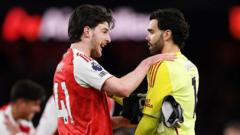
The rain in north London doesn't just fall; it slickens the concrete of Hornsey Road, turning the pre-game march into a silent, hooded pilgrimage. If you stand outside the Armoury megastore three hours before kickoff, you can smell it: fried onions, stale beer, wet wool, and the heavy, invisible vapor of expectation. It is a weight that has crushed finer talents than the ones currently pulling on the red and white shirt. For nearly two decades, this patch of London lived on memories of the Invincibles, a beautiful, haunting curse that whispered that greatness was something that belonged to the past.
Then came Martin Ødegaard.
To understand the Professional Footballers' Association Men’s Player of the Year shortlist, you have to look past the sterile statistics printed on the back of matchday programs. You have to ignore the clinical press releases detailing the presence of three Arsenal players alongside Manchester United's talismanic midfielder, Bruno Fernandes. The cold ink of a shortlist tells you who had a good season. It tells you nothing about the sleepless nights, the scars of near-misses, or the terrifying reality of carrying a global institution on your twenty-something shoulders.
Football is a cruel theater. We demand that these men be machines, yet we judge them entirely on their humanity—their nerve, their desperation, their ability to look into the abyss of a collapsing title race and refuse to blink.
The Boy Prodigy Who Refused to Die
Consider the trajectory of Arsenal’s captain. A decade ago, Martin Ødegaard was a circus act. He was the sixteen-year-old Norwegian boy wonder paraded around Europe’s elite clubs like a prized thoroughbred, ultimately swallowed whole by the glitz and politics of Real Madrid. He was supposed to be another cautionary tale. A career spent on loan at Heerenveen and Vitesse is usually where wunderkind dreams go to get buried.
But there is a quiet fury in Ødegaard. Watch him closely when the ball is on the opposite side of the pitch. He does not rest. He triggers the press with the frantic energy of a man trying to stop a robbery. His inclusion on the PFA shortlist is not merely a recognition of his assists or his elegant, dropped-shoulder passes that cut through low blocks like a scalpel. It is an acknowledgment of survival.
When Arsenal collapsed in the final stretch of the previous campaign, the post-mortem was brutal. They called the team soft. They said the young squad lacked the cynical edge required to dethrone the Manchester City machine. Ødegaard bore that criticism like a physical bruise. This season, his game shifted. The elegance remained, but it was underpinned by a feral urgency. He dragged his team through winter fixtures that would have seen previous Arsenal iterations capitulate.
He became the emotional thermometer of the Emirates Stadium. When he raises his arms to whip up the North Bank, it isn't an empty theatrical gesture. It is a demand for belief from a fan base that has been conditioned to expect disaster.
The Steel Beneath the Samba
If Ødegaard is the conductor, Gabriel Magalhães is the iron fortress that allows the music to play. It is rare for central defenders to capture the imagination of PFA voters. The award leans toward the creators, the goalscorers, the artists who provide the highlights for social media packages. To see Gabriel's name on the ballot is a testament to a shift in how the game is viewed by the players themselves.
The PFA award is unique because it is voted for by peers. It is decided by the strikers who have spent ninety minutes being shoved, suffocated, and mentally broken by the Brazilian defender.
Gabriel's journey is defined by an elimination of error. Two seasons ago, he was a volatile asset—capable of dominance but prone to the kind of emotional rushes that lead to cheap red cards and panicked penalties. He played with his heart on his sleeve, but his brain sometimes trailed a second behind. The transformation this year was absolute. Alongside William Saliba, he formed a partnership that felt less like modern football and more like a throwback to the uncompromising backlines of George Graham.
There is a specific moment from the season that encapsulates his growth. An away fixture under the lights, clinging to a one-goal lead while facing an aerial bombardment. The old Gabriel would have chased the ball, flown into a reckless challenge, or screamed at the referee. The matured Gabriel simply existed in the right space, winning header after header, his face a mask of pure concentration. He has learned the art of defensive patience. He turned the penalty box into his personal territory, and the rest of the league took notice.
The Reluctant Superstar
Then there is Bukayo Saka.
It is easy to forget how young he is because he has been the savior of this club for what feels like an eternity. He carries himself with a humility that masks a devastating competitive streak. Saka does not use the flashy stepovers of traditional wingers; his brilliance lies in efficiency. A drop of the hip, a burst of acceleration on the inside channel, and a curled finish into the far corner. Everyone in the stadium knows exactly what he wants to do. Nobody can stop him from doing it.
The burden on Saka is different from that on Ødegaard or Gabriel. He is the academy boy. The one who carries the hopes of the local community. Every time he takes a corner in front of the away fans, he is subjected to a torrent of noise—some of it partisan, some of it far uglier, a remnant of the national scars from international tournaments past.
His place on this shortlist is a triumph of resilience over trauma. To see him consistently produce world-class output while being fouled with systematic regularity by opposing full-backs is a masterclass in psychological endurance. He does not complain. He gets up, brushes the grass off his knees, and demands the ball again.
The Lonely King of Old Trafford
To look across the shortlist away from north London is to encounter a completely different kind of human drama. Bruno Fernandes represents the antithesis of Arsenal's collective harmony. He is an island of elite productivity in a sea of chaotic dysfunction.
Manchester United's season has been analyzed to the point of exhaustion. It was a campaign defined by tactical identity crises, boardroom overhauls, and a revolving door of defensive injuries. Yet, amidst the ruins of Old Trafford's worst moments, Fernandes remained an inevitable, irritating force of nature.
To the neutral observer, Fernandes can be difficult to love. He gesticulates. He argues with officials. He looks perpetually aggrieved, as if the universe is committing a personal injustice against him with every misplaced pass from a teammate. But talk to the players who share a pitch with him. His inclusion on the PFA shortlist by his peers is an act of profound respect for a man who refuses to give up on a bad hand.
Fernandes played more minutes than almost any other elite creative player in Europe. He created chances at a rate that defied the sluggish, disjointed nature of the system around him. While others faded into the background during United's lowest ebbs, Fernandes demanded the ball. He took the risks. He missed the passes, yes, but he had the courage to try them again thirty seconds later while seventy thousand people groaned in unison.
His presence on the list is a reminder that leadership isn't always dignified. Sometimes it is ugly, loud, and desperate. Sometimes it looks like a man screaming into the wind because he refuses to let the standards around him drop to zero.
The Invisible Voting Booth
When the ballots are distributed in training grounds across the country, players do not look at spreadsheets. They don't pull up expected assists (xA) or defensive progression metrics on their phones. They remember the physical reality of the matches.
They remember the feeling of trying to track Ødegaard’s movement between the lines, where he disappears into your blind spot the moment you turn your head. They remember the bruising reality of a corner kick with Gabriel pinned against their ribs, making it impossible to jump. They remember the sheer exhaustion of doubling up on Saka, knowing that one lapse in concentration means he is gone. They remember Fernandes, still sprinting in the ninety-fourth minute of a game that was already lost, looking for a way to hurt you.
This shortlist is a map of the league's psychological landscape. It tells us what the players value when the cameras are off and the PR machines are silent. They value the men who do not hide.
The debate will rage over who deserves to lift the actual trophy. The pundits will argue about trophies won, goals scored, and the ultimate destination of the Premier League title. But that is to miss the point of what this specific recognition means. To be chosen by the people who do the same job as you—who know the exact cost of a mistake, who know how much your hamstrings burn in December, who know the terror of a dip in form—is the ultimate validation.
As the rain continues to slick the streets of London and Manchester, these four men represent something larger than their respective clubs. They are the ones who refused to let the modern football machine grind away their human edge. They took the pressure of millions, translated it into moments of grace and defiance, and earned the right to be called the best among their peers.


